Cancel

    Open app

    Search

    Peace River Bridge

    4.0 (1 review)
    Open Open 24 hours

    Peace River Bridge Photos

    Recommended Reviews - Peace River Bridge

    Your trust is our priority, so businesses can't pay to alter or remove their reviews. Learn more about reviews.
    Yelp app icon
    Browse more easily on the app
    Review Feed Illustration

    3 months ago

    Helpful 6
    Thanks 2
    Love this 3
    Oh no 0

    Verify this business for free

    Get access to customer & competitor insights.

    Verify this business

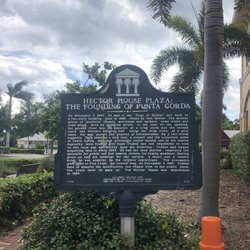
    Hector House Plaza: The Founding of Punta Gorda - Hector House Plaza: The Founding of Punta Gorda Historical Marker

    Hector House Plaza: The Founding of Punta Gorda

    4.0(2 reviews)
    2.5 mi

    There was not much going on this morning in the plaza. Sunday morning in early December and while…read morethere were a few holiday decorations up, there was no activity. There is a marker and it gives some great history. It has the same text on both sides. It reads, "On December 3, 1887, 34 men in the "Town of Trabue" met here in a two-story building, built in 1887, owned by Tom Hector. The diverse group of landlords, tenants, merchants and workers, some white and some black, were all qualified voters. At the time of the meeting, the ground floor was the location of a drug store and the second story was Hector's billiards hall. Above the drug store, at a pool table, the men passed the articles of incorporation by a two-thirds majority. They selected a city seal, a council and the corporate name of Punta Gorda. Although politically active locally and in his native Kentucky, town founder Col. Isaac Trabue had not registered to vote on this issue and was barred from the balloting. Trabue had begun acquiring land in early 1883. He had the land platted, reserving the shoreline for public use and naming streets for family members. Having given up half his holdings for rail service, a depot and a luxury hotel, he was angered by the settlers' ingratitude. The documents were filed at Pine Level, the county seat, on December 7, 1887. Trabue sued to dissolve the municipality and regain title to the public lands. Ten years later he gave up. The Hector House was demolished in 1988." There are some benches here to enjoy the Florida weather. There is street parking nearby. It is marker number F-639 and it was erected in 2008 by the City of Punta Gorda and the Florida Department of State. [Review 1584 of 2025 - 2165 in Florida - 25134 overall]

    Located across from the Old Charlotte County Courthouse, Hector House was where 34 voting citizens…read moreof Punta Gorda signed the charter incorporating it into a city on December 3, 1887. They selected a city seal, town council, and changed the name of the town from Trabeu to Punta Gorda which means fat point, as the town protrudes out where Charlotte Harbor and the Peace River meet. The decision to change the name of the town angered town founder Issac Trabeu. Trabeu had not registered to vote on the issue. He had acquired the land in 1883 and platted it, naming the streets for his family members. He gave up some of his land to the railway and to build a luxury hotel. He felt the town was very ungrateful for his sacrifices. He attempted to regain the title to the public lands for the next 1o years but he finally gave up and went back to his native Kentucky. Hector House was owned by Tom Hector and contained a drug store on the first floor and a billiards hall on the second floor. It was torn down in 1988 but there is a historical marker explaining the significance of the site. The city wanted to save the house but they didn't have anywhere to move it to. They have since created the Punta Gorda History Park to house their historic buildings. The plaza has been retained in remembrance of this important event in the towns history. The plaza has benches and landscaping. A solar canopy has also been added by FPL that generates clean energy as well as shade for anyone sitting under it. On Saturdays a farmers market is held in the plaza. It is nice place to relax in downtown Punta Gorda.

    Photos
    Hector House Plaza: The Founding of Punta Gorda - Hector House Plaza: The Founding of Punta Gorda Historical Marker

    Hector House Plaza: The Founding of Punta Gorda Historical Marker

    Hector House Plaza: The Founding of Punta Gorda - Solar canopy

    Solar canopy

    Hector House Plaza: The Founding of Punta Gorda

    See all

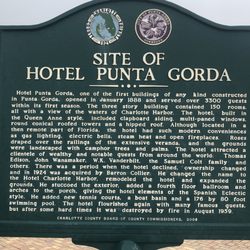
    Hotel Punta Gorda

    Hotel Punta Gorda

    5.0(1 review)
    2.5 mi

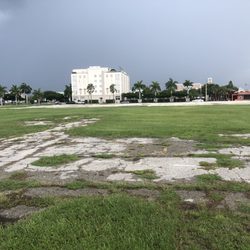
    Hotel Punta Gorda was one of the first buildings of any kind constructed in Punta Gorda. It was…read morelocated at the southern terminus of railroad service on Florida's west coast, which was provided by the Florida Southern Railway. The hotel was built by Henry Plant who was known for building grand hotels on Florida's east coast like the ones Henry Flagler was building on Floridas east coast. Hotel Punta Gorda was one of 20 grand hotels built in Florida in the 19th century when it opened in January 1888. During it's first season it served over 3,300 guests which was quite the feat considering the area was sparsely populated. The three story building contained 150 rooms all with a view of the waters of Charlotte Harbor. The Queen Anne style included clapboard siding, multi-paned windows, round conical roofed towers and a hipped roof. Not everyone was enamored with the beauty of the hotel. Reporter Mr. Peeples from the Punta Gorda Herald wrote in 1910: "The big unsightly building known as the Hotel Punta Gorda continues to be an eyesore and an incubus to the town and there seems no prospect that it will ever be anything else. ... The huge old hulk standing idle and ugly for nine years past is actually a curse to the community." Located in a remote area of Florida the hotel still had many modern conveniences like gas lighting, electric bells, steam heat and open fireplaces. The grounds were beautifully landscaped with camphor trees and palms. Visitors to the hotel included wealthy and notable snowbirds Thomas Edison, John Wanamaker, W. K. Vanderbilt, and the Samuel Colt family. The hotel declined through the years and closed in 1914. In 1924 Barron Collier purchased the hotel and changed it's name to the Hotel Charlotte Harbor. Over three years and $250,000 he remodeled the hotel and expanded the grounds. He stuccoed the exterior, added a fourth floor private apartments, a fifth floor glassed in ballroom, arches to the porch, a boat basin and a 176 x 80 foot swimming pool. In 1927 two clay tennis courts were put in for famous tennis player Big Bill Tilden who started his career in Punta Gorda and he won a tournament here in 1931. Reopened on January 2, 1927 the hotel flourished again with many famous guests until the Great Depression 5 years later. Upon Colliers death the hotel was sold to G. Floyd Alford in 1944 and he let Martin Fleischman take over the mortgage in 1956. Mr. Fleischman changed the name of the hotel to the Charlotte Harbor Spa and poured money into turning it into a health retreat but it never turned a profit. A fire on August 14, 1959 provided the death knell for the hotel. The fire could be seen or 25 miles and firefighters were called out from three counties. At one point the fire threatened to engulf the rest of the town. By the time the fire was put out there was only a blackened chimney and the twisted metal of the elevators left. The cause of the fire remains a mystery. A dedication ceremony was held on September 9, 2009, at West Marion Avenue for the historical marker. It was paid for by the Charlotte County Historical Center and the City of Punta Gorda. All that is left as a reminder of the hotel is this marker, a downtown mural, and the hotels fountain that sits in Punta Gordas History Park. The land the hotel sat on is currently for sale.

    Photos
    Hotel Punta Gorda - Mural of the hotel in the downtown when it was called the Hotel Charlotte Harbor.

    Mural of the hotel in the downtown when it was called the Hotel Charlotte Harbor.

    Hotel Punta Gorda
    Hotel Punta Gorda

    See all

    Military Heritage Museum

    Military Heritage Museum

    4.8(17 reviews)
    3.2 mi

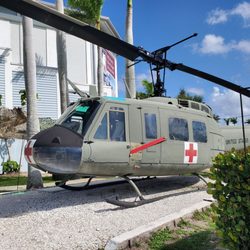
    I spent 2 1/2 hours with a Veteran guide, Jeff Sherwin, the Gallery Section Captain. Jeff had many…read moredetails, anecdotes and personal experiences to share, it made for a fascinating afternoon. There are many exhibits, well laid out, including artifacts, videos, newspaper clippings, interactive opportunities, and much, much more. It makes discovering facts about our American history a little less overwhelming. Many things I discovered I either never learned in high school or didn't remember. Everyone I encountered who works and volunteers here is friendly and welcoming, with a terrific sense of humor. So many stories, I could go back and spend another few hours and learn even more. I highly recommend a trip to this museum. If you are fortunate enough to have Jeff as your guide, you will learn the 3 things required for victory, common to every war (Hint: W.A.O.). Find out where Kleenex got its start before manufacturing hygiene products and why Lucky Strike changed is packaging from green to white. I am very proud to be an American. The history on display conveys where we came together, where we messed up, how we learned and how we continue to grow as a nation. I learned so much in a short period of time, mostly that history is important for each of us to understand our heritage. "Those who cannot remember the past are condemned to repeat it" --George Santayana. Thank you, Jeff, for your service and for spending your time with us.

    We visited often. The volunteer staff are knowledgeable and fun to chat with. School trips are a…read morepriority for these folks. Education is key to remember our history

    Photos
    Military Heritage Museum
    Military Heritage Museum
    Military Heritage Museum

    See all

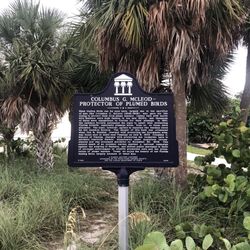
    Columbus G. Mcleod Protector of Plumed Birds - Columbus G. Mcleod Protector of Plumed Birds Historical Marker, Punta Gorda

    Columbus G. Mcleod Protector of Plumed Birds

    5.0(2 reviews)
    5.7 mi

    The Columbus G. McLeod marker sits near the edge of Ponce de Leon Park, and even with the sky…read moreflattened into a dull gray the place still has that easy Punta Gorda rhythm where people wander in from the parking lot, the shoreline drifts along quietly, and the marker becomes a small pause in the middle of it all. The beach view was not doing much on an overcast day, but the park itself carries enough charm to make the stop worthwhile, and the marker's simple presentation fits the setting without trying to compete with anything around it. What struck me most was how McLeod's fight to protect Florida's plumed birds echoes the spirit called out on the Paul Kroegel statue over in Sebastian, another reminder that conservation in this state was built by stubborn, principled individuals who refused to look away. Reading the marker brings that same sense of early guardianship, the kind of work that shaped the wildlife we take for granted today, and standing there in the soft light of an overcast morning, it felt like a quiet tribute to someone who understood the cost of doing the right thing even when the world wasn't paying attention. The marker reads, "Many wading birds can be seen here, largely due to the sacrifice of men like Columbus G. McLeod (1848-1908), who gave his life trying to protect them from plume hunters. Ladies' hats with exotic bird feathers were high fashion for the late 1800's, and thousands of birds were slaughtered in Florida for their plumage. In 1901 the Audubon Society persuaded the state to adopt laws protecting Florida wildlife, especially plumage birds. Even so, no funds were allocated. The state, however, agreed to deputize two wardens hired by the Audubon Society. The danger of this work was evidenced when Guy M. Bradley, charged with protecting the Everglades area, was found shot to death near Flamingo on July 8, 1905. Columbus G. McLeod of Placida, charged with protecting to rookeries here in northern Charlotte Harbor, disappeared under suspicious circumstances and was presumed murdered on November 30, 1908. This second death of an Audubon warden sparked a national campaign against the wearing of feathers, and shifted public sentiment in favor of stronger enforcement of wildlife protection laws and the prosecution of plume hunters. Today we enjoy the beauty of our Florida wading birds largely because of these men." It is marker number F-552 and it was erected in 2004 by The Peace River Audubon Society and the Florida Department of State. [Review 108 of 2026 - 2229 in Florida - 25298 overall]

    There is a historic marker in Ponce de Leon Park commemorating Columbus G. McLeod. At the turn of…read morethe century Florida's native bird population was being wiped out by plume hunters who were killing the birds for ladies hats. To help protect the birds that were on the verge of extinction, the National Audubon Society hired game wardens to patrol the rookeries and enforce state game laws. This job could be dangerous and Everglades Game Warden Guy M. Bradley was found murdered on July 8, 1905. Game Warden Columbus McLeod (1848-1908) was charged with protecting the breeding grounds of the birds of northern Charlotte Harbor. He is presumed to have been murdered during patrol in Lee County, Florida. It is believed that he was searching for egret hunters at Cayo Pelau Island when he disappeared. His boat was eventually located sunk with sand sacks tied to it and his hat was located nearby with two axe chips, blood, and hair on it but his body was never located. He was 63 at the time of his disappearance. Columbus G. McLeod Preserve in Ft. Myers was named in his honor. The death of the two game wardens shifted public opinion against wearing feathers and led to stronger wildlife protection laws. Thanks to the sacrifice of these two men along with countless others who patrolled and lobbied for laws to protect the birds we are still able to have native birds in the wild today. Although there is still not as many as were here in the late 1880's before hunting began, their number continues to grow every year.

    Photos
    Columbus G. Mcleod Protector of Plumed Birds - Columbus G. Mcleod Protector of Plumed Birds Historical Marker, Punta Gorda

    Columbus G. Mcleod Protector of Plumed Birds Historical Marker, Punta Gorda

    Columbus G. Mcleod Protector of Plumed Birds
    Columbus G. Mcleod Protector of Plumed Birds

    See all

    Punta Gorda History Park

    Punta Gorda History Park

    4.4(5 reviews)
    3.2 mi

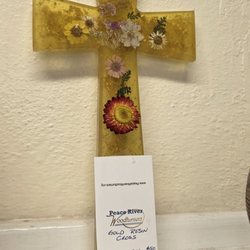
    We drove up to visit on a Sunday when the hosted the little farmers market. We were very surprised…read moreto see all the little buildings on the grounds that are host to different art guilds. The incredible art and craft work being be done there is truly amazing.

    This is a 9 acre history park in the center of Punta Gorda. I love the purpose of this park. It was…read moreformed to preserve the historic structures of the city. In 1988 the Hector House which is where the name of the town was changed from Trabeu to Punta Gorda was slated for demolition in 1998 and it was subsequently torn down. The city wanted to save the building but did not have a place to move it to so they created this park to display their buildings. The city moved the historic structures in danger of demolition to the park to protect them. The buildings are arranged around a small community garden meant to look like what you would have found here in 1890. Part of it contains a butterfly garden. The fountain in the center of the park was salvaged from the Hotel Punta Gorda when it was sold in 1925. This fountain and a downtown mural are the only reminders from the hotel built in 1897 as a stop on the Florida Southern Railroad. because the wooden hotel burned down in 1958. The park is maintained by the Punta Gorda Garden Club and the park is owned and operated by the Punta Gorda Historical Society. Right now there are are four structures in the park which include the Price House designed by architect Maxwell Price which now contains offices and restrooms, the Quednau-Hindman House which was a former mayors residence, the Cigar Cottage built to house workers of the El Palmetto Cigar Company factory, and the Trabue Land Management Office which also served as the post office.Three of the buildings are opened for tours from 10 to 2 daily and by appointment. Each of the buildings has a QR code in front of them so you can learn about them even if they are not open. The park also has a community produce garden tended by local families and it is the site of a weekly farmers market on Sundays. The gardens and Price House can be rented for private events. The park also serves as the trail head for Linear Park and the Shared Use path.

    Photos
    Punta Gorda History Park
    Punta Gorda History Park
    Punta Gorda History Park

    See all

    Peace River Bridge - landmarks - Updated May 2026

    Loading...
    Loading...
    Loading...