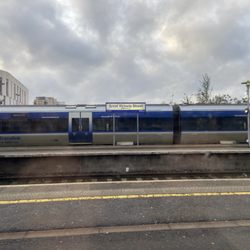
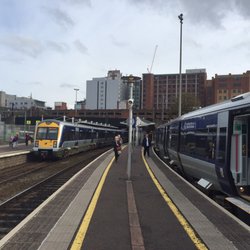
Another snapshot from a railway station. This time my home town is the muse…read more
OK, so I'm going to be biased in favour of my fabulous home town. It's my roots, deep roots, a town over 1,000 years old with the oldest hand excavated canal in the United Kingdom and the first post reformation Presbyterian church in Ireland.
Nine tenths of all who have lived are dead: we all walk on the bones of our ancestors.
I still smile when I quote the bitter couplet about my home town by Swift, the author of Gulliver's Travels, he was a harsh, Rhadamanthus like, judge of human nature:
High Church, low steeple,
Dirty streets and proud people.
And while he observed this over 300 years ago, his observations still remain mostly true - although in Gerard Loughran we have one of the best street cleaners in the country.
I remember when Newry railway station went right into and through the centre of our town - part of the site is where Translink now garage their bus fleet.
The steam trains also chugged their way through town to Warrenpoint and the sea. As a child I often played in the town centre railway station.
Often I was scooped up by the firemen from the station platform in Newry centre and placed into the smoky, noisy, hot heart of the action, as we hissed and clickety clacked through the country side to the sea with the wind offering some relief against intense heat and stinking sulphur of red hot burning coal.
The arms that scooped me up fed the insatiable beast with hunks of coal nearly as big as me. I was in awe of these gentle giants of sooty men who wore blue boiler suits, heavy linen shirts, with sleeves rolled up, steel toe-capped, thick laced, chunky, black leather boots and engineers caps.
All this childhood joy came to an end for me at the malicious hands of Dr Beeching.
He became a household name in the UK in the early 1960s for his report The Reshaping of British Railways, commonly referred to as "The Beeching Report", which led to far-reaching destructive changes in the railway network, popularly known as "the Beeching Axe".
This thug, who was made a Baron by the Tories (some things never change), ignored the dire social consequences of cutting 4,000 miles of railways. Decisions that still rankle in many communities today.
So this branch of Newry railway station opened in 1855 and it is now the town's main station located in the northwest of Newry on the main Dublin-Belfast line.
It's close to the beautiful and spectacular Craigmore Viaduct, an 18 arch stone and iron construction that sweeps across the valley of the Camlough River and carries the Belfast to Dublin railway line that also goes over the nearby Egyptian Arch - so named because of its resemblance to the nemes headdress worn by Ancient Egyptian pharaohs.
The bridge (and the arch) was designed by John Benjamin Macneill, an eminent Irish civil engineer, with construction beginning in 1849 and the viaduct formally opened in 1852, just before the industrial revolution began. Just 34 years earlier Dom Pérignon laid down the rules for champagne production and Just imagine it opened in the midst of the French Revolution, within 10 years Catherine the Great would rule Russia, inside 20 years Russians would be the first Europeans to colonise Alaska and within 24 years America would strike for independence.
The highest of the viaduct's arches is 126ft, making Craigmore the highest viaduct in Ireland; another Newry first. It is around a quarter of a mile long and is a prominent feature in the south Armagh landscape rainbow lit for Newry Pride every August and purple lit for the NHS.
The railway station is 166 years old now, outlasting Beeching who is only a sour footnote in history and my childhood; I do hope he's buried under a busy railway line.