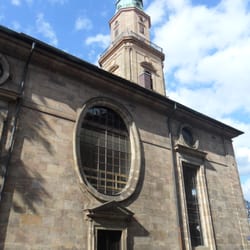
The Frauenkirche, Church of Our Lady, is a stunning Gothic church. However a brutal past lies…read moreburied beneath its foundation.
The Gothic church was built by Holy Roman Emperor Charles IV between 1352 to 1362. The church was constructed directly on the ruins of one of Nuremberg's main Jewish synagogues.
During the Black Death in 1349, a brutal pogrom was orchestrated to remove Nuremberg's medieval Jewish quarter. The local community wanted the prized area for a new marketplace. They petitioned and were granted legal immunity to demolish the Jewish ghetto and confiscate the space. Over 500 Jewish residents were massacred. Homes destroyed. The local Jewish synagogue torn down to rubble. A thriving Jewish neighborhood erased almost overnight. The Holy Roman Emperor then commanded that this church be constructed on the site. A reminder of Imperial and Christian dominance.
One of the most notable features of the church is the Männleinlaufen (little men's procession). This mechanical clock commemorates the Golden Bull of 1356. The clock mechanism is activated at midday, when a bell is rung to start the sequence and is followed by the trumpeters and drummer. Then a procession of the electors marches around the figure of the Holy Roman Emperor.
Although the church itself is stunning, the history is dark. It stands as a sober reminder of how medieval politics, plague scapegoating and the Holy Roman Emperor collided to change the course of history in Nuremberg. Hundreds of years later, Nuremberg again was the center of history again.