Cancel

    Open app

    Search

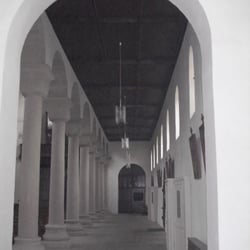
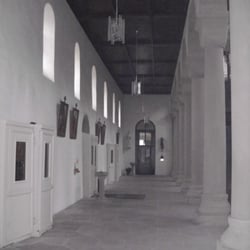
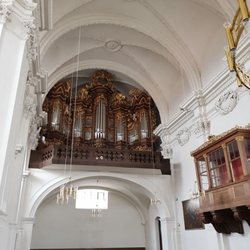
    Martinskirche

    4.5 (2 reviews)
    Closed Closed

    Martinskirche Photos

    Martinskirche Reviews in Other Languages

    Verify this business for free

    Get access to customer & competitor insights.

    Verify this business

    Bamberger Dom St. Peter und St. Georg

    Bamberger Dom St. Peter und St. Georg

    4.7(31 reviews)
    0.5 km

    With more than 1,000 years of history, this cathedral is simply magnificent. A "Castrum Babenberg"…read moreexisted on the Domberg (Cathedral Hill) and was mentioned in 902 for the first time. It was founded in 1002 by King (and later crowned as the Holy Roman Emperor by pope Benedict VIII in 1014) Heinrich (Henry) II and consecrated in 1012. Emperor Heinrich II died in 1024, and his wife empress Kunigunde in 1040. With the tomb of the couple, the cathedral contains the remains of the only imperial couple that was canonized. The second bishop Suidger of Bamberg was elected as Pope Clemens II. in 1046. His last resting place in the Bamberg Cathedral is the only preserved tomb of a pope in Germany and north of the Alps. After the first two cathedrals burned down in the 11th and 12th centuries, the current structure, a late Romanesque building with four large towers, was built in the 13th century. The cathedral is about 94 m long, 28 m broad, 26 m high, and the four towers are each about 81 m high. It contains many works of art, including the marble tomb of the Emperor Heinrich II and his wife, the Empress Kunigunde, considered a masterpiece of the sculptor Tilman Riemenschneider, and carved between 1499 and 1513. Another well-known treasure of the cathedral is an equestrian statue known as the Bamberg Horseman (German: Der Bamberger Reiter). This statue, possibly depicting the Hungarian king Stephen I, most likely dates to the period from 1225 to 1237.

    Dominating the hillside above the old town of Bamberg is its imposing late Romanesque Cathedral…read more The current building is the third to stand on the site, after the original (founded by Heinrich II and his wife Kunigunde in 1104), and its successor, both burned down. Erected in the 13th Century, the style is a mixture of late Romanesque (particularly the doorways and windows) and early Gothic, best seen in the arcades. The exterior is dominated by four spires and some impressive sculpture in the porches: the interior has some lovely treasures - particularly the late Gothic tomb of its founders, Heinrich and Kunigunde, and the unusual but impressive equestrian statue of the Bamberg horseman. Sadly, the decision to strip away the plaster and wall decoration in the 19th Century does detract from the atmosphere: the bare expanse of stone could do with some colourful banners (or restored plaster and fresco) to enliven it. The cathedral has two crypts, one of which, containing saintly relics, can be visited. The west choir was roped off in my visit but contains the only papal tomb North if the Alps (that if Clemens II).

    Photos
    Bamberger Dom St. Peter und St. Georg
    Bamberger Dom St. Peter und St. Georg
    Bamberger Dom St. Peter und St. Georg

    See all

    Karmeliterkloster - Nebenaltare

    Karmeliterkloster

    4.0(2 reviews)
    0.7 km

    The monastery of St. Mary and St. Theodore on Kaulberg was an abbey of Cistercian nuns to 1553;…read morefrom 1589 to 1802 it was and is again from 1902 the Carmelite monastery. According to tradition, Bamberg's first bishop Eberhard I is said to have founded a hospital for the sick and poor on the hill opposite the Bamberg Cathedral in 1030 and consecrated it to St. Theodore. In 1157, Bishop Eberhard II of Bamberg, with the help of Countess Palatine Gertrud, a sister of King Konrad III., to build the women's monastery of St. Maria and St. Theodor. When the monastery was founded, Bishop Eberhard II was primarily motivated by the intention that "our city, which is surrounded on all sides by bulwarks of canons and monks, also has consecrated virgins in its vicinity, the service of God in it and the caring for the poor and strangers leave nothing to be desired." The women's monastery was looted in the Peasants' War in 1525 and dissolved after the Second Margrave War in 1554. In 1589 the Carmelites, who had previously lived in the monastery in the Au, moved in. The convent was famous for its library, for which a separate library building became necessary in 1593 and was redesigned in 1675. Between 1692 and 1702 Leonhard Dientzenhofer redesigned the monastery church in Baroque style. The west wing was rebuilt from 1737 and the convent buildings were rebuilt. In 1797 the spiers were renewed. The ceiling painting in Johann Anwander's library was created around 1755. The Carmelite monastery was dissolved in 1803 in the course of secularization. The Bavarian military administration had all the pillars of the west wing torn out and replaced by a wall with windows. The real estates were auctioned and furnishings from the church were sold to other churches. The buildings were used, among other things, as a hospital, schoolhouse and barracks. In 1902, shod Carmelites from Straubing acquired the monastery complex. From September 1, 1918 to 1989, the Carmelites supervised the Marianum boys' seminary. Since 1946, the Carmelites have supported the Theresianum (Bamberg) late professions with a humanistic grammar school, college and seminary. My photos won't do any justice about the beauty of this sanctuary inside. It is simply magnificent with beautiful furnishings, altars, shrines, etc. There's a very nice book/gift shop adjacent to the church. It is a must visit while you are in Bamberg. You will not regret it for sure.

    Photos
    Karmeliterkloster - Skulptur

    Skulptur

    Karmeliterkloster - Nebenaltar

    Nebenaltar

    Karmeliterkloster - Blick in den Innenhof

    See all

    Blick in den Innenhof

    Martinskirche - churches - Updated May 2026

    Loading...
    Loading...
    Loading...