Cancel

    Open app

    Search

    Maria Trost Photos

    Maria Trost Reviews in Other Languages

    St. Peter und Paul - Skulptur

    St. Peter und Paul

    3.7(3 reviews)
    41.6 km

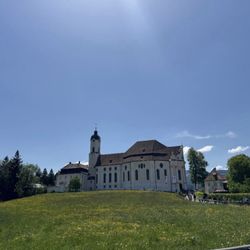
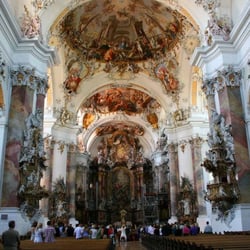
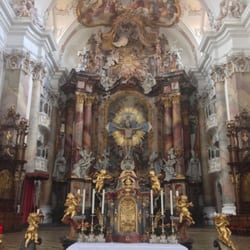
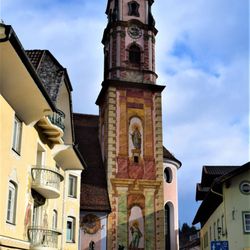
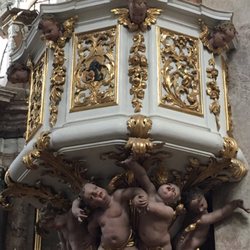
    It is the Catholic parish church of Oberammergau in the Garmisch-Partenkirchen District (Bavaria),…read moreis an important example of the southern German Baroque. It was built from 1735 to 1749. The sculptures were created by Franz Xaver Schmädl, the pictures and frescoes by Matthäus Günther. A pre-Romanesque predecessor church was probably built as early as the ninth century, possibly replacing an even older wooden church. At this time, the Welfe Ethiko withdrew here with twelve companions to a life in a monastic community. In 1167, the Kempten monastery was given twelve courtyards with the right to present themselves through the church. In 1295 and 1362 they became the property of the Augustinian monastery in Rottenbuch. All pastors of Oberammergau can be completely documented from 1432 to the secularization of the monastery in 1802; they all were Augustinian Canons. The Oberammergau parish was founded in the 12th century by the Rottenbuch canon monastery, with which it remained pastorally connected until secularization. The first church was replaced by a Gothic building in the High Middle Ages. This had become so dilapidated at the beginning of the 18th century that the new baroque building was tackled. The middle picture of the high altar shows the Mother of God as the heavenly helper of those who ask for intercession and contribute gifts. It is replaced by a figure of the risen Christ during Easter and the Passion Play. The statues of the apostles Peter and Paul as well as the outside of St. Joseph and Joachim with their attributes are remarkable. The Lamb of God is enthroned on the book with seven seals above the tabernacle . The two side altars on the choir arch are dedicated to the theme of redemption through Christ's sacrifice on the cross. The left altar shows in a rare representation God's decision to salvation as an "inner conversation" of the Trinity. The saints Martin and Gregory the miracle worker appear at the side. The right altar shows Christ on the cross -- this cross is considered to be the one in front of which the Oberammergau residents took their vows of the Passion Play in the year of the plague in 1633 -- with Mary and John and, on the outside, the "good thief" Dismas and Mary Magdalene . The altars in the side extensions are dedicated to the holy clan (left; altarpiece by Günther) and Saint Anthony of Padua (right; picture by Johann Jakob Zeiller ). It's a very gorgeous sanctuary to say the least (photos).

    Photos
    St. Peter und Paul - Hauptaltar, Nebenaltare und Deckengemälde

    Hauptaltar, Nebenaltare und Deckengemälde

    St. Peter und Paul - Kirche St. Peter und Paul

    Kirche St. Peter und Paul

    St. Peter und Paul - Nebenaltare und Hauptaltar

    See all

    Nebenaltare und Hauptaltar

    Benediktinerabtei Ettal - Informationstafel

    Benediktinerabtei Ettal

    4.6(21 reviews)
    43.9 km

    We visited Ettal for a schnapps tasting via the Edelweiss resort's tour program and it was…read morewonderful. I wish I could buy the hueyliquer in the US! Unfortunately, you can only get it here. I didn't want to deal with shipping it home so I did not get any and now I have regrets!

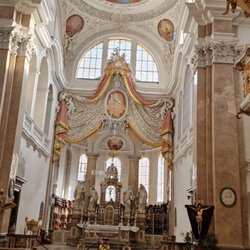
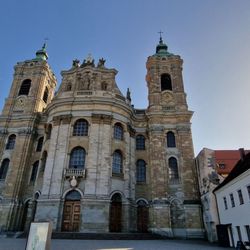
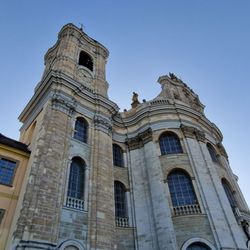
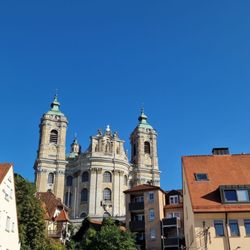
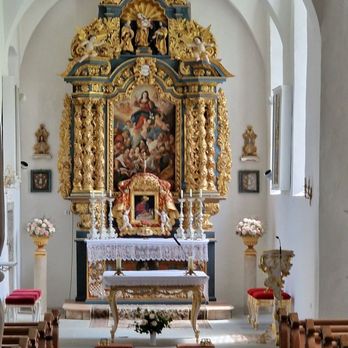
    Kloster Ettal (Ettal Abbey) is a Benedictine monastery in the village of Ettal close to…read moreOberammergau and Garmisch-Partenkirchen in Bavaria, Germany. With a community of more than 50 monks, with another five at Wechselburg, the Abbey is one of the largest Benedictine houses. Ettal Abbey was founded on 28 April 1330, Saint Vitalis of Milan's day, by Emperor Ludwig the Bavarian in the Graswang valley, in fulfilment of an vow, on his return from his coronation in Rome, on a site of strategic importance on the primary trade route between Italy and Augsburg. The foundation legend is that Ludwig's horse genuflected three times on the site of the original church building, where a marble statuette of the Madonna and Child ("Frau Stifterin" or the "Ettal Madonna") now stands. The statuette was brought by Ludwig from Pisa as a gift for his new foundation. It soon became an object of pilgrimage. The church is dedicated to the Assumption of the Blessed Virgin. The foundation originally consisted of a Benedictine double monastery -- a community for men and another for women -- and also a house of the Teutonic Knights. The original Gothic abbey church, built between 1330 and 1370, was a modest structure in comparison to the great churches of medieval Bavaria. The abbey suffered great damage during the Reformation at the hands of the troops of Maurice of Saxony, but survived the troubles of the Thirty Years' War (1618-1648). In 1709, under Abbot Placidus II Seiz, the golden age of Ettal began with the establishment of the "Knights' Academy" ("Ritterakademie"), which developed into a highly successful school and began the educational tradition of the abbey. In 1744, the abbey and the abbey church were largely destroyed in a fire. The subsequent spectacular re-building in the Baroque style, with a double-shelled dome, was to the plans of Enrico Zuccalli, a Swiss-Italian architect working in Munich, who had studied with Bernini. The decoration was primarily carried out by Josef Schmutzer of the Wessobrunn School of stuccoists and Johann Baptist Straub, who was responsible for the altars and the chancel. Ettal's importance as a place of pilgrimage grew with the new buildings and it became one of the most important monasteries in the Alpine region. For my personal interest: during the winter of 1940-1941, the German pastor and theologian Dietrich Bonhoeffer (1906-1945) spent some months at the monastery as the friend and guest of the Abbot. Like Bonhoeffer, a number of those in the Ettal community were involved in the conspiracy against Hitler. While at Ettal, Bonhoeffer also worked on his book Ethics. Catholic priest Rupert Mayer was kept at the Abbey under house arrest from 1939 to 1945 by the Nazis to prevent him from further anti-Nazi preaching. In 1993, Ettal re-founded the former Wechselburg Abbey in Saxony, an old monastery of the Augustinian Canons, as a Benedictine priory. Ettal maintains a Byzantine Institute. This Benedictine monastic building complex is magnificent. It's worth your visit when you are in the area for sure.
    Photos
    Benediktinerabtei Ettal - Hauptaltar

    Hauptaltar

    Benediktinerabtei Ettal
    Benediktinerabtei Ettal

    See all

    Maria Trost - churches - Updated May 2026

    Loading...
    Loading...
    Loading...