Cancel

    Open app

    Search

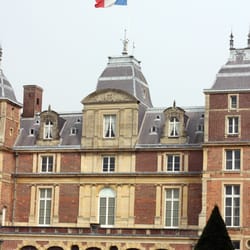
    Mairie de Dieppe

    1.0 (1 review)
    Closed 8:00 am - 12:00 pm, 1:00 PM - 5:00 PM

    Mairie de Dieppe Photos

    Mairie de Dieppe Reviews in Other Languages

    Verify this business for free

    Get access to customer & competitor insights.

    Verify this business

    The Brunswick Estate - Lansdowne Place

    The Brunswick Estate

    5.0(1 review)
    133.2 km

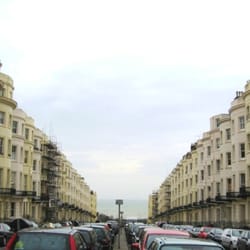
    The Brunswick Estate - comprising Brunswick Square, Brunswick Terrace and Brunswick Place, and the…read moreimmediately surrounding streets, is one of the finest set-pieces of Regency architecture in Britain. This huge development came about largely through just two men: the landowner, the Reverend Thomas Scutt, and the ambitious young architect Charles Augustin Busby. The estate was built largely as a speculative development, reaping the rewards of the European peace of 1815, which had revived the economy and led especially to investment in property. Busby's plans for the new estate were not just about houses; he planned a complete Regency town, with different types of housing for different social classes, a church, market hall, town hall, two pubs (separate ones for the workers and the gentry, naturally) and public baths. It even had its own police and fire service. Busby set out the design and specifications for the individual houses, including the building materials to be used, and it was then for the speculators to complete their construction. As well as its location close to the sea, it was close to the iron-rich springs in what is now St Ann's Well Gardens, which became a small but fashionable Spa. The main streets were named in honour of Caroline of Brunswick, wife of the Prince Regent, (later George IV). As the landowner, Scutt's role was largely passive, since he stood to profit only from the sale of leases. But he cooperated with Busby in releasing the land in packets as required, helping to make the whole venture a great success. Built between 1826 and 1840, it helped Hove to develop as a fashionable counter-point to Brighton, being close enough for its inhabitants to enjoy its pleasures, while living in quieter and more select surroundings, which were then largely rural. This undoubtedly helped start the social rivalry between Brighton and Hove! Many were second home owners from London - starting another trend still evident today. The architecture comprises three main set-pieces. The estate is centred on Brunswick Square, which runs from Western Road as a short avenue before broadening out into a rectangular square, the centre of which forms a small public park with flower beds, trees and lawns. On the sea front, it is flanked on either side by Brunswick Terrace, which has been extended on the west beyond the original symmetrical form, but in a sympathetic style. Brunswick Place, north of Western Road, was just outside the original estate, and added later in the same style. Many of the houses have distinct rounded façades, with the terraces often grouped either side of a row of more formally classical designs, incorporating Corinithian and Ionic columns and pilasters. Shell and ammonite decoration is also used throughout. The western extension of Brunswick Terrace is more severe in its classical style, but still impressive. Many of the houses have balconies with cast-iron balustrades and all have matching cast-iron railings at street level. Over the years, the houses have mostly been redeveloped into flats, many of which became run down. To preserve the architectural unity in 1976 an Act of Parliament was passed, which requires the owners to paint the houses every 5 years, and specifies the exact paint which they are to use! The warm, yellow colour is officially known as 'Hove Cream'. One of the houses in Brunswick Square is now a museum: The Regency Town House is a grade 1 Listed terraced home of the mid-1820s, and is being developed as a heritage centre and museum to focus on the architecture and social history of Brighton & Hove between the 1780s and 1840s. (Advanced booking is required.) Despite this, the interiors of many of the buildings are rather shabby, reflecting the difficulty of maintaining such buildings in good order. Another modern problem is the need for parking, and the streets are rather overwhelmed with parked cars (the UK having not yet adopted the rather clever continental practice of building underground car parks). Nevertheless, this remains one of the most impressive pieces of early 19th century architecture in Britain.


    Photos
    The Brunswick Estate - The more severe classicism of the western extension of Brunswick Terrace

    The more severe classicism of the western extension of Brunswick Terrace

    The Brunswick Estate - Brunswick Terrace - western arm

    Brunswick Terrace - western arm

    The Brunswick Estate - Brunswick Place

    See all

    Brunswick Place

    Maison de Van Gogh - The town's church.

    Maison de Van Gogh

    4.5(10 reviews)
    123.4 km

    It was so cool to visit the little town of Auvers-sur-Oise where Vincent Van Gogh spent the final,…read moreyet very productive, 70 days of his life before his suicide death at age 37. We stood at the very spots where he painted some wheat fields, where he painted the town city hall, and where he painted the local church. We saw the inn where he rented a room for those final days. Visiting here definitely gives you a sense of connection with one of the world's greatest painters. He painted what he felt from the scene in front of him and the style of his 2100 paintings was ahead of his time as he never achieved any fame until well after his death. It's well worth a visit!

    So I realize that some of the things I do only appeal to a certain demo…read more..... Some people are going to appreciate this more than other and some are going to ask why I would drive an hour plus through Paris traffic to get to Auvers-sur-Oise? The answer is that I'm a damn Van Gogh nerd..... The Van Gogh traveling experience is great but nothing.....nothing compares to standing in front of the real thing. I didn't think it could get much better than being at Orsay and admiring Starry Night over the Rhône. Or being at MOM and seeing The Starry Night (Arles) Yea, I was wrong. Being at Auvers-sur-Oise and walking in his footsteps is an experience all it's own. Visiting the house he rented the room he would eventually die in is a somber experience. The true highlight though is the Van Gogh walk..... Walk the same roads and fields, stop and look at the inspiration from some of his last and most recognizable paintings. The city has done a great job of marking the trail and setting up informational stations along the route. I cannot recommend this trip enough. I'll be back one day.....

    Photos
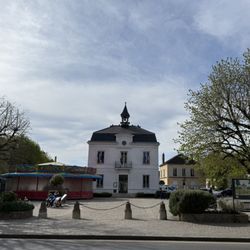
    Maison de Van Gogh - So cool to stand in the spot where Van Gogh painted the city hall of the town of Auvers-sur-Oise where he spent the final days of his life.

    So cool to stand in the spot where Van Gogh painted the city hall of the town of Auvers-sur-Oise where he spent the final days of his life.

    Maison de Van Gogh
    Maison de Van Gogh - The town's city hall.

    See all

    The town's city hall.

    Château d'Eu - Western facade

    Château d'Eu

    4.5(2 reviews)
    28.2 km

    Full disclosure - my most recent visit is in 2013 - but I forgot to load these pictures up, and I…read morenever reviewed - so here goes! My maternal paternal family goes back at least six generations living in Eu proper - while my maternal/maternal family was sourced from Corsica in the late 19th century, but, that's irrelevant to this review. What is relevant is that the Chateau has been a backdrop for most of my youthful summers - and some of those in adulthood. American tourists might very well overlook Eu, but it has a rich history - mainly that which includes Guillaume le Conquerant (William the Conquerer) as well as Lorcán Ua Tuathail (St. Laurence O'Toole the Archbishop of Dublin - back in the Norman conquest days). Regardless, the Chateau itself is host to several significant historical events. For Anglophiles, of interest would be Queen Victoria's summer stays in 1843 and 1845 as guest of Louis Philippe. the cost of a self-guided tour is modestly priced. If you're reading this, then you're very likely considering going anyway - so my review is moot. I'll let the photos do the talking. botanists will enjoy the classic French gardens, interior decorators of yesteryear will take interest in the over-the-top interiors. Back in the mid-sixties, the town of Eu took possession of the Chateau. Today, the town hall is situated on the property. If you're visiting the Chateau, it'd be a shame for you not to experience the St. Laurent O'Toole chapel at the top of the overlooking northern hill - as well as the Collegial (what most of you might think of when you think of Cathedrals from the era of Cluny).

    Photos
    Château d'Eu - It's all about controlling shutter speed AND f/stop.

    It's all about controlling shutter speed AND f/stop.

    Château d'Eu
    Château d'Eu

    See all

    Hove Town Hall

    Hove Town Hall

    3.3(6 reviews)
    134.1 km

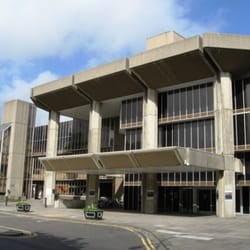
    The original Town Hall at Hove was built in 1882 to the designs of Alfred Waterhouse, best known…read morefor Manchester City Hall and the Natural History Museum in London. This splendid red brick gothic edifice, with its 110ft clock tower, was a well-known landmark until a fire in 1966 severely damaged much of the fabric. A picture of the old Town Hall can be seen at: http://www.mybrightonandhove.org.uk/page_id__5858_path__0p115p188p941p.aspx After several years of debate as to whether to rebuild within the remaining fabric or build a completely new hall, a competition was held for a completely new replacement building, which was won by John Wells-Thorpe, of Gotch & Partners. The new building, completed in 1974, is very much of its time: the structure is covered in unpainted grey-brown rough-cast concrete panels, with large expanses of tinted glass. It's not quite brutalist in style, thanks to the detailing on the panels, and the extensive planting around it softens the harder edges. But it's still a love-it-or-hate-it sort of building architecturally. I think it's mellowed rather well with time, and its low profile and set-back facades don't try to compete with the surrounding, older buildings. The building houses an information point (branded 'Citydirect') for the City Council's services, open 8.45-16.30h Monday - Friday. It also has various function and meeting rooms, which through the year host many diverse events, such as the Sussex Beer & Cider Festival held annually in March.

    Hove Town Hall is a festival of the early 1970s, a mirrored, faux-wooden parade of concrete and…read moreangular features that don't do much to soften the blow of your parking fine. It looks inside like a once-grand hotel gone to seed, with the smoked glass looking onto overly polished walnut accents on the concrete walls. These bits of concrete look like a cast of real wood, which is definitely, definitely better than unadorned concrete. Nevertheless, it's still, ahem, bare concrete. Even the lighting looks like it's been around since back in the day, with yellow gels casting a weird golden glow over everything. It's as if you've taken the wrapper off a caramel Quality Street and held it in front of your eyes. It's worth going here just for the pure authenticity of it - they really don't seem to have updated anything since it was built, so it's a living historical monument to the age of bizarre buildings. A word of counsel - if you do have to go here, for whatever reason, and I hope it isn't as unpleasant as many of the reasons you might pitch up here (parking, housing regulations...), but if you do - don't leave out a visit to the loo. That be-mirrored fairground attraction will stay with me for some time to come.

    Photos
    Hove Town Hall
    Hove Town Hall
    Hove Town Hall

    See all

    Mairie de Dieppe - townhall - Updated May 2026

    Loading...
    Loading...
    Loading...