Regarded by many as the best preserved Elizabethan town house in the UK, this historic gem is well…read moreworth a visit. It contains a wealth of decorative plasterwork and woodwork.
History
The house was built by Robert Wynn, a younger son of John Wynn of Gwydir Castle. He had served with the British Ambassador in Bruges, and travelled around the Continent. When he retired to Conwy, aged 50, he built himself a town house incorporating the latest features and styles, reflecting his prestige. It was built 1576-1585.
After his death, a dispute over his inheritance meant the house was eventually split into a lodging house, and also functioned as a school, and then the headquarters of the local antiquarian society, before being taken over and restored by Cadw (Welsh Historic Monuments).
The house
This large building occupies a whole block of Conwy's streets. The main frontage consists of an elaborate gatehouse, courtyard and then the main house, which has its own courtyard and garden. The exterior has been plastered and limewashed, as it would have been originally.
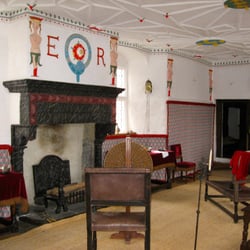
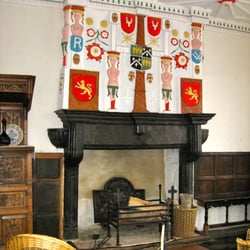
Inside, the rooms are a mixture of the 'working' rooms of the house kitchen, storage rooms, servants' quarters and so on, and the grander rooms intended for Wynn and his family. These have impressive fireplace mantels and panelling, and particularly large expanses of decorative plasterwork. In many places this is highly coloured, and includes decorative friezes of coats of arms, Tudor roses and other heraldic devices (and above all, Wynn's initials, RW, which appear everywhere).
Another recurring motif is that of naked caryatids, carrying bowls of strawberries on their heads. They wear loincloths of leaves, and cover one breast, leaving the other bare. The plasterwork images are often touchingly naive and primitive, as local plasterers tried their best to reproduce unfamiliar images copied from pattern books.
The house also has some impressive furnishings, although these have been sourced separately and are not original. In the attic, one room is furnished as it would have been in the early 19th century, as the home of a lodger, a washer-woman.
Practicalities
There is a guided audio tour available, which is well worth using, although the Tudor jingle which precedes each section may get irritating after a while. There are also static presentations on aspects of Tudor and later life. Access for those with restricted mobility is limited, due to the presence of stairs and uneven floors.
There is also a shop at the entrance selling the usual cards, books and gift items.