1. Lahaina Restoration Foundation

0

Lahaina, HI

Cancel

Open app

Search

Lahaina Restoration Foundation

4.7 (3 reviews)
Closed • Closed

Lahaina Restoration Foundation Photos

You might also consider

More like Lahaina Restoration Foundation

Recommended Reviews - Lahaina Restoration Foundation

Your trust is our priority, so businesses can't pay to alter or remove their reviews. Learn more about reviews.
Yelp app icon
Browse more easily on the app
Review Feed Illustration

3 years ago

Helpful 1
Thanks 0
Love this 1
Oh no 0

7 years ago

Helpful 2
Thanks 0
Love this 1
Oh no 0
Photo of Richard F.
156
2689
12042

7 years ago

Helpful 12
Thanks 0
Love this 12
Oh no 0

Ask the Community - Lahaina Restoration Foundation

You might also consider

Verify this business for free

Get access to customer & competitor insights.

Verify this business

Waine'e Graveyard

Waine'e Graveyard

(1 review)

Waine'e was the first Christian cemetery in Hawaii and the final resting place for much of the…read moreHawaiian Royal Family. From the Lahaina Historical Guide: The sacred Queen Keopuolani, the highest royalty by virtue of bloodlines in all Hawaii, born in Wailuku in 1780; she was the first Hawaiian baptized as a Protestant. Wife of Kamehameha I, mother of Kamehameha II and III. (1778 - Sep 16, 1823) King Kaumuali'i, the last king of Kauai. His island was the only one that Kamehameha the Great never took with force.(1780 - May 26, 1824) High Chief Ulumaheihei Hoapili, a general and King Kamehameha I closest friend; Hoapili married two of Kamehameha's queens, Keopuolani and Kalakua. He was governor of Maui from 1823 until his death. (~1775 - Jan 3, 1840) Hoapili-Wahine (Kalakua Kaheiheimalie), wife of High Chief Hoapili and governor of Maui from 1840 to 1842, who donated 1,000 acres of land to start Lahainaluna School. (1778 - Jan 16, 1842) Kekauonohi, one of the five queens of Kamehameha II, born in Lahaina in 1805, served as governor of Kauai from 1842 to 1844. (1805 - Jun 2, 1851) High Chiefess Kuini Liliha, granddaughter of King Kahekili, daughter of Hoapili; Liliha visited King George IV with her husband, Boki, Kamehameha II and Queen Kamamalu. In 1830 Liliha started a rebellion with 1,000 soldiers on Oahu while she was governor there. Her father, Hoapili, forced her to give up her office and return to Maui. (1802 - Aug 25, 1839) Princess Nahienaena, darling of the high chiefs and the Hawaiian people, sister to kings Kamehameha II and III. (1815 - Dec 30, 1836) Many missionary children are buried in Waine'e Cemetery, as is Rev. Richards, who baptized Queen Keopuolani on her deathbed in 1823. Visitors should be aware that Hawaiians consider this site sacred.

Pali Tunnel

Pali Tunnel

(1 review)

The Pali Tunnel is a 315' long, 2-lane bi-directional tunnel on Maui's state highway 30, AKA…read moreHonoapiilani Highway, located on the "pali ", or cliffs between McGregor Point and Ukumehame on the island's west coast. It is Hawaii's oldest tunnel and the only one on Maui. The tunnel's facades are upside down trapezoids, with the year "1951" engraved on both sides. The half cylindrical-shaped interior is naturally bumpy from the mountain's boulders and rocks. It's short enough to not warrant lighting, but a solar-powered system was installed around the late '90's, early '00's mainly for bicyclists. The push of a button before entering the tunnel on either side turns on the lights then times off automatically. I've seen it lit only once so far. There are many myths and urban legends when driving through the tunnel, such as the driver taking their hands off the wheel and placing both hands on the vehicle's ceiling for the entire duration inside while steering with their thighs. Another more popular and still current one is honking or holding your horn the entire way through. Both are pointless, stupid and dangerous, so just don't do it! I've always wondered why they constructed the tunnel instead of blasting through the mountain to create passes like they did on the other 99% of the highway. Possibly due to the geography/topography? TIP: If you look above the tunnels (and on both sides of the current highway while on the pali), you can still see the old roadway and cut outs that used to be the slow and dangerous route to and from west & central Maui.
Plantation Museum

Plantation Museum

(5 reviews)

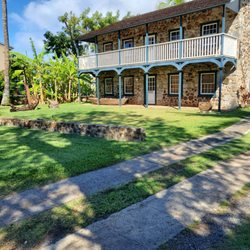
My family was born and raised on Puukolii. I enjoyed growing up visiting the museum. I hope they…read moreopen a new one by the smoke stack soon. I want to show my kids where their family came from.

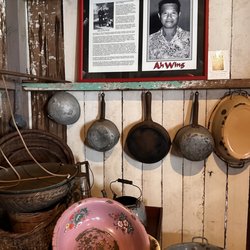
I was looking for the bathroom after eating at a restaurant right next door on the second floor of…read morethis shopping complex in old Lahaina. Overhead sign of plantation worker cutting sugar cane, complete with face mask, and this was before the pandemic! Tiny museum shows through drawings, artifacts, exhibits and photographs the history of Lahaina plantations. No entry fee. Plantation days and tourism exhibit. When the demand for whale products waned, it was discovered that processed sugar could survive the long trip to the mainland from Hawaii. Pineapple products, and sugar plantation pictures. Pictures of various pieces of sugar harvesting field machinery, a crane on metal treads with a grabbing device for picking up piles of cut sugar cane, tractor type truck for pulling truck loads of cut caner. Steam locomotive for pulling railway wagons of cut sugar cane. Exhibits, pictures and films showing the history of sugar cane in Hawaii from the late 1800s through the 1950s. Also shown are the immigrant workers that these companies exploited. Hawaii imported thousands of Chinese and Japanese workers to toil in the very labor intensive sugar harvesting industry. Workers head to toe with protective clothing from the centipedes, scarf to keep out the dust, with long sleeved padded pants and shirts, ready to harvest the sharp spikes of the sugar cane plants, and hat to protect from tropical sun. Very hard labor work under difficult conditions, before mechanization in the 1950s. Not a job many Americans would do today! Exhibit on WW2 in Hawaii, including the attack on Pearl Harbor. Worker strikes in the 1950s for better work conditions and pay. Sugar industry and plantations went downhill with the first commercial flights of the Boeing 707 four engine jet liner in 1959, which reduced the flight time from the west coast from 12 hours to 6 hours to Hawaii. Tourism became the premiere industry of Hawaii. After eating a big lunch at "Down the Hatch" restaurant, a lot of people are going to pass here on their way to doing "Down the Hatch" at the restrooms.

Lahaina Restoration Foundation - museums - Updated October 2026

Loading...
Loading...
Loading...