LaFayette Visits Augusta Historical Marker Photos
More like LaFayette Visits Augusta Historical Marker
Recommended Reviews - LaFayette Visits Augusta Historical Marker
Start your review...



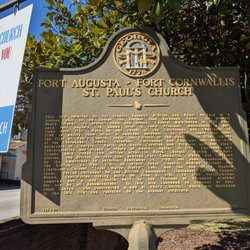
Augusta has a way of folding its layers of history into the landscape so quietly that you can walk past a parking lot or a modern storefront and never guess that a national hero once stepped ashore here, and the Lafayette marker is one of those reminders that the city was already old with memory long before the Civil War reshaped it. The marker reads, "This is the site of the old Planter's Hotel, which was burned in 1839. There the Marquis de LaFayette was entertained during his visit to Augusta in March 1825. LaFayette landed at Savannah on March 19th and traveled to Augusta with Governor Troup a few days later. Arriving on the steamboat "Altamaha", LaFayette was greeted by a great procession of musicians, soldiers, clergymen, and citizens, who accompanied him into the city and to the Planter`s Hotel, where apartments had been prepared for him. The next day, Mayor William Holt formally welcomed the Marquis at the City Hall. The festivities planned in honor of LaFayette were even more lavish than those enjoyed by General Washington when he visited the city in 1791. An elaborate banquet and ball climaxed his visit. LaFayette left Augusta on Friday, March 25th, and with Governor Troup journeyed on to Milledgeville. The reverence which the people of Augusta felt for this most beloved American ally is relfected in a toast proposed at the banquet: "A man whose sovereignty is above that of kings - LaFayette who reigns in the hearts of the whole people." The marker was erected in 1962 by the Georgia Historical Commission. It is marker number 121-42. It stands as a small but vivid link to a moment when Augusta was part of a national celebration of gratitude, pride, and Revolutionary heritage, and it adds another thread to the city's long, layered story. [Review 207 of 2026 - 908 in Georgia - 25396 overall] read more