War museums tend not to be my cup of tea. I find the traditional museum set up rather at odds with what I think one should be seeking to achieve with such a place, the static, glass-cased exhibits being too far removed from their settings to mean much. Large boards with written information rarely hold my attention sufficiently for me to be able to put the exhibit in place. La Coupole is very, very different.
La Coupole is a site of immense interest. A launching site for the huge V2 rockets used by the Germans during World War 2, this site serves both as a museum, a shrine and a lesson to us all.
The first thing that hits you when you arrive at La Coupole is quiet and a sense of foreboding. Standing in a chalk quarry and looking up through a vast, hollowed-out hillside capped with a concrete dome you then realize the size of this project. The main buildings are left just as they were left in 1944. There are more modern buildings scattered around the perimeter but these just serve to make the main attraction that much more austere.
The entrance to the main area is through a long concrete tunnel through which the V2 bombs would have been brought on rail tracks. Alcoves to the sides of the tunnel provided hiding places for the manufactured shells. There's a concentration camp train stationed just outside the entrance and this provides a real sense of discomfort. This is Hell only you know, deep down, that you'll walk out again.
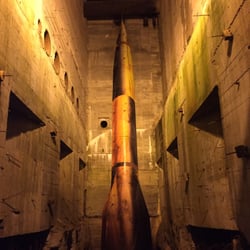
The museum element of the attraction is, to my mind, superb. A reconstructed (full-scale) V2 stops you in your tracks. It shouts evil from its very being. The museum leads you through the development and workings of the V2s and how the site worked. It then moves through time, showing how the V2 and other nation's variations contributed to the newer intercontinental missiles that were developed and then eventually onto space. It's hard to think, coming out of such an evil, austere setting and invention, that the space race was facilitated by the very same technology.
One can guide oneself around the site, with information boards available in both French and German. Alternatively free multi-lingual audio guides are available which were excellent. Films were also being shown with English commentary. read more