Cancel

    Open app

    Search

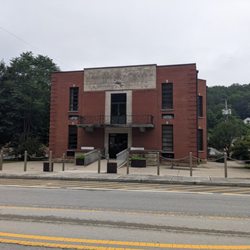
    Knox County Courthouse

    3.0 (1 review)

    Knox County Courthouse Photos

    Recommended Reviews - Knox County Courthouse

    Your trust is our priority, so businesses can't pay to alter or remove their reviews. Learn more about reviews.
    Yelp app icon
    Browse more easily on the app
    Review Feed Illustration

    3 years ago

    Helpful 9
    Thanks 2
    Love this 8
    Oh no 0

    Verify this business for free

    Get access to customer & competitor insights.

    Verify this business

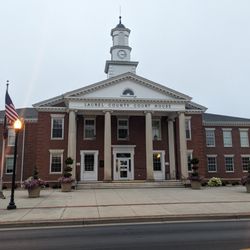
    Jefferson County Courthouse - Jefferson County Courthouse, Dandridge

    Jefferson County Courthouse

    5.0(1 review)
    64.4 mi

    Dandridge, Tennessee was founded in 1783 and named for Martha Dandridge Washington. It is the…read moresecond oldest town in the state and has served as the county seat of Jefferson County since its creation in 1792. Early settlers were drawn by the French Broad River, and the town quickly became a hub for stagecoach and steamboat travelers, with taverns and inns that still stand today. Jefferson County, named for Thomas Jefferson, was carved from the Southwest Territory and grew rapidly with Scots-Irish pioneers and Revolutionary War veterans who farmed its fertile valleys. Both the town and county were deeply affected by the Civil War, with skirmishes at Dandridge in 1863, and later by the Tennessee Valley Authority's construction of Douglas Dam and Cherokee Dam during World War II, which reshaped the landscape and economy. Despite threats of flooding, Dandridge was saved by a protective levee. The courthouse was completed in 1845 in the Greek Revival style. The two‑story building was assembled with hand‑made bricks, a wooden cupola, and a distinctive roof built entirely without nails, showcasing the craftsmanship of mid‑19th‑century builders. Its durability is remarkable: unlike many Tennessee courthouses, it has never suffered a major disaster, meaning county records dating back to 1792 remain intact. During the Civil War, it was used as a hospital, and in 1957 it became home to the Jefferson County Historical Museum, which preserves artifacts ranging from Native American tools to Civil War relics and even the 1806 marriage bond of Davy Crockett and Polly Finley. The building is still in active use though secured on a Saturday morning. There is plenty of street parking and there is a parking lot nearby on Gay Street. [Review 1460 of 2025 - 582 in Tennessee - 25013 overall]

    Photos
    Jefferson County Courthouse - Jefferson County Courthouse, Dandridge

    Jefferson County Courthouse, Dandridge

    Jefferson County Courthouse - Jefferson County Courthouse, Dandridge

    Jefferson County Courthouse, Dandridge

    Jefferson County Courthouse

    See all

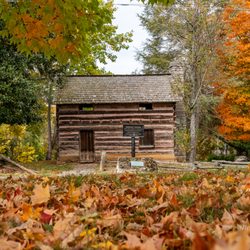
    Capitol of State of Franklin - The Lost State of Franklin Cabin in the fall. Located on College Street in Greeneville, TN.

    Capitol of State of Franklin

    4.7(3 reviews)
    76.2 mi

    It's a wonderful trip into the past when you visit this cabin. It is across the street from Town…read moreHall and has a cool history. There are informational plaques. It is free and open to the public all the time.

    Located in Greeneville, TN about 2 blocks from the President Andrew Johnson Home and museum. It is…read morea quick walk over and something you shouldn't miss.. It is absolutely FREE and a piece of history you don't want to miss. The state of Franklin never came about but it could have been a 51st state if it hadn't fell through the cracks during all the civil war fights going on. You can go into the cabin and look around. I recommend you checking it out. HISTORY: In 1784, North Carolina attempted to resolve its debts by giving the U.S. Congress its lands west of the Appalachian Mountains, including Greene County, abandoning responsibility for the area to the federal government. In response, delegates from Greene and neighboring counties convened at Jonesborough and resolved to break away from North Carolina and establish an independent state. The delegates agreed to meet again later that year to form a constitution, which was rejected when presented to the general delegation in December.[12] Reverend Samuel Houston (not to be confused with the later governor of Tennessee and Texas) had presented a draft constitution which restricted the election of lawyers and other professionals. Houston's draft met staunch opposition, especially from Reverend Hezekiah Balch (1741-1810) (who was later instrumental in the creation of Tusculum College). John Sevier was elected governor, and other executive offices were filled. A petition for statehood for what would have become known as the State of Franklin (named in honor of Benjamin Franklin) was drawn at the delegates session in May 1785. The delegates submitted a petition for statehood to Congress, which failed to gain the requisite votes needed for admission to the Union. The first state legislature of Franklin met in December of 1785 in a crude log courthouse in Greeneville, which had been named the capital city the previous August.[13] During this session, the delegates finally approved a constitution which was based on, and quite similar to, the North Carolina state constitution. However, the Franklin movement began to collapse soon thereafter, with North Carolina reasserting its control of the area the following spring. In 1897, at the Tennessee Centennial Exposition in Nashville, a log house that had been moved from Greeneville was displayed as the capitol where the State of Franklin's delegates met in the 1780s. There is, however, nothing to verify that this building was the actual capitol. In the 1960s, the capitol was reconstructed, based largely on the dimensions given in historian J. G. M. Ramsey's Annals of Tennessee

    Photos
    Capitol of State of Franklin
    Capitol of State of Franklin
    Capitol of State of Franklin

    See all

    Knox County Courthouse - courthouses - Updated May 2026

    Loading...
    Loading...
    Loading...