Schwäbisch Hall or Hall for short was first mentioned in a document dating from 1063. It's…read moreunclear, but Hall possibly refers to the open-pan salt making method used there until the saltworks closed down in 1925. Salt was produced from brine by the Celts at the site of Schwäbisch Hall as early as the fifth century BC. Hall flourished through the production of salt and coins after imperial mint was founded by Emperor Frederick I Barbarossa. Hall became a Free Imperial City of the Holy Roman Empire around 1280.
From the 14th to the 16th centuries, Hall systematically acquired a large territory in the surrounding area, mostly from noble families and the Comburg Monastery. The wealth of this era can still be seen in some gothic buildings like St. Michael's Church (rebuilt 1427-1526) with its impressive stairway (1507). The town joined the Protestant Reformation very early. Johannes Brenz, a follower of Martin Luther, was made pastor of St. Michael's Church in 1522 and quickly began to reform the church and the school system along Lutheran lines.
Hall suffered severely during the Thirty Years' War (1618-1648) though it was never besieged or scene of a battle. However, it was forced to pay enormous sums to the armies of the various parties, especially to the imperial, Swedish and French troops. Between 1634 and 1638 every fifth inhabitant died of hunger and disease, especially from the bubonic plague. The war left the town an impoverished and economically ruined place, but with the help of reorganizations of salt production and trade and a growing wine trade, there was an astonishingly fast recovery.
The Napoleonic wars brought the history of Hall as a Free Imperial City to an end. Following the Treaty of Lunéville (1801), the duke of Württemberg was allowed by Napoleon to occupy the town and several other minor states as a compensation for territories on the Left Bank of the Rhine that fell to France.
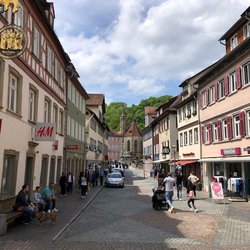
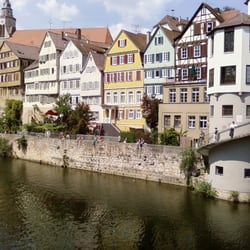
Although Swäbisch Hall doesn't have any medieval fortifications walls surrounding it like Rothenburg o. d. T. or Dinkelsbühl, it certainly provides a very quaint medieval atmosphere with its numerous half-timbered houses and buildings, cobble stone streets, massive Gothic church on the hill, and Kocher River running through it. You can certainly enjoy strolling and wandering in this town for hours imagining how one's life might have been during those days. You'll enjoy visiting this town.