
King's Chapel Burying Grounds Photos


More like King's Chapel Burying Grounds
Recommended Reviews - King's Chapel Burying Grounds
Start your review...


Reviews With Photos

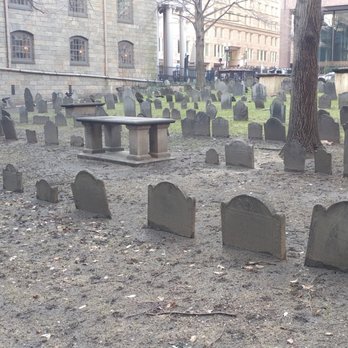
Located on the Freedom Trail, this burying ground was established in 1630! Similar to Granary, this cemetery has remained intact while the city has built up and hustled around it. While Granary seems to house a lot of founding fathers, King's Chapel seems to be more for important political, military, and religious figures in early Boston time. A little less surrounded by tall buildings, this burying ground has more light and seems slightly less eerie. However there are definitely some incredibly old markers and ones that can barely been seen or read. If you are walking the Freedom Trail, it's definitely worth a pop in but you probably won't need to spend too much time there.


King's Chapel has become one of my absolute fave burying grounds over the years. Every time I'm in Boston, I find myself wandering over here - it has some of the best memento mori and so much history. I always try to catch the chapel open bc I would love to see inside - especially the crypts - but somehow never seem to catch it open lol. This burying ground isn't actually affiliated with the chapel itself as it's much older - it was established in 1630!! (see my previous review for more details). It's a stop on the Freedom Trail and very much worth exploring. There's also a lovely mosaic on the sidewalk outside that marks the site of the oldest public school in America of which Benjamin Franklin was an alumni! What I love most and what keeps me coming back is the memento mori and the peaceful calm over the site amidst all the hustle and bustle of the city. There are two beautiful, very unique examples of memento mori right in the front by the street - both with various depictions of Father Time battling Death. Very interesting and beautifully preserved. I've not seen this particular motif on any other memento mori as of yet. There are lots of info signs around the grounds and it's particularly lovely in autumn of course. Highly recommend.

Walking over to Faneuil Hall I stopped by here to pay my respects and appreciate history here in Boston. It's a beautiful solemn place.


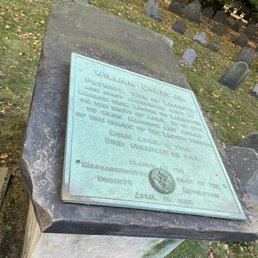
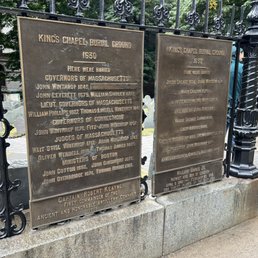
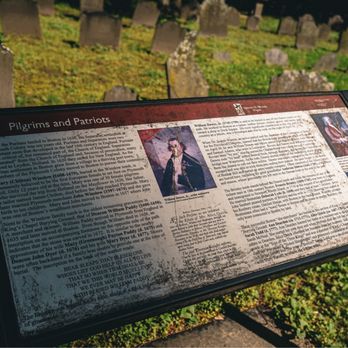
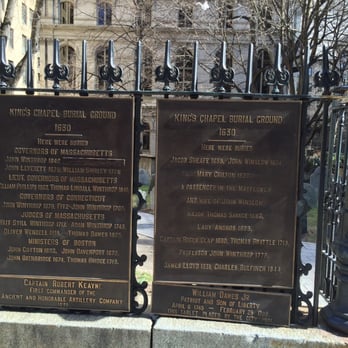
King's Chapel Burying Ground is the oldest cemetery in Boston. It was founded in 1630, the same year that Boston was founded. The earliest graves and tombs were scattered in no specific pathway. In the early 19th century, cemeteries were like public parks and beautification projects ensued. An iron gate was added. Headstones were moved to follow pathways, but often did not match the body buried below. Many governors, patriots and pilgrims are buried at this historic cemetery. William Dawes rode in 1775 to warn the Continental Army about the British on the same evening as Paul Revere. Mary Chilton is believed to be the first woman who stepped off the Mayflower onto land. John Winthrop was the first governor of Massachusetts. Thomas Brattle advocated against the witch trials. He was also the treasurer for Harvard. William Emerson was the father of Ralph Waldo Emerson. Elizabeth Pain may have inspired Nathaniel Hawthorne's The Scarlet Letter. Perfect for a quick step back into history along the Freedom Trail.


King's Chapel Burying Ground is part of the Freedom Trail and is a quick stop along the way. It is much smaller than the other cemeteries on the trail but some of the headstones date back to the 1600's. There is no one hugely famous in this graveyard, but it is still worth the visit to walk around and see the old pictures carved into the headstones.

Another stop on the Freedom Trail, King's Chapel Burying Group has a number of slightly less famous people but are still important patriots and Massachusetts leaders including Governors and Lieutenant Governors. The great Oliver Wendell is laid to rest here as is Mary ChilTon who was a passenger on the Mayflower. Clear paths exist and it is easy to stay off the grass. A litter pickup is needed here but I did grab a couple of bits and put them in the bin near the exit. Be respectful!


King's Chapel Burying Grounds is a small cemetery next to King's Chapel, both locations on the Freedom Trail. The King's Chapel Burying Grounds is worth a stop if you're hitting all of the spots along the Trail, but it wasn't as meaningful or as interesting to me as the buildings you can tour (including the King's Chapel itself). Still worth a quick stop.


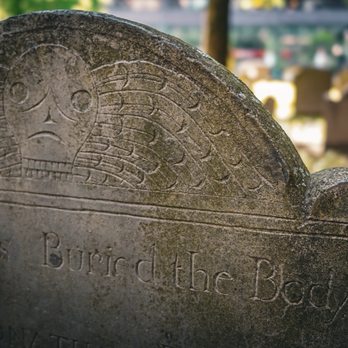
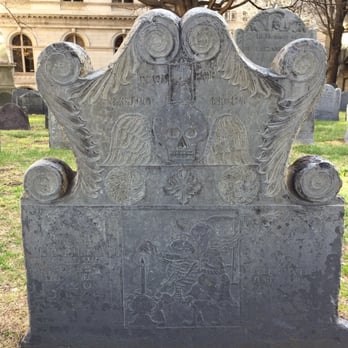
I love visiting historic cemeteries. The gravestones are like artwork and the stories they tell can be both fascinating and mysterious. The King's Chapel Burying Grounds is the oldest cemetery in Boston dating back to 1630 which is mind-boggling to me. Although so many things in Massachusetts date back at least that far the thought of things happening on the very ground on which I am standing, but back in the 1600s gives me goose bumps. The cemetery is on a small plot of land adjacent to King's Chapel (which is another historic must-see). The gates leading into the cemetery are open most days and one is free to wander in and look about. It can be hard to see some of the stones clearly because one must keep on the cement path and not wander onto the grass due to the fragility of the graves. The etchings and designs that go into many of the gravestones is incredible. They give you an idea what was "in style" depending on the era. The skull with wings is one of my favorites. What is written on the stone about the deceased can be basic and factual to the more poetic and mysterious. There are a number of notable people buried here including John Winthrop who was a Puritan and the first governor of Massachusetts. There is a woman buried here by the name of Elizabeth Pain. She is said to have been the inspiration for Hester Prynne in Nathaniel Hawthorne's book The Scarlet Letter. Elizabeth Pain (1652-1704) had the misfortune (given the era) of having a child out of wedlock. The child died and she was brought to trial for what was claimed to be the child's murder. She was acquitted of this charge but was found guilty of negligence. Her sentence was a fine and a flogging....flogging and whipping being big back in the day. It was said at her trial that she "did not have the feare (sic)of God before hir (sic) eyes and was led by the Instigation of the devil." Who knows what really happened but something tells me this woman was marked as up to no good the moment she gave birth to that child sans husband. Elizabeth ultimately married but died a marked woman at 52. There are lots of interesting tales like this to be found by researching some of the notables buried here. I gave the cemetery only 3 stars because I am concerned about how such an historic place as this can be so freely accessed by the public which causes me worry about the care of the extremely fragile gravestones. They have lasted this long I know but I think when the cemetery is open I believe there should always be some kind of "keeper" minding things. Its location is on super busy Tremont Street. With hordes of pedestrians and heavy street traffic only a few yards away, this is not a good recipe for gravestone preservation. Nonetheless, this site is well worth a visit. For the best experience, find a cemetery tour so you can learn as much as you possible while you are there.
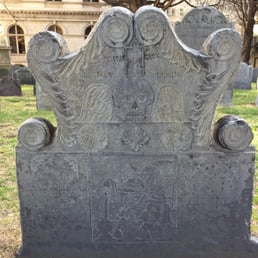

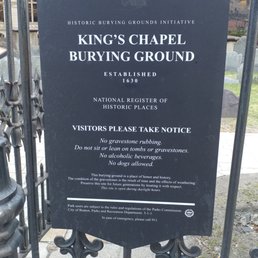
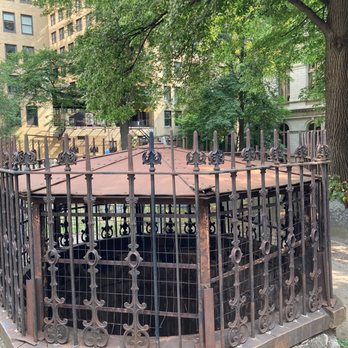
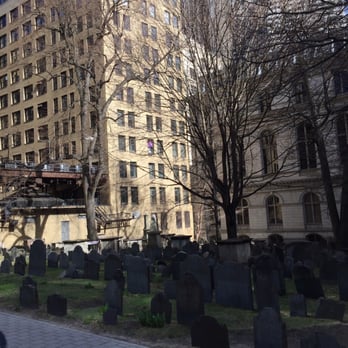
Located right next the King's Chapel, this historical cemetery is #6 landmark of the Freedom Trial. It is one of the oldest cemetery in Boston, established in1630. It's a relatively smaller cemetery than compared to the Granary Burying Ground and you can walk through it all relatively quickly. Off to the right hand side of the cemetery is a huge pit where it drops all the way to the bottom of the cemetery that's been blocked off by a metal fence.. which left me wondering what it was used for and why it's there. There cemetery itself is very peaceful and definitely not as much foot traffic as Granary. The only thing to be careful is because the gravestone markers are very close to the walking grounds, to NOT rub up against them to wear them down or knock them over to break them. Option to walk through or not since you can pretty much see it all from the outside without having to really step in.


Very eerie at night. The tombstones are pretty neat to see. Small cemetery. Was not as memoriable as the other Freedom Trail locations, just was a quick and easy stop on my trail walk.


King's Chapel Burying Grounds is the second cemetery on the Freedom Trail and probably the smallest to visit. Very easy to find, in downtown, next to King's Chapel! It dates from 1630 and it's the oldest in the city. It was pretty crowded the day I visited, but I lingered, took my time and managed to see everything in less than half an hour at my own leisure. John Winthrop, who was the first governor of Massachusetts is buried here and Mary Chilton, the first woman who got off the Mayflower. There's also a metal ventilation shaft in a corner connected with Boston's subway - Tremont street stop, my husband was fascinated by it and started to look into it. Very interesting historic site, great to visit and free! read more



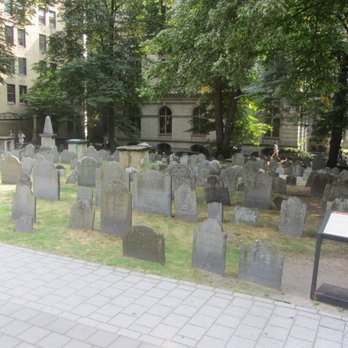

Strolling into King's Chapel Burying Ground felt like stepping directly back into 17th-century Boston. Founded in 1630, it's the oldest burying ground in the city -- the grounds where the earliest colonists of Boston found their final rest. Even though the name is "King's Chapel," the burial ground was always municipal, not church-owned -- the adjacent King's Chapel was built later (starting in the late 1600s) when colonists parceled out a chunk of the grounds for it. Walking among the weathered headstones and slate grave markers -- many carved with the iconic Puritan "death's-head" imagery (skulls, hourglasses, angels) -- really hits home the fragility (and the boldness) of early colonial life. One reads "Memento Mori" and you can't help but reflect. A little history deep-cut: who you're standing beside If you lean into the headstones and read the inscriptions, you're literally next to some of the founding figures of early New England: * John Winthrop -- the first governor of the Massachusetts Bay Colony. * Mary Chilton -- believed to be the first European woman to set foot in what became New England. * William Dawes -- yes, that William Dawes who rode alongside (but different from) Paul Revere on his famous midnight ride. You get this weird -- but powerful -- mix of reverence and tension: the stories of Puritan settlers, colonization, early governance, and the messy complexity of history. Ambience & layout: small, somber, surprisingly peaceful It's a small plot -- under a half-acre -- sitting wedged into downtown Boston near Tremont Street. The grounds are surrounded by a granite wall and wrought-iron fencing, and inside there's a quiet, parklike feel. Paths run through, and the stones are arranged in rows (though those rows were moved there in the 1800s -- the stones don't necessarily lie over the remains they mark). Final verdict If you love history, cemeteries, colonial America -- or just want a quiet moment reflecting on the roots of Boston -- King's Chapel Burying Ground is a gem. It's small, maybe easy to walk right past if you're distracted by city bustle. But once you slow down and look at the stones, the place becomes as much a respect-filled memorial as a living history book. Do yourself a favor: go there at a quiet hour, maybe early morning or late afternoon light, read a few stones, and let yourself imagine what early colonial Boston might have felt like. read more


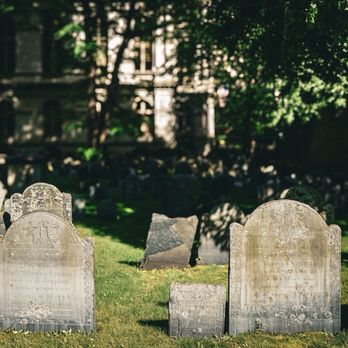





I find cemeteries spooky yet tranquil. If I see a cemetery, I have an urge to walk through it; creepy yet calming. Since this is the oldest burial ground in Boston, it's a no brainer to check this out. When Boston was first settled, this burial ground came to be in 1630! Supahh old! (Boston Accent). There is a walking path throughout the grounds and it's fenced in. Right outside the gates, you see and hear the bustling city. King's Chapel was built later in 1688, but it's not affiliated with the cemetery. The tombstones were so old and so cool; some of the tombstones, you can't see the inscription on it anymore. I'm surprised some are still showing after 394 years! There are some popular remains on these grounds; John Winthrop (Massachusetts' first governor) and Mary Chilton (first woman pilgrim to step on the soil) to name a couple. We noticed a huge hole in ground that was gated; found out that it's ventilation for the subway and bodies had to be moved for it to be built. This is also on the freedom trail! Overall, the oldest cemetery I've been to and I enjoyed waking through it. read more




Located on the Freedom Trail, this burying ground was established in 1630! Similar to Granary, this cemetery has remained intact while the city has built up and hustled around it. While Granary seems to house a lot of founding fathers, King's Chapel seems to be more for important political, military, and religious figures in early Boston time. A little less surrounded by tall buildings, this burying ground has more light and seems slightly less eerie. However there are definitely some incredibly old markers and ones that can barely been seen or read. If you are walking the Freedom Trail, it's definitely worth a pop in but you probably won't need to spend too much time there. read more
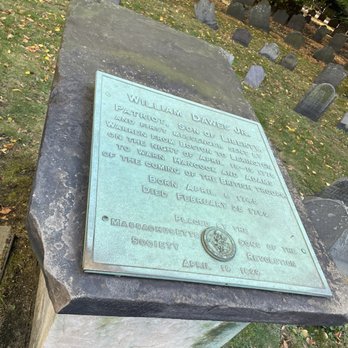


King's Chapel has become one of my absolute fave burying grounds over the years. Every time I'm in Boston, I find myself wandering over here - it has some of the best memento mori and so much history. I always try to catch the chapel open bc I would love to see inside - especially the crypts - but somehow never seem to catch it open lol. This burying ground isn't actually affiliated with the chapel itself as it's much older - it was established in 1630!! (see my previous review for more details). It's a stop on the Freedom Trail and very much worth exploring. There's also a lovely mosaic on the sidewalk outside that marks the site of the oldest public school in America of which Benjamin Franklin was an alumni! What I love most and what keeps me coming back is the memento mori and the peaceful calm over the site amidst all the hustle and bustle of the city. There are two beautiful, very unique examples of memento mori right in the front by the street - both with various depictions of Father Time battling Death. Very interesting and beautifully preserved. I've not seen this particular motif on any other memento mori as of yet. There are lots of info signs around the grounds and it's particularly lovely in autumn of course. Highly recommend. read more


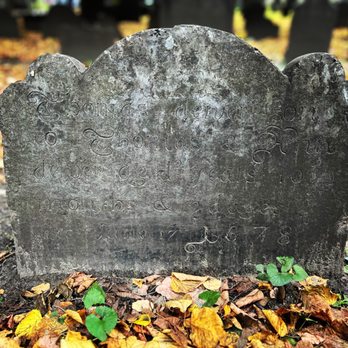
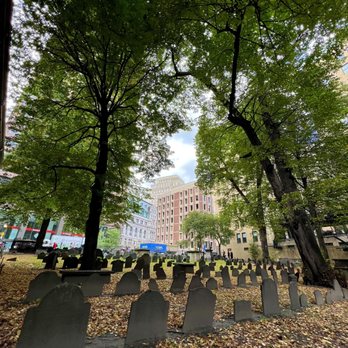


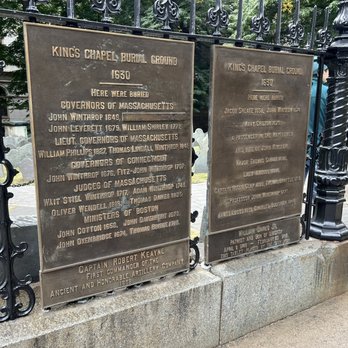


King's Chapel Burying Ground is the oldest cemetery in Boston. It was founded in 1630, the same year that Boston was founded. The earliest graves and tombs were scattered in no specific pathway. In the early 19th century, cemeteries were like public parks and beautification projects ensued. An iron gate was added. Headstones were moved to follow pathways, but often did not match the body buried below. Many governors, patriots and pilgrims are buried at this historic cemetery. William Dawes rode in 1775 to warn the Continental Army about the British on the same evening as Paul Revere. Mary Chilton is believed to be the first woman who stepped off the Mayflower onto land. John Winthrop was the first governor of Massachusetts. Thomas Brattle advocated against the witch trials. He was also the treasurer for Harvard. William Emerson was the father of Ralph Waldo Emerson. Elizabeth Pain may have inspired Nathaniel Hawthorne's The Scarlet Letter. Perfect for a quick step back into history along the Freedom Trail. read more


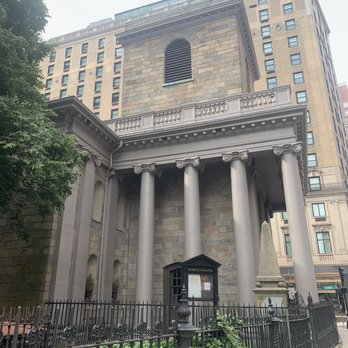
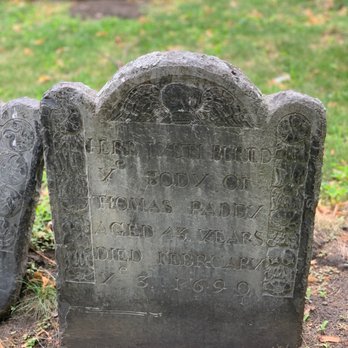

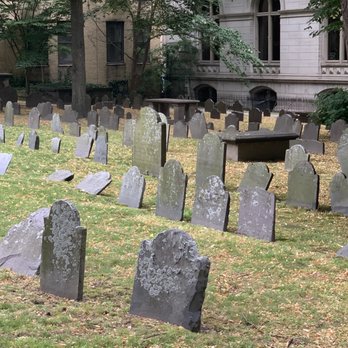

King's Chapel Burying Ground is part of the Freedom Trail and is a quick stop along the way. It is much smaller than the other cemeteries on the trail but some of the headstones date back to the 1600's. There is no one hugely famous in this graveyard, but it is still worth the visit to walk around and see the old pictures carved into the headstones. read more

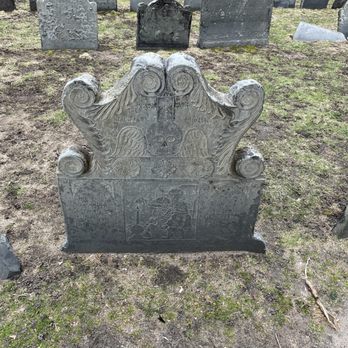

Another stop on the Freedom Trail, King's Chapel Burying Group has a number of slightly less famous people but are still important patriots and Massachusetts leaders including Governors and Lieutenant Governors. The great Oliver Wendell is laid to rest here as is Mary ChilTon who was a passenger on the Mayflower. Clear paths exist and it is easy to stay off the grass. A litter pickup is needed here but I did grab a couple of bits and put them in the bin near the exit. Be respectful! read more




3 years ago

King's Chapel Burying Grounds is a small cemetery next to King's Chapel, both locations on the Freedom Trail. The King's Chapel Burying Grounds is worth a stop if you're hitting all of the spots along the Trail, but it wasn't as meaningful or as interesting to me as the buildings you can tour (including the King's Chapel itself). Still worth a quick stop. read more


13 years ago
I love visiting historic cemeteries. The gravestones are like artwork and the stories they tell can be both fascinating and mysterious. The King's Chapel Burying Grounds is the oldest cemetery in Boston dating back to 1630 which is mind-boggling to me. Although so many things in Massachusetts date back at least that far the thought of things happening on the very ground on which I am standing, but back in the 1600s gives me goose bumps. The cemetery is on a small plot of land adjacent to King's Chapel (which is another historic must-see). The gates leading into the cemetery are open most days and one is free to wander in and look about. It can be hard to see some of the stones clearly because one must keep on the cement path and not wander onto the grass due to the fragility of the graves. The etchings and designs that go into many of the gravestones is incredible. They give you an idea what was "in style" depending on the era. The skull with wings is one of my favorites. What is written on the stone about the deceased can be basic and factual to the more poetic and mysterious. There are a number of notable people buried here including John Winthrop who was a Puritan and the first governor of Massachusetts. There is a woman buried here by the name of Elizabeth Pain. She is said to have been the inspiration for Hester Prynne in Nathaniel Hawthorne's book The Scarlet Letter. Elizabeth Pain (1652-1704) had the misfortune (given the era) of having a child out of wedlock. The child died and she was brought to trial for what was claimed to be the child's murder. She was acquitted of this charge but was found guilty of negligence. Her sentence was a fine and a flogging....flogging and whipping being big back in the day. It was said at her trial that she "did not have the feare (sic)of God before hir (sic) eyes and was led by the Instigation of the devil." Who knows what really happened but something tells me this woman was marked as up to no good the moment she gave birth to that child sans husband. Elizabeth ultimately married but died a marked woman at 52. There are lots of interesting tales like this to be found by researching some of the notables buried here. I gave the cemetery only 3 stars because I am concerned about how such an historic place as this can be so freely accessed by the public which causes me worry about the care of the extremely fragile gravestones. They have lasted this long I know but I think when the cemetery is open I believe there should always be some kind of "keeper" minding things. Its location is on super busy Tremont Street. With hordes of pedestrians and heavy street traffic only a few yards away, this is not a good recipe for gravestone preservation. Nonetheless, this site is well worth a visit. For the best experience, find a cemetery tour so you can learn as much as you possible while you are there. read more

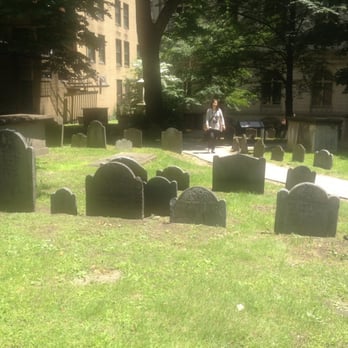


Located right next the King's Chapel, this historical cemetery is #6 landmark of the Freedom Trial. It is one of the oldest cemetery in Boston, established in1630. It's a relatively smaller cemetery than compared to the Granary Burying Ground and you can walk through it all relatively quickly. Off to the right hand side of the cemetery is a huge pit where it drops all the way to the bottom of the cemetery that's been blocked off by a metal fence.. which left me wondering what it was used for and why it's there. There cemetery itself is very peaceful and definitely not as much foot traffic as Granary. The only thing to be careful is because the gravestone markers are very close to the walking grounds, to NOT rub up against them to wear them down or knock them over to break them. Option to walk through or not since you can pretty much see it all from the outside without having to really step in. read more





12 years ago


11 years ago

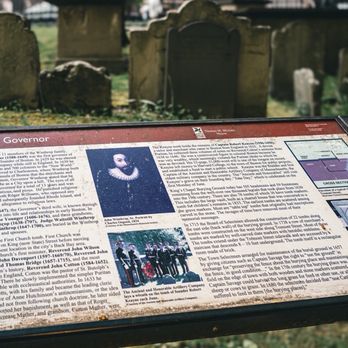
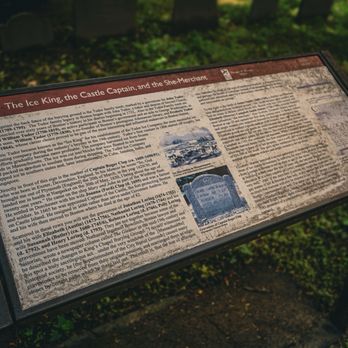
As a Canadian tourist, I decided to make the most of my limited trip by taking a walk on the Freedom Trail, which led me to this cemetery. The educational markers were detailed and it was nice that they'd let an area like this be open to the public. My only complaint is that upon entering the cemetery, I wish that there was a marker indicating which direction to go. The educational markers are definitely in a certain order, and I went left instead of going right. The self-guided tour makes more sense if you read them in the correct order. Cool place though, and if you have even a passing interest in American history, you should try to check it out. read more


9 years ago
More info about King's Chapel Burying Grounds
King's Chapel Burying Grounds Reviews in Other Languages
Ask the Community - King's Chapel Burying Grounds
Review Highlights - King's Chapel Burying Grounds

















Why does Yelp recommend reviews?
2 reviews that are not currently recommended
The reviews below are not factored into the business's overall star rating.

7 years ago


