I can sum up all the stuff I'm about to write in one quick sentence: I've been training with Master Kevin for seven and a half years now, and can easily see myself here for as long another seven and a half.
The Hapkido program is an extremely orthodox art with a direct lineage to the founder of Hapkido. It focuses entirely on ending a confrontation as fast as possible and in a way where the assailant will not be giving chase. The idea behind the techniques is to generate power through the use of body mechanics and off-balances with a minimal emphasis on pain compliance (as pain does not always factor in when in a heated situation) and then finish with a quick and devastating end.
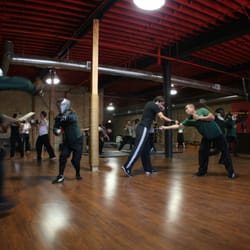
Hapkido does not have forms, but rather, the techniques are trained in a live-action setting with a partner. And there is _no_ sparring. We train to destroy bad people who attack us out in the world, not garner points. Sparring would be a dismally short affair; with one person winning the match, and the other ending their martial career. Doesn't really seem worth it.
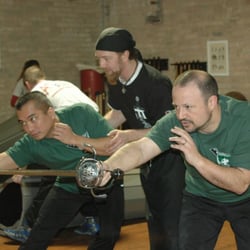
The Kuhapdo program is an equally orthodox art, but includes, in addition to the Korean stylings, a strong Japanese influence. We teach both the Korean and Japanese (Chung Suk Kuhapdo and Muso Jikiden Eisen Ryu, Yamauchi Ha, respectively) simultaneously, giving the student the opportunity to see and train in both; as they are rather different in nature. The Korean forms tend to be long, combat oriented, with numerous cuts, redraws, and maneuvering. Whereas the Japanese forms tend towards a very short (one to two cuts on average), but highly meditative and exacting. They are both highly enamored with the ideas of chivalry (or Bushido, if you will) and to accept the seriousness and gravity of the responsiblity and power of wielding a sword. It is said that where Hapkido cultivates the body, Kuhapdo cultivates the spirit.
The Kuhapdo program differs in the sense that it requires of its students much self-discipline rather than self-actualization. The classes tend to be more of a forum of self training and questions. You can only be shown the techniques so many times before its just up to you to do them on your own without instruction. The rewards one attains for trainging in sword for many years are great, but, congruently, the requirements of self are equally high.
The sword forms provide a great contrast to the Hapkido training. If Hapkido could be described as 'doing what works for you right now' Kuhapdo could be described as 'doing what centuries of tradition tell you.' Hapkido is very free-flowing and 'as the situation demands,' and Kuhapdo is very driven by the discipline to do things exactly the same every time. Both arts augment each other tremendously, as high end Kuhapdo and Hapkido techniques are the same thing. One just happens to be holding a sword; the motions and theory are the exact same.
Its been said in these reviews already, but it bears repeating: this is a school that emphasizes _learning_ technique. We do not glaze over the techniques a few times for rote learning, but rather try to engage students to think not just "how does this work?" but rather "why does this work?" Once the second question is answered by the student, the possibilities are endless. There is a written syllabus, and it is only a few hundred techniques; but it should be thought of more as a foundation than a all-encompassing, end-all list of things there are to learn. Once the student has advanced enough, it is just a simple matter of transforming the written techniques into more scenario specific adaptations.
Again, it cant be stressed enough, the school is about learning techniques. If you're looking for someone to scream at you while standing in a line doing punch-kick-combos, there are plenty of fine establishments to accommodate that, but that is not what we're about. If you're looking for good, intensive, one-on-one training in a friendly atmosphere, you will find exactly that at our school.
Please feel free to call or visit the website for more information. Or better yet, stop by the school for a talk with Master Kevin. He is there for just about every class offered, and is more than happy to talk to anyone about what we offer. read more