Ever wonder what was going on beyond the walls of the Rotunda? Now you can experience it for…read moreyourself!
Presented by Cincinnati's finest, the docents of Heritage Programs, this walking tour takes guests to see the non-public areas of Union Terminal and Cincinnati Museum Center. I'm a big fan of the Museum, but this tour blows the exhibits out of the water. It's fascinating!
Here's what we saw:
- Behind-the-scenes of the OMNIMAX theatre, including the room behind the big screen. (The screen is actually a dome made up of many, many tiny holes so that the sound can project into the audience. The sound system is behind the giant screen.) We also saw the archive reels of film that each weighed 200 lbs. and were 4 feet in diameter. Titles included everything from rafting at the Grand Canyon to a Rolling Stones concert.
We were then led into the projection room, which is the big glass room outside the theatre entrance. From outside, you can see the reels of film being spooled through the projector. They spin super fast, and could probably cut off an arm. The projector also travels up an incline to show the film in the theatre. Ever wonder why the OMNIMAX tickets cost extra? Well, a replacement lightbulb for the projector costs $6,000 every three months. And that's just for the bulb! The OMNIMAX projector itsself cost $1.2 million and each film is $25,000! (Hey, there's over three miles of film on one spool!)
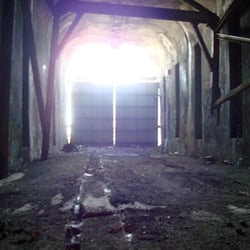
- We went outside to the Union Terminal train yard and stood along side the tracks. The area is mainly used for commercial transportation now. We saw where the former concourses for Union Terminal were demolished during the renovation in 1990. There was also a secret tunnel from Union Terminal to the Post Office located on Dalton Street. In the tunnel, there were old 1910s wagons and motor carts from the 1950s that are still in use today.
- We met the Facilities Manager, who took us on a tour of the mechanics room. We saw a huge color-coded scheme of four boilers and six coolers, and learned how hot and cold air is engineered from these systems. Surprisingly, heating and air conditioning is more complex than you'd think! The Facilities Manager did a great job of talking in layman's terms for the group and giving us interesting tidbits about the museum. Did you know the Museum's monthly electric bill is $50,000 and the gas bill is $30,000? In comparison, CMC's $13.00 admission is a bargain!
- We met the preservationist at the Cincinnati Historical Society Library, saw his workshop, and learned how to properly care for and preserve photographs and books. Then he took us into the archive stacks (the room where all the artifacts are stored) and showed us pictures and maps from Cincinnati in 1778, told about the Civil War, Ruth Lyons, and many other tales. Tucked away downstairs, the Library itself is gorgeous, quiet, very well organized and free to the public. The collections contain more than 40,000 books, 50,000 pamphlets, 60,000 architectural drawings and over 1 million images.
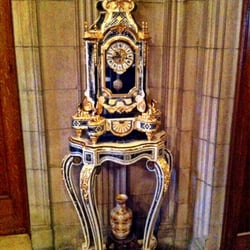
- We climbed several flights of stairs to the "high steel" of the Rotunda. We walked across the glass floor in the Rotunda window to view the mechanics of the Union Terminal clock (the one on the front facade of CMC.) The clock contains all of its original gears from the 1930's and is breathtaking to watch in action.
- We climbed even higher into the "high steel" to the very tip-top of the Rotunda arch. We saw all of the support beams weaving the structure, and the handmade iron rivets. We also saw a wooden peg with a 6-inch diameter that was the main support for all of these beams in the Rotunda. Imagine, that entire structure dependent on a 6-inch peg! Hey, it's held up for 80 years and counting!
The Behind-The-Scenes tour is four hours long and costs $30. Normally, I get restless after four hours straight, but I was immersed with all of the sights and stories! Heritage Programs docents are amazing at telling stories. Guests are learning about history but are having too much fun to notice. Our group was smiling, laughing, and joking with our docent throughout. Plus after four hours of walking, you get a great workout!
The tour can be appreciated by anyone age 10 and older. I saw everyone from young tourists, to retired couples, to grandpa and grandkids enjoying themselves.
I highly recommend taking the Behind-The-Scenes of Union Terminal Tour as your midday Saturday activity. It's a fantastic way to start out your weekend, and you'll have a whole new appreciation for Cincinnati Museum Center too!