Cancel
Open app
Search
Sign Up
Log In
Nearby
Bookmarks
Start a Project
Add a Business on Yelp
Add Review
Call
Directions
Start your review...
Get app
13 years ago
We attended here when we lived for a year in Germany. The people welcomed us warmly and we felt very much at home.
Hofbrunnstr. 85
81477 Munich
Germany
Solln
089 794882
Call Now
Hours
What time does Internationale Gemeinde open?
What time does Internationale Gemeinde close?
Get access to customer & competitor insights.
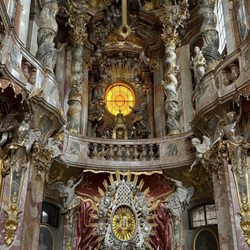
Asamkirche St. Johann Nepomuk is absolutely beautiful. When we visited, the gate was closed, so we…read morecouldn't sit inside, but we could still stand and look around. We were also able to take some great pictures. Definitely worth seeing!
Tiny ornate church hidden in plain site…read more Built by two brothers it is a stunning gorgeous church. Best of all it is a quick visit so it won't bite into your Hofbrauhaus drinking time....Wink Wink.
Asamkirche
See all
Huge fan of Churches...and this one is pretty darn awesome…read more Beautiful ornate large place of worship. Gets busy so be patient. Cool to visit the tower and the views of the plaza below. Recommend if you are visiting Munich.
St. Peter's Church is Munich's oldest parish church, dating back to the 12th century. The church's…read moreinterior features stunning Baroque frescoes and woodwork, but the highlight is its bell tower, which offers panoramic views of Munich and, on clear days, the surrounding Alps.
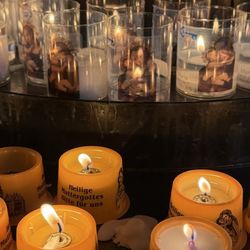
Light a candle. Say a prayer.
Seitenaltare
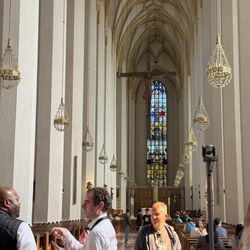
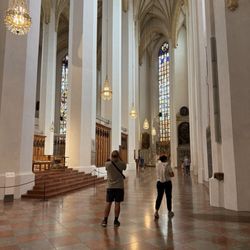
Frauenkirche is a 15th-century cathedral celebrated for its stunning Gothic architecture. The…read morecathedral is best known for its distinctive twin onion-domed towers, which dominate the Munich skyline. We purchased our tickets at the information booth, climbed some spiral steps and got into an elevator to go to the top of the dome. The 360 degree views of the city were expansive. Under each window was information and highlights about what we were viewing. Inside the Frauenkirche is a wide central hall with a high vaulted ceiling & stunning stained-glass windows. We explored the interior & the unique "Devil's Footprint" on the floor, a famous local legend.
Such a historical landmark that is worth visiting. The high ceilings are amazing to view…read more Take a few minutes to soak in the atmosphere and the incredible architecture.
I had the privilege of visiting Planett in 1967, I was born in Planegg in 1951 and traveled with my…read moreMother and sister to the United States in 1952. My father was in the Army , but learned on the visit in 1967 that my Mother and Father were Married in this church. My Grandfather Paul Lang took me to Planegg on a day trip. I remember a tree an oak tree growing within the confines of the church. It would be nice to know more about this church.
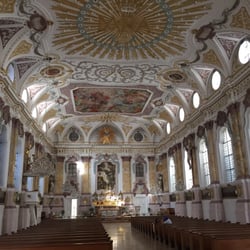
St. Michael's Church (St. Michaelskirche) is a must stop for any visitor to central Munich. We…read morevisited on Dec. 23rd as we were touring the Christmasmarkets in central Munich. When you've been walking and walking, this church is a very convenient place for rest, peace and contemplation. The church is immense. Its barrel-vaulted ceiling is the largest outside of St. Peter's in Rome. The church was built by the Jesuits as part of the Counter-Reformation. A painting of St. Ignatius Loyola, founder of the Jesuits, is on the right. I walked down to the crypt, but didn't go for the 2 euros crypt view. The church itself is breath-taking. The church is right next to Marienplatz on Kaufingerstrasse. The iconic Rathaus (Globckenspiel) etc. are nearby. It would be nice to catch a mass here.
Saint Michael's is a beautiful white church in the old section of Munich surrounded by chain stores…read moreand hordes of people. St. Michael's is the 1st & largest Renaissance building north of the Alps. For more than two centuries this magnificent church influenced church building in southern Germany. The streets and alleys of Munich were narrow, as in all medieval cities. There was not enough space for admiring grand façades. St. Michael's was the first church in the city that was given such a monumental front wall, a fascade. The new building was not oriented to the east like older churches, but it was fitted into existing architectural structures of the city.
High Altar
One of many Side Altars
The Marion Congregation was founded in the early 1900's and Fr Rupert Mayer the founder was well…read moreknown for his open stand against the nazi regime. He spoke out against anti-Catholic baiting campaigns and fought against Nazi church policy. Fr. Mayer spoke from the pulpit of St. Michael's in downtown Munich and because he was a powerful influence in the city, the Nazis could not tolerate such a force to oppose them. On 16 May 1937, the Gestapo ordered Fr. Mayer to stop speaking in public which he obeyed, but he continued to preach in church. He ended up in jail on numerous occasions as a result of his stand. It is an ordinary looking building from the outside but when you step in its beautiful. Nice ornate walls and ceiling and very peaceful. It was my first visit here and I was delighted we stepped in for a peek.
Looks like a regular house from the outside, but inside is a fantastic double church. Upstairs, a…read moreBaroque beauty which usually has a mix of faithful praying and tourists in awe wandering the pews. And downstairs, where the "Apostle of Munich" and Anti-Nazi Preacher, Blessed Rupert Mayer lies, a vaulted, cavernous "lower" church. Thousands of people visit his grave and pray in the chapel every year. A sight to behold that blends history, architecture and contemporary life in Munich in a unique way.
Brands by name
Articles by date
A gorgeous Kloster steeped in history. If you happen to be in the area please stop by and admire…read morethe gorgeous interior of the place. The surrounding are also nice and it is a very peaceful area.
This charming little church is tucked away close to the tram route along Müllerstrasse, not far…read morefrom the Sendlinger Tor. The Church, dedicated to St. Stephen, is the former cemetery church of the old South Cemetery of Munich. The church is a branch church of the Mother Parish of St. Peter. It was built from 1674 to 1677 by Georg Zwerger, to replace the previous wooden Salvatorkirchlein, erected in 1576. This was demolished in 1638, in the Thirty Years' War, to deny the invading Swedish force a foothold outside the city defences. The church is in a restrained baroque style: the most notable exterior feature is the small onion dome, which houses two small bronze bells.