Cancel

    Open app

    Search

    Hampton Historical Marker

    2.0 (1 review)

    Hampton Historical Marker Photos

    More like Hampton Historical Marker

    Recommended Reviews - Hampton Historical Marker

    Your trust is our priority, so businesses can't pay to alter or remove their reviews. Learn more about reviews.
    Yelp app icon
    Browse more easily on the app
    Review Feed Illustration

    8 years ago

    Helpful 5
    Thanks 0
    Love this 1
    Oh no 0

    Verify this business for free

    Get access to customer & competitor insights.

    Verify this business

    General Putnam Monument

    General Putnam Monument

    5.0(1 review)
    5.4 mi

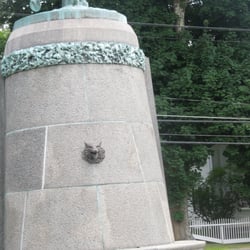
    In 1718, 22-year old Israel Putnam moved from MA to CT to be a farmer. He ended up in the military…read moreand served with distinction during the French and Indian War, rising to the rank of captain, and then major. But his greatest glory lay ahead. When British bullets killed Massachusetts colonists at Lexington and Concord, legend has it that Putnam became so enraged that he abandoned his plow in the field, jumped on his horse, and rode 100 miles to Boston to join the Revolution. He rose to the rank of Major General and led his troops in the Battle of Bunker Hill (where legend also has it that he uttered the immortal words "Don't fire until you see the whites of their eyes") and the Battle of Long Island. This fabulous monument has an 8 foot tall bronze statue of General Israel Putnam on his horse. The statue is mounted on s 20-foot tall granite base. It was dedicated on June 14, 1888 and it marks Putnam's grave. Check out the detail of Putnam's Revolutionary War uniform. You'll see boots, a tri-cornered hat, knee britches, and a coat with fancy epaulets. Of course he has a sword dangling from his belt. One interesting detail I saw on the base was a wolf head. Supposedly, as a boy Putnam crawled into a wolf cave and killed a wolf! Plaques on the base are inscribed as follows: Sacred be this Monument to the memory of ISRAEL PUTNAM, Esq. Senior Major General in the Armies of the United States of America, who was born in Salem, in the Province of Massachusetts on the 7th day of January, A.S. 1718 and died on the 29th of May A.D. 1790 Passenger, if thou art a soldier, drop a tear over the dust of a Hero, who ever attentive to the lives and happiness of his men dared to lead where any dared to follow. If a Patriot, remember the distinguished and gallant services rendered thy country by the Patriot who sleeps beneath this marble; if thou art honest, generous and worthy, render a cheerful tribute of respect to a man whose generosity was singular, whose honesty was proverbial; who raised himself to universal esteem and offices of eminent distinction by personal worth and a useful life.

    Photos
    General Putnam Monument
    General Putnam Monument
    General Putnam Monument

    See all

    Ashford Historical Marker - "heh heh I spelled trash"

    Ashford Historical Marker

    1.0(1 review)
    7.4 mi

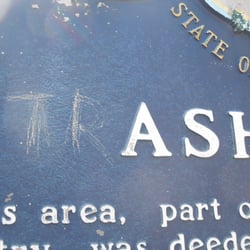
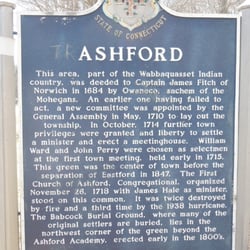
    As a lover of history, there are some interesting facts on this marker about Ashford's ties to the…read moreRevolutionary War and the Civil War. But what distinguishes this marker from so many of the other CT Historical Commission markers I've seen is its poor condition and evidence of vandalism. Some genius or PH.D. candidate decided it would benefit society to scratch the letters "T" and "R" in front of the name "Ashford". "Hey guys-- look what I spelled!!" If that wasn't bad enough- check out the deplorable condition of the marker's support posts, the crumbling concrete is falling out of the posts and the rusty steel rebar is exposed. It looks disgusting. This is a two-sided marker from the CT Historical Commission in the familiar white lettering on a blue background. It has different inscriptions on each side. It's located on a small green across from the Ashford Academy. The sign itself is in good condition, but those support posts don't bode very well for the future of the marker. It was dedicated in 1980 and the full inscription reads: SIDE 1: This area, part of the Wabbaquasset Indian country, was deeded to Captain James Fitch of Norwich in 1684 by Owaneco, sachem of the Mohegans. An earlier one, having failed to act, a new committee was formed by the General Assembly in May, 1710 to lay out the township. In October, 1714 further town privileges were granted and liberty to settle a minister and erect a meetinghouse. William Ward and John Perry were chosen as selectmen at the first town meeting, held early in 1715. The green was the center of town before the separation of Eastford in 1847. The First of Ashford, Congregational, organized November 26, 1718 with James Hale as minister, stood on this common. It was twice destroyed by fire and a third time by the 1938 hurricane. The Babcock Burial Ground, where many of the original settlers are buried, lies in the northwest corner of the green beyond the Ashford Academy, erected early in the 1800's. SIDE 2: While the school was being built in 1825, the Academy Association added an upper story for advanced students. Among the important persons who received their early education here was General Edward Whitaker, awarded the Congressional Medal of Honor for gallantry during the Civil War. Under a flag of truce he received assurance that General Lee would surrender unconditionally at Appomattox in 1865. Ashford was the birthplace of Colonel Thomas Knowlton, commander of the Knowlton Rangers in the Revolutionary War. He marched to Lexington with seventy-eight of Ashford's men. Only eight Connecticut towns furnished more. Knowlton, as second in command of Connecticut forces, defended the rail fence at Bunker Hill. He was killed in the Battle of Harlem Heights. Early in the 19th century Ashford had a number of grain and saw mills, several tanneries, a cotton mill, and a glass factory. The railroads, however, bypassed this area, and Ashford now is agricultural in economy and a residence for many commuters to other towns.

    Photos
    Ashford Historical Marker
    Ashford Historical Marker
    Ashford Historical Marker

    See all

    Israel Putnam Marker

    Israel Putnam Marker

    4.0(1 review)
    5.5 mi

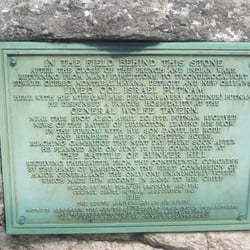
    His exploits remind me of a comic book super hero…read more In childhood he crawled into a wolf den to kill a wolf. He was minutes away from being burned at the stake by Indians. He was farming at his CT home when he heard of the killings at Lexington and Concord. So what did he do? He abandoned his plow, jumped on his horse, and rode 100 miles in 18 hours to join the revolution. This monument in the form of boulder and bronze plaque commemorates the patriotic life of General Israel Putnam and is located in the center of Brooklyn, CT. It was dedicated on the 200th anniversary of his birth, close to where he operated a tavern with his wife. the plaque's inscription tells his glorious story, his rise to command colonial forces at the Battle of Bunker Hill, and his subsequent promotion to become George Washington's second in command. The full inscription reads: In the field behind this stone after the close of the French and Indian wars, returning from many expeditions to ticonderoga, fort edward, quebec, montreal, havana, detroit, and new orleans lived col. israel putnam here, with his wife (2nd) mrs. deborah (avery gardiner) putnam he dispensed a famous hospitality at the general wolfe tavern near this spot, also, april 20, 1775, putnam received news of the battle of lexington. leaving his plow in the furrow with his son daniel, he rode one hundred miles in eighteen hours, reaching cambridge the next day. there soon after he planned and on june 17, 1775, commanded at the battle of bunker hill receiving thereafter from the continental congress by the hand of washington the first commission of major general (and the only one unanimously voted) which made him second in rank to his chief ----- placed by the town of brooklyn and the colonel daniel putnam association inc. 1918 the 200th anniversary of his birth ----- patriot, remember the heritages received from your forefathers and predecessors, protect and perpetuate them for future generations of your countrymen. The plaque has become difficult to read because of the copper patina over time. Maybe a restoration should be in order for the 300th anniversary of his birth in 2018?

    Photos
    Israel Putnam Marker
    Israel Putnam Marker

    See all

    Prudence Crandall Museum

    Prudence Crandall Museum

    3.9(7 reviews)
    7.0 mi

    We visited in July 2019 and were told they will be undergoing a 1 year restoration project…read morebeginning in the Fall. So don't wait! Go before the end of August 2019 or you will have to wait until summer 2021 to visit again! Ok, now that that is out of the way: We drive past this museum about once a month and finally made the stop in. I am so glad we did. It's so interesting. I had no idea who Prudence Crandall was. A trained teacher, whose family lived in the area, she was asked to open a school for the local affluent girls, which she was happy to do. Shortly after opening, a black woman asked her to attend the school as well and after some personal and religious deliberation Prudence said yes. The extent the community went through to stop black girls from attending her school is astounding! Even going so far as to try to burn down the house. Besides the history of the school you will learn about those who supported her, what some of her students went on to accomplish and where Prudence Crandall ended up in her senior years. There is a video presentation at the end of the tour which is quite well produced. On the second floor there is information on how schools have changed through the years in CT and some of the effort by Americans of African descent to acquire an education and the liberty they were promised at emancipation. If you go before they close for the season this year, you can complete a questionnaire after your tour (take the guided tour, so worth it!) and let them know what you liked most and what you'd like to see in the new collection when they reopen after restoration. They give you a gift for completing the survey. Also, items in the gift shop are presently half off before the restoration, so plan to pick up some personal and gift items. Beginning Sept 1, the museum director has two months to move all the collections out of the building. While structural work is completed beginning in November, she will have the task of developing new collection displays. A mighty task indeed. I look forward to going back in 2021 to see the new displays. I hope you make it in this year before the restoration begins.

    This museum is an amazing CT story (one of the most unique in the state), but the tour was a…read moreterrible experience. I asked some contextual questions relating to the local social and cultural history, and the docent not only didn't answer them, but was dismissive that I would be curious to know their answers. I've been to many, many museums, and never experienced anything close to this coldness before. Everything the docent provided was already on the informational placards in the rooms. I wish I just read off of those instead (and I so much prefer personal interaction, but in this case, the reading of the placards would have been infinitely more preferable).

    Photos
    Prudence Crandall Museum - Information about the museum by parking area

    Information about the museum by parking area

    Prudence Crandall Museum - Joan DiMartino, Museum Curator & Site Superintendent gave us a 50 minute guided tour of the Prudence Crandall home and boarding school.

    Joan DiMartino, Museum Curator & Site Superintendent gave us a 50 minute guided tour of the Prudence Crandall home and boarding school.

    Prudence Crandall Museum

    See all

    Pomfret Historical Marker

    Pomfret Historical Marker

    4.0(1 review)
    6.3 mi

    Pomfret Fact # 1 - James A. McNeill Whistler lived here. You may not recognize his name, but you…read moremost definitely know his mother! Pomfret Fact # 2 - Pomfret's origin is traced to an Indian chief that sold over 15,000 acres to 12 businessmen. I wonder what he got for that? Pomfret Fact # 3 - "Pomfret" is a pretty cool name, don't you think? The marker is located on the Mashamoquet Road (Rt. 44) in front of Town Hall. It's a two-sided marker from the CT Historical Commission, with the familiar white lettering on a blue background. It has the same inscription on both sides. The marker dates to 1979 and is in very good condition. The full inscription reads: The Town began as the "Mashamoquet Purchase," 15,100 acres brought by twelve proprietors in 1686 from James Fitch of Norwich, who had acquired it from the Indian sachem, Owaneco. In 1713 the Town was incorporated and named for Pontefract in Yorkshire, England. On Old Windham Road stands the Abington Meeting House (1751), the oldest Connecticut church in continuous use, The Pomfret Public Library is the successor to the oldest such society in eastern Connecticut and the Social Library of Abington (1813) is the oldest active library formed by women in America. The Pomfret Manufacturing Company (1806) located along the Quinebaug River in a section that is now part of Putnam, was the first large cotton textile mill in the State. Among one-time residents of Pomfret are Israel Putnam, a major general in the Revolutionary War; James A. McNeill Whistler, artist; and Louise Chandler Moutlon and Robert Hillyer, poets. Erected 1979 by the Town of Pomfret, the Pomfret Historical Society, and the Connecticut Historical Commission.

    Photos
    Pomfret Historical Marker
    Pomfret Historical Marker
    Pomfret Historical Marker

    See all

    Hampton Historical Marker - landmarks - Updated September 2026

    Loading...
    Loading...
    Loading...