Cancel

Open app

Search

Goshen Historical Marker

3.3 (3 reviews)

Goshen Historical Marker Photos
More like Goshen Historical Marker

Recommended Reviews - Goshen Historical Marker

Your trust is our priority, so businesses can't pay to alter or remove their reviews. Learn more about reviews.
Yelp app icon
Browse more easily on the app
Review Feed Illustration

12 years ago

Helpful 9
Thanks 0
Love this 9
Oh no 0

6 years ago

Helpful 5
Thanks 0
Love this 8
Oh no 0

8 years ago

Helpful 4
Thanks 0
Love this 3
Oh no 0

Verify this business for free

Get access to customer & competitor insights.

Verify this business

Cornwall Historical Marker

Cornwall Historical Marker

4.0(2 reviews)
5.3 mi

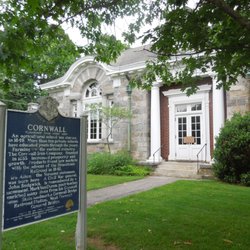
So my dog and I decided to take a nice socially distanced walk in Cornwall, and see this lovely…read moresign while there. Right now, being between two blizzards, it's really hard to get to the back of the sign, but the front is readily accessible from the cleared sidewalk. Interestingly, the Town Hall still has Christmas decoration up in the windows. You can literally hear cows mooing in the distance, that's how peaceful and country this sign is.

This is the 140th historical marker I photographed and wrote about. But it's the very first time…read morethat what I read and what I'm writing includes the word "Obookiah". That's a "who?" and not a "what?", because the O Man was a Hawaiian student at Cornwall's Foreign Mission School two hundred years ago. That's one of the historical nuggets you'll read about on this marker. It's a two-sided marker from the CT Historical Commission with the familiar white lettering on a blue background. Its located on the front lawn at Town Hall on Pine Street. The sign dates to 1975, and its condition shows some signs of wear and tear -staining, fading, and peeling. Obookiah would be sad to see that. The full inscription reads: This area was once part of the Western Lands ordered surveyed by the Legislature in 1731. Yale Lands were surveyed and three hundred acres were set aside for income for Yale College in 1732. At an auction in Fairfield in 1738 the town was sold in fifty shares, named Cornwall, and incorporated in 1740. After the church "gathered" in 1740 schools began to open. In time there were seventeen school districts. The Foreign Mission School in 1817 numbered among the students an Hawaiian, Obookiah, who links Cornwall eternally to Hawaii. An agricultural school was started in 1849. More than ten private schools have educated youth through the years. Farming was the earliest industry. The Cornwall Iron Company, founded in 1833, increased prosperity and growth. Products found new markets with the advent of the Housatonic Railroad in 1842. Ira Allen, the Vermont statesman, was born here. A Civil War general, John Sedgwick, is remembered by a monument. Mark Van Doren, poet-teacher, enriched many lives from his Cornwall home. State Landmarks: Cornwall Bridge Railroad Station, West Cornwall Covered Bridge. Erected by the Town of Cornwall The American Revolution Bicentennial Committee of Cornwall and the Connecticut Historical Commission 1975

Photos
Cornwall Historical Marker

See all

Winchester Center Historical Marker

Winchester Center Historical Marker

4.0(1 review)
6.5 mi

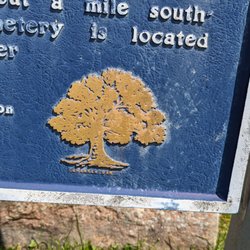
This is one of those state signs in every town, village, and "used to have people living here"…read moreplace in Connecticut. Winchester Center is closest to the la as t of those categories. It's very pretty, and people do live there, but if you need a bottle of milk you're driving at least 20 minutes. Anyway, it does warrant itself a sign from the state, titled "Winchester Center, 'The Old Society'" and reads: The first ecclesiastical society of Winchester was incorporated by the central assembly of the colony of Connecticut at its May session, 1768. The following year, a small, low, steeple-roofed building was erected for a meeting house about 7/10 of a mile south of the present Winchester Center Green;a rough granite post marks the site. The first census of the colony, taken in 1756, has 24 as the population of the entire town of Winchester. The next census, taken in 1774, shows 327 whites, 12 blacks. The Congregational Church was formed October 30, 1771, with 14 members. Only five years after the erection of the first house of worship, a committee was sent from the county court at Litchfield "to pitch the stakes" for a meeting house at the 'center'. On October 11, 1785, Dr. Josiah Everett deeded to the society for the sum of 1 £, 16s and 3d "lawful money" for a certain piece of land containing 56 1/2 rods "to build a meeting house on for divine worship, and for a suitable green around the same." In 1786 a new edifice was erected on this Green. The whipping post and stocks, those indispensable pillars of New England law and order, stood nearby on the green. The post served also for the posting of public notices. The third church, Greek revival with a Doric portico and facade of matched boards, was erected in 1841. Just north of the green, land was provided by 'Squire' Issac Bronson; with the stipulation that no building was ever again to be erected on the green. Our father's built shelter for their families and stock, then the church of God, then the school house. The early records of the town do not contain any accounts of building the first public schoolhouse. However, there is no doubt such buildings were erected. The 'chapel', across Winchester road from the church, began its existence as 'the Academy' finances by a group of investors "who purchased rights payable in higher education for their children." The Winchester institute (which stood some 700 north of the center green) a commodious seminary building opened in 1858 as a boarding and day school. It was the seat of learning for such great men as Dr. Fredrick S. Dennis and Dr. William H Welch (the latter discovered "ether"); after use as a seminary it became The Hill View Inn (destroyed by fire in 1929). The center had at one time two country stores, the Bronson Bros at the north side of the Green and S&L Hurlbut on Newfield Road. The latter building was acquired in 1895 by the Winchester Grange. Fire destroyed it in 1951 and the present grange hall was its replacement. The Winchester Center cemetery, acquired Mar. 16 1773 and the Hurlbut family cemetery are on South road, about a mile south east. The Danbury Courier cemetery is on Benedict road part of the original Winchester Center Settlement. You can park across from the sign near the Grange hall, and dash across and see it. The sign itself is on a small triangle of land, and you'll undoubtedly be in the way of cars if you try to park there.

Photos
Winchester Center Historical Marker

See all

Goshen Historical Marker - landmarks - Updated May 2026

Loading...
Loading...
Loading...