Golden Spike Trail Photos


You might also consider


More like Golden Spike Trail
Recommended Reviews - Golden Spike Trail
Start your review...



6 months ago
One of my favorites single track trails! A decent climb if you're heading west. Great for dogs! read more

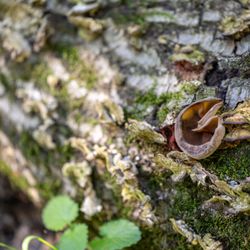
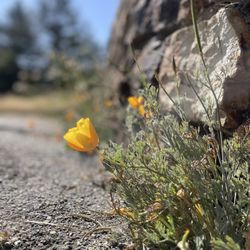
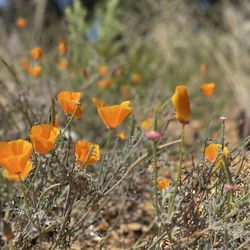
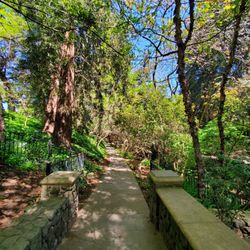
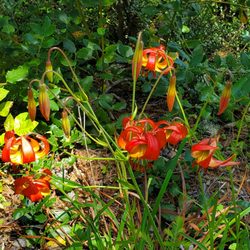
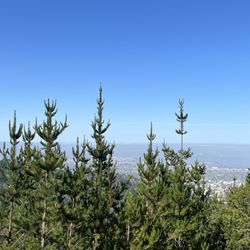
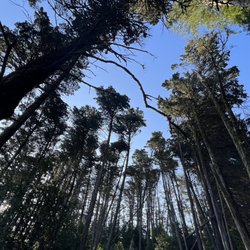
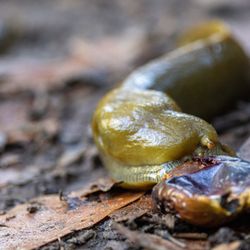
GOLDEN SPIKE TRAIL. Before taking this hike, I sometimes park in the lot adjacent to the Trudeau Center. Trail maps and an official trailhead to Dunn Trail are found at the east edge of this parking log. The route along Dunn Trail brings you through a prairie that contains dozens of serpentine boulders and, at the far eastern side of this prairie is the trailhead to Golden Spike Trail. If the lot is full, you can park on Skyline by the curb near Trudeau Center. MY PHOTOGRAPHS. One of my pictures was taken in serpentine prairie at the start of my hike. The others were taken at various locations along Golden Spike Trail: (1) Tree with many wiggly moss-coated branches. (2) Octopus tree (meaning a tree with many branches that form arches that bend to the right and bend to the left). (3) Another octopus tree. (4) Close-up view of graffiti girl. (5) Mountain goat standing on stone monument to boys who built Golden Spike Trail. (6) Mountain goat standing on top of boulder in serpentine prairie. I bought the mountain goat from gift shop at Glacier National Park. This was my first photo of the day. HISTORIC MARKER ON GOLDEN SPIKE TRAIL. Once you pass the horse stables, you will encounter on Golden Spike Trail a historic marker with a metal plaque that describes the boys who built this trail. Further along, on this lengthy and fairly level stretch of hiking, you will encounter a branch in the trail, which takes the form of TOYON TRAIL (Toyon takes you up uphill to West Ridge Trail). Continuing along Golden Spike Trail, the trees thin out and scraggly little brushes dominate the groundcover, and you will encounter yet another branch in the trail. This branch takes the form of a tiny trail that is only 20 feet long, and it connects directly with WEST RIDGE TRAIL. I took this tiny connecting trail, and then made the return hike all the way up the steep West Ridge Trail, then down Graham Trail, and then along the level Dunn Trail back to the parking lot at Trudeau Center. BOOK BY AMELIA SUE MARSHALL. Amelia Sue Marshall is the author of EAST BAY HILLS. This book describes the origin of many of the trails in Redwood Regional Park, including Golden Spike Trail. We learn that a big storm in 1962 caused flooding and massive piles of mud. We learn that, "park managers decided to build a new trail, parallel to . . . Redwood Road . . . inmate crews from Alameda Country juvenile hall provided labor . . . a monument with a brass plaque stands at the spot where two crews of boys met in 1965" to build Golden Spike Trail. SERPENTINE. As stated above, the western terminus of Golden Spike Trail is located in a prairie that contains serpentine boulders. Serpentine has the chemical formula 3 magnesium atoms, 2 silicon atoms, 5 oxygen atoms, and 4 hydroxy groups. Serpentine is the name of a group of minerals, including chrysotile (a type of asbestos), antigorite (the most common type of serpentine), and lizardite (has scaly surface) Serpentine is colored green and it has a slippery feel. Oakland hills contain a series of rocky outcroppings called, ophiolite. The ophilite rocks are made of either serpentine, rhyolite, or gabbro. See, pages 314-316 of Doris Sloan and Donald Wells (2006) The Hayward Fault. Geological Society of America Field Guide 7. See also, oaklandgeology dot com, for its description of the serpentine in the Oakland hills. See also, page 38 of, National Geographic Pocket Guide Rocks & Minerals by S.Garlick. See also, page 3 of Guide to Mount Diablo Geology (by Mount Diablo Interpretive Association). read more


More info about Golden Spike Trail
7867 Redwood Rd
Oakland, CA 94619
Directions
Hours
Indoor Amenities
Outdoor Amenities