Cancel

Open app

Search

Friar's Point Photos

Recommended Reviews - Friar's Point

Your trust is our priority, so businesses can't pay to alter or remove their reviews. Learn more about reviews.
Yelp app icon
Browse more easily on the app
Review Feed Illustration
Photo of Andrew C.
3
186
75

16 years ago

Helpful 0
Thanks 0
Love this 0
Oh no 0

Verify this business for free

Get access to customer & competitor insights.

Verify this business

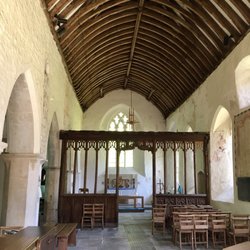
Church of Saint Cadog - 14th Century chapel with mediaeval screen

Church of Saint Cadog

(1 review)

Llancarfan is a delightful village in the Vale of Glamorgan, tucked away up a narrow valley (and…read moreaccessed - be warned - via some very narrow lanes). Best known for its pub, the Fox and Hounds, it is also home to one of Wales's oldest Christian sites. Here, St Cadoc founded a small monastery around 515AD. Viking raids and economic decline meant that, by the Norman conquest, the original foundation was probably a shadow of its former self, but evidence points to small Norman church having been founded on the site, rebuilt between the 12th and 15th centuries into the impressive church we see today. As well as the robust Gothic architecture, the church retains a fine mediaeval screen and Retford. But Pride of place is reserved for the substantial remains of mediaeval wall paintings, which rank among the best in Britain. For here are a superb rendition of St George and the dragon, being watched by a fine red-bearded king, his queen and the daughter (who St George is saving), with her sacrificial lamb, all watched over by the Virgin Mary. Then there is s complete rendition of the Seven Deadly Sins and a less complete depiction of the Seven Corporal Acts of Mercy. Finally there is a wonderful death and gallant, where a rotting corpse (complete with toad and worms) leads a young 15th Century dandy out of the church and into the graveyard. This is the only surviving depiction of this motif in a British church. The tower has a small Romanesque window set high up, possibly re-used from the earlier Norman church. The church still has regular services and is well worth a visit.

Sully Island - Sully Island, near Penarth

Sully Island

(2 reviews)

This little grassy island is on the north coast of the Bristol Channel, not far from Penarth. It is…read morereached from the village of Swanbridge and the car park of the Captain's Wife pub at low tide. At these times it is possible to walk over the natural causeway onto the 'island' but great care must be taken not to be cut off when the tide comes in again! There have been many accidents as the result of carelessness (and stupidity) and there is now a sign at the north end which states, You are Risking your Life by Visiting this Island! It is probably best just to view it from the mainland..

Sully Island is a small island of 14.5 acres (c. 6 ha) 450m off the coast of Glamorgan, mid way…read morebetween Penarth and Barry, near the village of Sully. It is linked by a natural rocky causeway to the mainland, which comes ashore near the Captain's Wife pub in the hamlet of Swanbridge. The island has a long association with smuggling, but evidence of Bronze Age burial mounds, Viking remains and a defended Saxon homestead indicate it has been used, if not always inhabited, for thousands of years. Notorious pirate Nighthawk buccaneer Alfredo de Marisco is reputed to have established a base on Sully Island in the 13th century. Earlier in 2011 the island was put for a sale: the asking price was £95,000, and a group of local people were trying to buy it to retain public access. During much of the historical era, it has been used on and off by smugglers: the coves at Swanbridge and nearby St Mary's Well Bay, sheltered by the island, formed a minor port and fishing village until the 19th century, and the island was used to hide contraband goods rather than declare them: records indicate both goods and illegal immigrants were seized in the 16th and 17th centuries. The island was also the site of several wrecks, most notably the Antarctic Survey vessel the SY Scotia in 1916 (although the vessel had by that stage been sold into commercial cargo service). The island is designated as a Site of Special Scientific Interest and has an unusual flora and fauna, with rare plants including the bee orchid, the marine spleenwort and the adder's tongue fern, and (as Peter Caton points out) interesting rock formations. Finally, I would reiterate the warning about the dangers of crossing to the island. The causeway is uncovered for about only 3 hours at low tide, and the tides rise rapidly. The causeway has appropriate warning signs at the landward end. A school-friend of my mother's was drowned here before World Way II attempting to swim back to the mainland.

Friar's Point - landmarks - Updated May 2026

Loading...
Loading...
Loading...