I was exploring the history of Orlando in the historic Greenwood Cemetery when I discovered this…read moremarker dedicated to the Eppes and Shine families buried here. I learned from the sign that they were descendants of Thomas Jefferson who made their mark on early Orlando.
Francis Wayles Eppes VII, was 8 years old in 1809 when he spent Christmas in Virginia with his grandfather Thomas Jefferson who had just completed two terms as president. Francis's mother was Jefferson's beloved daughter Maria who died during child birth in 1804 when he was three. His father John Epps was a congressman who remarried and was often away in Washington, DC. so Francis grew up in the care of his grandfather. Francis was the only one of Maria's three children to live to adulthood. Jefferson had set aside the family outpost called Poplar Forest, a 300 acre estate near Lynchburg, Va. for Francis as his inheritance. When Francis turned 15, Jefferson sent him a letter with this advice "Above all things, and at all times, practice yourself in good humor. This, of all human qualities, is the most amiable and endearing to society."
Thomas Jefferson died in 1826, when Francis Eppes was 25 and married to Elizabeth with two children. The Jefferson family ended up selling Monticello and Poplar Forest due to debts and legal problems. Francis Eppes landed in Tallahassee with his young family but his wife Elizabeth would pass here during child birth like his mother and two of his seven children died in infancy. Francis Eppes remarried Susan Margaret Ware (1815-1887), the daughter of a governor of Georgia. They lived at Pine Hill, a 1,900-acre plantation, and had six more children, four girls and two boys. Francis Eppes founded St John's Episcopal Church and went on to serve two terms as mayor of Tallahassee in the 1840s and 1850s. He was one of the founders of Florida State University when in the 1850s he helped establish the West Florida Seminary that would become the university where he would serve 11 years on the school's board, eight of them as president.
The Civil War hit the Francis Eppes family hard. Eppes sold his land but it was purchased with worthless Confederate money. The family was broke and they moved further south into what would become Orlando, a frontier outpost that sprung up from Fort Gatlin, an outpost during the Seminole Wars. In Orlando Francis Eppes became a citrus farmer.
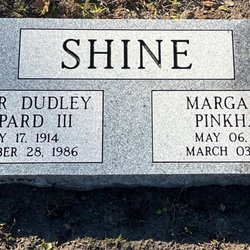
Three of the Eppes daughters married three Shine brothers in 1866. Martha Virginia married Capt. Thomas Jabez Shine, called T.J., Capt. Tom Shine, a Confederate veteran, was the director of the First National Bank, a board of trade officer, an alderman, and commander of the Orlando Guards, later named Shine Guards. In 1879, Thomas built a home on Orange Avenue with the first indoor bathroom in Orlando. The first sidewalk in the city ran past the house and it had a tennis court. He named the cross street Jefferson Street in honor of his wife's family
Caroline Matilda married David Shepard Shine who became deputy clerk of Orange County and was appointed postmaster. Caroline and her sister Martha
served their communities as members of the Rosalind Club, Sorosis, and with other charities.
The third Shine brother Dr. William F. Shine was married to Martha Eppes. Unlike the previous two couples, they did not live in Orlando. Dr. William F. Shine, served as a Civil War surgeon and practiced medicine in St. Augustine after the war. Maria Jefferson Eppes founded the St. Augustine Chapter of the Daughters of the American Revolution which bears her name.
Francis Eppes died on May 30, 1881 a few months before his 80th birthday. Francis Eppes and Susan Ware Eppes are buried in Orlando's Greenwood Cemetery in a family plot with members of the Shine family, including T.J. Shine, and their descendants. The Shines are noted for being among Orlando's earliest civic minded families. Marker F-838 was erected in 2014 by The City of Orlando and the Florida Department of State.