The name, Plaza de las Tres Culturas or Plaza of the Three Cultures, can be applied to many sites…read morethroughout Mexico. It's the intersection of ancient civilization, their Spanish conquerors and modern culture.
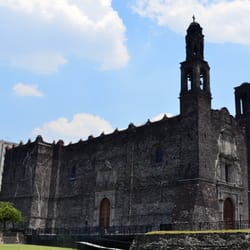
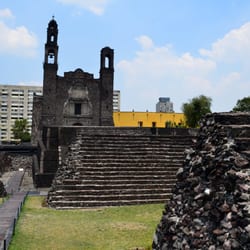
In this case, the ancients are the Aztecs and the remnants of their city of Tlatelolco in these stone expansive foundations seem to be faring better than the Spanish church, built in 1610, that lords its precarious shadow like a sundial over it all. In the late 19th century, during the regime of President Porfirio Díaz, this Church of Santiago was converted to an explosives warehouse. In 1948, the building made a return as a church although it appears as if a mere firecracker could send this volcanic stone edifice crashing to the ground.
This area has become known for war, protest, and death. In 1473, a war between Aztec factions of Tenochtitlán and Tlatelolco led to many deaths here. (The remains of 54 people from that war were discovered here and a couple, seen in an embrace, is referred to as the Lovers of Tlatelolco.) Hernán Cortés invaded here in 1521 and was victorious over Cuauhtémoc. Dead bodies were supposedly everywhere stacked high one upon another. The pre-Columbian era was officially over.
The modern era has not immunized this area from death, either. Hundreds of student protesters were massacred here in 1968 by troops of President Gustavo Díaz Ordaz. His extreme actions to enforce order and present stability to the world on the eve of the Mexico City Olympics resulted in world-wide infamy.
There are no jaw-dropping pyramids or macabre sculptures on display so architecture takes a back seat to history and, surprisingly, modern life because this area still sees protests. Nearby murals attest to that. When I walk the platforms that snake through this complex, I look up at the surrounding 20th century apartment complexes and offices towers then wonder what residents see when they look out of their windows to Plaza de las Culturas? Do they visualize a thriving pre-Columbian marketplace considered the largest in the entire valley of Mexico, an ancient bloody battleground, or a center of protest that helps define the current culture and direction of a future Mexico?