Cancel

    Open app

    Search

    Doak House Museum

    5.0 (1 review)

    Doak House Museum Photos

    Recommended Reviews - Doak House Museum

    Your trust is our priority, so businesses can't pay to alter or remove their reviews. Learn more about reviews.
    Yelp app icon
    Browse more easily on the app
    Review Feed Illustration

    1 year ago

    Helpful 0
    Thanks 0
    Love this 0
    Oh no 0

    Verify this business for free

    Get access to customer & competitor insights.

    Verify this business

    Andrew Johnson National Historic Site - Another house in town he lived at

    Andrew Johnson National Historic Site

    4.9(17 reviews)
    3.7 mi

    Very nice historical landmark in a quaint, beautiful town. On our way from NC to Knoxville we…read moredecided to stop and are glad we did. Like others, I didn't know much about President Johnson. I knew he had some difficulties, but his life is interesting. He went from being a tailor to the President. Life was hard back then, and he made the most of it. Very tumultuous time in our country. Nice gift shop and a lot of interesing things to see. We were there on a Sunday so most of the town was closed up. Great place to walk and enjoy the natural beauty.

    As presidents go, the one who took over for Abraham Lincoln is generally held in low regard…read more History is interesting regardless of whether it's good or bad, so a diversion to this Eastern Tennessee town to catch this museum turned out to be a worthwhile effort. There is a museum and a couple of historic sites, as well as a statue. A charming stream traverses the site, and while not free of trash, it did have some nice greenery and a crayfish. Free tours were offered of the family home. I noted with some amusement that Andrew Johnson opposed the expansion of the federal government and thus probably would not have approved of his house becoming part of a large national park system. The content about the role and constraints of government is historically interesting but certainly is relevant contemporaneously. A variety of interesting health information also popped up; apparently his family was wracked by tuberculosis, which was incurable at the time. One might argue that the diseases afflicting the country during Reconstruction were likewise impossible to cure at the time, but we'll never know. Even his own museum doesn't think that President Johnson was successful in that effort. I doubt anyone will find a lovelier spring day than I did to visit, but the history won't change, and I've visited several presidential sites for presidents who are either obscure or not well regarded, and they have all been interesting.

    Photos
    Andrew Johnson National Historic Site
    Andrew Johnson National Historic Site
    Andrew Johnson National Historic Site - Exterior view of the Visitor Center.

    See all

    Exterior view of the Visitor Center.

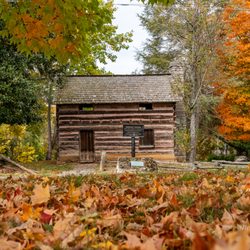
    Capitol of State of Franklin - The Lost State of Franklin Cabin in the fall. Located on College Street in Greeneville, TN.

    Capitol of State of Franklin

    4.7(3 reviews)
    3.8 mi

    It's a wonderful trip into the past when you visit this cabin. It is across the street from Town…read moreHall and has a cool history. There are informational plaques. It is free and open to the public all the time.

    Located in Greeneville, TN about 2 blocks from the President Andrew Johnson Home and museum. It is…read morea quick walk over and something you shouldn't miss.. It is absolutely FREE and a piece of history you don't want to miss. The state of Franklin never came about but it could have been a 51st state if it hadn't fell through the cracks during all the civil war fights going on. You can go into the cabin and look around. I recommend you checking it out. HISTORY: In 1784, North Carolina attempted to resolve its debts by giving the U.S. Congress its lands west of the Appalachian Mountains, including Greene County, abandoning responsibility for the area to the federal government. In response, delegates from Greene and neighboring counties convened at Jonesborough and resolved to break away from North Carolina and establish an independent state. The delegates agreed to meet again later that year to form a constitution, which was rejected when presented to the general delegation in December.[12] Reverend Samuel Houston (not to be confused with the later governor of Tennessee and Texas) had presented a draft constitution which restricted the election of lawyers and other professionals. Houston's draft met staunch opposition, especially from Reverend Hezekiah Balch (1741-1810) (who was later instrumental in the creation of Tusculum College). John Sevier was elected governor, and other executive offices were filled. A petition for statehood for what would have become known as the State of Franklin (named in honor of Benjamin Franklin) was drawn at the delegates session in May 1785. The delegates submitted a petition for statehood to Congress, which failed to gain the requisite votes needed for admission to the Union. The first state legislature of Franklin met in December of 1785 in a crude log courthouse in Greeneville, which had been named the capital city the previous August.[13] During this session, the delegates finally approved a constitution which was based on, and quite similar to, the North Carolina state constitution. However, the Franklin movement began to collapse soon thereafter, with North Carolina reasserting its control of the area the following spring. In 1897, at the Tennessee Centennial Exposition in Nashville, a log house that had been moved from Greeneville was displayed as the capitol where the State of Franklin's delegates met in the 1780s. There is, however, nothing to verify that this building was the actual capitol. In the 1960s, the capitol was reconstructed, based largely on the dimensions given in historian J. G. M. Ramsey's Annals of Tennessee

    Photos
    Capitol of State of Franklin
    Capitol of State of Franklin
    Capitol of State of Franklin

    See all

    Statue of President Andrew Johnson

    Statue of President Andrew Johnson

    5.0(1 review)
    3.8 mi

    This is a Statue of 17th President of the United States of America, Andrew Johnson…read more Located across the street from his home and museum....FREE to view and enjoy!!!! HISTORY: Andrew Johnson, the 17th President of the United States, spent much of his active life in Greeneville. In 1826, Johnson arrived in Greeneville after fleeing an apprenticeship in Raleigh. Johnson chose to remain in Greeneville after learning that the town's tailor was planning to retire. Johnson purchased the tailor shop, which he moved from Main Street to its present location at the corner of Depot and College streets. Johnson married a local girl, Eliza McCardle, in 1827. The two were married by Mordecai Lincoln (1778-1851), who was Greene County's Justice of the Peace. He was a cousin of Abraham Lincoln, under whom Johnson would serve as Vice President.[24][25] In the late 1820s, a local artisan named Blackstone McDannel often stopped by Johnson's tailor shop to debate issues of the day, especially the Indian Removal, which Johnson opposed. Johnson and McDannel decided to debate the issue publicly. The interest sparked by this debate led Johnson, McDannel, and several others to form a local debate society. The experience and influence Johnson gained in debating local issues helped him get elected to the Greeneville City Council in 1829. He was elected mayor of Greeneville in 1834, although he resigned after just a few months in office to pursue a position in the Tennessee state legislature, which he attained the following year. As Johnson rose through the ranks of political office in state and national government, he used his influence to help Greeneville constituents obtain government positions, among them his long-time supporter, Sam Milligan, who was appointed to the Court of Claims in Washington, D.C.[26] Whilst Andrew Johnson was away from home, during his vice-presidency, both union and confederate armies often used his home as a place to stay and rest during their travel. Soldiers left graffiti on the walls of Johnson's home. Confederate soldiers left notes on the walls expressing their displeasure, to put it delicately, of Johnson. Evidence of this can still be seen at the Andrew Johnson home. Andrew Johnson had to almost completely renovate his home after he returned home from Washington D.C. The Andrew Johnson National Historic Site, located in Greeneville, was listed on the National Register of Historic Places in 1963. Contributing properties include Johnson's tailor shop at the corner of Depot Street and College Street. The site also maintains Johnson's house on Main Street and the Andrew Johnson National Cemetery (atop Monument Hill to the south). A replica of Johnson's birth home and a life-size statue of Johnson have been placed across the street from the visitor center and tailor shop.

    Photos
    Statue of President Andrew Johnson
    Statue of President Andrew Johnson

    See all

    Doak House Museum - museums - Updated May 2026

    Loading...
    Loading...
    Loading...