Cancel

Open app

Search

Cresson Sanatorium & Prison

5.0 (1 review)

Services - Cresson Sanatorium & Prison

Venue rental

Cresson Sanatorium & Prison Photos

More like Cresson Sanatorium & Prison
Recommended Reviews - Cresson Sanatorium & Prison

Your trust is our priority, so businesses can't pay to alter or remove their reviews. Learn more about reviews.
Yelp app icon
Browse more easily on the app
Review Feed Illustration

3 years ago

Helpful 2
Thanks 0
Love this 1
Oh no 0

Verify this business for free

Get access to customer & competitor insights.

Verify this business

East Broad Top Railroad - A steam powered excursion train arrives at the Orbisonia Station, ready to board another load of happy passengers!

East Broad Top Railroad

(12 reviews)

So here's the deal: I rode the Pumpkin Patch Express at East Broad Top Railroad, and while it was…read moreabsolutely adorable, festive, and full of fall charm... I'm docking a star for one very specific reason -- they advertised a Halloween costume contest with every train departure and then... just didn't do it. Like, poof. Gone. No announcement, no explanation, no spooky spirit. Just me in a full Halloween costume wondering what in the Great Pumpkin was going on. Let me back up. I had to cancel my original trip a few weeks before because of a family emergency. Their staff was super helpful, issued me a gift card, and made rebooking easy. Total gold stars for that. I ended up rebooking on the last day of the Pumpkin Patch Express, and even splurged for seats in the caboose (because who doesn't want to pretend they're in a vintage movie for a day?). It was $65.32 for two adults, and honestly worth it for the unique view alone. The Orbisonia Station was clean, festive, and well-run. Fall décor everywhere, the kind of stuff Pinterest dreams are made of. The train ride? Perfectly timed -- long enough to enjoy the scenery, short enough that I didn't start questioning my life choices or wishing for snacks. When we arrived at the pumpkin patch, it was like stepping into autumn heaven: games, bounce house, mini-golf, food trucks, firepits, and plenty of pumpkins. The whole setup was great -- even the port-a-johns were clean (which is the real fall miracle here, let's be honest). We hit the food trucks first (pro tip!) and scored seats in the sunshine next to a firepit. I devoured my lunch, soaked up the view, and might've gotten a little competitive playing mini-golf -- nailed the final hole in one and absolutely celebrated like I'd just won the Masters. Now... back to that nonexistent costume contest. Picture me: all decked out, fully committed, ready to strut my spooky self for glory. I walk up to the counter, big smile, ready to ask where the contest will be -- and a rather grumpy man behind the desk hits me with a "Yeah, we're not doing that anymore." No apology, no explanation, no nothing. Just crushed dreams and a ticket in hand. Sir. I have read your Facebook event posts. All. Of. Them. You promised me a costume contest. You got me excited. And you're telling me this now? On the platform? In my Halloween costume? I'll admit it -- I was bummed. Like, "eat extra candy corn later to cope" bummed. But I wore my costume proudly anyway (as did my adventure buddy and a few other brave souls), made my own fun, and still had a great time. Though I definitely whined about it the entire train ride back. My poor adventure companion earned a medal that day. So yeah, East Broad Top -- the train, the views, the pumpkin patch setup -- all awesome. But if you're going to advertise something, please follow through. Some of us plan our entire fall outfit strategy around these things, okay? Still, I can't stay too mad. I had a blast, the caboose ride was a dream, and it's a memory I'll be laughing about for a long time. Just...maybe next year, they can keep their event promises or update their marketing so folks know what to expect? Less ghosting on the costume contest and more ghost costumes, deal?

Very family friendly, love the staff and great to see during Christmas and Halloween . Very…read morebeautiful to see always.

Mount Washington Tavern

Mount Washington Tavern

(5 reviews)

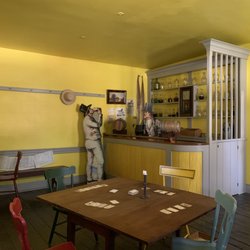
Pleasant little trip into 1830's roadside tavern history (and more history of the National Road,…read morecomplimenting some of the history at next door's Fort Necessity visitors' center), such as what sort of people traveled, how they traveled, what they could afford to eat, and how they slept (uncomfortably and sharing space with strangers).

The previous two Yelpers certainly explained the tavern well enough but I'm going to throw in a few…read moredetails that they overlooked. First and foremost is that it's an oddity of history that George Washington came to own the land on which he fought his first battle. He fought his first battle at Fort Necessity right down the hill from where the tavern stands in 1754. As history will tell you, things didn't turn out so well for young Colonel Washington. But the area stuck with Washington and fifteen years after his defeat at Fort Necessity he came back to buy the land consisting of 234 1/2 acres in southwestern Pennsylvania. The tract of land was called "Mount Washington" and embraced the Great Meadows. However, little did he know then that this tract would later boast a tavern whose story would live for generations. Although Washington never lived to see his land flourish, he knew it would be an excellent site for an inn. Soon after his death the first federally funded road was laid down through this country, crossing the Mount Washington tract, thus proving his speculations correct. Travelers stopping at the Mt. Washington Tavern were pleased to find a commodious brick and stone tavern of eleven rooms in two stories, with an attic and basement. Built around 1827 by Judge Nathaniel Ewing of Uniontown, the Tavern was operated by James and Rebecca Sampey and did a lively business from the time it opened. Four conditions were prevalent at this inn: the place was clean, the food was good, the landlady was civil and her husband was sober. The building was an inn for only a short period of time from its construction in 1827-8 to 1855 when the importance of The National Road declined due to railroad construction. It was then used as a private home until 1932 when the Commonwealth of PA purchased it and eventually the NPS acquired it in 1961 while making the building part of Fort Necessity National Battlefield. Today the tavern serves as sort of a museum of what life would have been like traveling the National Road in the mid-19th century. The tavern is open seasonally from April-November normally the same hours as the visitors' center but in particular thanks to the lingering effects of the Sequester, that is subject to change and you should call before coming as the hours are not updated on the nps.gov site.

Lemon House - The tavern.

Lemon House

(2 reviews)

Lemon House is part of the Allegheny Portage Railroad National Historic Site, meaning that it…read moreresides on the land and can be viewed while you are there. To note, Lemon House is one of the buildings you can see from the highway on your way by. Lemon House is an original building on the grounds. It has been restored to what it would have looked like for the time period. Lemon House, at times, gives you a better timetable for the time that the railway was in use. I suppose you can view this an an extension of the visitor center. When you walk in you are greeted by one of the rangers, they give you a little run down of the inside of the place and let you go on your way. They are also there to ask any questions, might you have them. You only get to view the first floor of this place. What you will get to see is the dining area, bar, and fancy parlor. The Fancy Parlor was by far my favorite room in here. Decorated with pieces from the time period and giving you a glimpse into how people would interact and relax. The dining room is kind of like a cafeteria style area, great big room specifically for eating your meal. The tavern area seems a bit small, but I can see it working. The other rooms on the first floor have not been restored to what they would have looked like. Instead they hold the informative information about the structure. This information gives you the timeline of the house, right down to who owned it at what time and how it changed hands so much. It also tells you that this is not the original house. They built this one here to be near the railway in order to take advantage of the traffic and offer services. They are not sure where the original house stood to this day. It is a beautiful structure. Great addition to the grounds, and I am happy that they decided to save the structure for reuse instead of demolishing it. It would have been too bad if they had.

"The Lemon House is a museum, not a working tavern or restaurant." So says my guidebook from the…read moreAllegheny Portage Railroad National Historic Site. Located just south of the visitor's center and the engine house, it's one of the major attractions at the site and one of the few that has been completely restored. The Lemon House shows how the socioeconomic structure developed along the railroad and the Main Line. It was owned by Samuel and Jean Moore Lemon, two of the many entrepreneurs who used the development of the areas natural resources and transportation links in order to make a living. Travelers along the Main Line would stop here to eat, drink, and regale each other with their journeys' tales. The Lemon House was restored in 1997 in the style of 1830-1850, specifically what it might have looked like in 1840. I say "might" because as with the engine house, any plans or schematics for the design of the building have been long lost. There's also little evidence as to how the tavern was operated or what the menu might have been. What the restorers did know however were such things as period artworks and documentation of other 19th century taverns (many had remained in business into the 20th century). Also historians do know what the social mores were at the time, so we will keep them in mind as we tour the building. Historians also do know a few things about the Lemons. Jean Moore Lemon (1797-1880) was well educated and apparently was the bookkeeper for the tavern. The local banks have records of her signature. Her obituary praised her for her charity works. Samuel Lemon (1793-1867) was born in Huntingdon County, PA. His grandfather served in the War of Independence and his father in the War of 1812. He was best known as a tavern owner and businessman. He must have had some business acumen because the Lemon House was very solidly built. So let's take a tour of the Lemon House. Like the travelers of the day, we enter through the central hallway. In most houses the hallway was very welcoming and it's likely that travelers preferred this room. Here travelers could read the paper, play games, or catch up on the stories of the day. It is furnished with simple wooden chairs and benches which could withstand the elements. Period paintings, not original to the house, adorn the walls. The next room is the bar room. Ladies, we are allowed in here today but we would not have been back when the tavern was operating. The social mores of the day required men to act as gentlemen and women to act as ladies. In general, women of any social standing did NOT go into bar rooms. Here the men could ignore the social graces of the day. Guys, imagine such notorious behavior as removing your dress coat or tilting your chair back. Imagine uttering such oaths as "hell" and "damn"! Now the barroom was restored based on a watercolor "Country Inn" by August Koller. The watercolor was painted in 1840 in western PA. We proceed into the fancy parlor. Here a man or woman who wished to have a more quiet retreat could dine or relax (notice girls, we don't get our own room here--ah, the Victorian social graces). You did not have to be rich in order to use the fancy parlor, but you had to exhibit social graces. The furniture was designed for correct posture and appropriate behavior. Chairs were uncomfortable because they did not want you to linger or sleep here. Interestingly, you could smoke or chew tobacco in here and you can see the silver spittoons on the floor. Of course there is a piano because refined ladies would know how to play one. It's likely that Mrs. Lemon entertained neighbors and guests here. The last room we'll take a look at is the Double Dining Room, also known as the Common Room. Travelers and the occasional local foik could stop for a meal here. Unlike today, it was one set meal. There were no choices of what you wanted to eat. Stew was the most likely meal to be served because it could be kept hot on the stove all day. Trains would pull in and the crew would shout out "1 hour for lunch!". Community seating was the rule of the day, meaning you dined with strangers. This was done for efficiency's sake. This community seating lives on today--if you've ever eaten in an Amtrak diner car, you'll know what I mean. I could go on, but I'm almost out of space here. The Lemon House is my favorite site here because it's so complete and it gives you an idea of how people traveled back then. Quite a difference from the Holiday Inns and Denny'ses of today, huh?

Cresson Sanatorium & Prison - historicaltours - Updated May 2026

Loading...
Loading...
Loading...