If you're on a road trip and adventurous enough to seek out Carhenge, why not get slightly more…read moreadventurous and seek out the VERY remote Hudson-Meng Bison Bonebed in the Ogalalla National Grasslands, the site where paleo-humans left the bones of many hundreds of ancient bison (without the skulls), over many hundreds of years, piled and scattered over a small area.
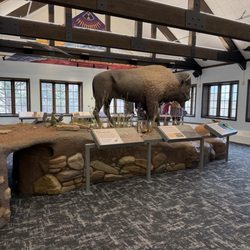
At the end of 15-miles of gravel road, there is a small parking lot, restrooms with plumbing, a small pond teeming with loud frogs and surrounded by lush greenery and shade-trees, and an air-conditioned archealogical dig/gift shop/visitors center, about the size of a large barn. A small staff will greet you, show you an informational video about the history of the bonebed and give you a tour of the archealogical dig and show you the bones.
It may not be as large and perhaps not as interesting as the fossilized rhinoceroses at the Ashfall in northeastern Nebraska several hours east from here, nor does it have the (ahem) mammoth proportions of the VERY interesting mammoth site in Hot Springs, South Dakota a short drive to the north (both of which are highly recommended), but it does offer a trailhead into the Toadstool Geological Formation located in adjacent grasslands.
The Bison Trail runs out from about the entrance to the visitors center, across federal grazing lands, down into several "badlands"-style gullies and to the Toadstool campground - 3 miles away, for a six-mile out and back hike. At least one other trail intersects this trail about a mile out with signage noting that Toadstool is three miles down it also, so you can make the hike longer, or shorter, or into a loop as desired. Enjoy the strategically placed bison sculptures that give a sense of what ancient humans might have seen along this same trail.
There are also numerous cattle trails cutting this way and that through the grasslands, but the intentionally placed human trail is marked by wooden sign-posts sticking up out of the prairie grass about 50-100 yards apart to show you the way. The ranger also told us that we were welcome to just wander about wherever we wanted, sign-posts-be-damned. But you may have to contend with a barbed-wire fence or two or three - there are, however, gates or slots through the fence that human hikers can fit through on the regular trail.
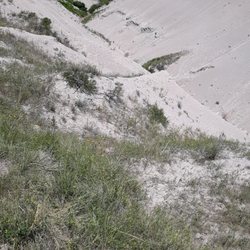
From the visitors center, the trail goes down into and up out of a small shaded gully, then out to another large gully that looks more like the badlands. Down into and up out of the second gully, then across more grasslands to a third gully (about 1.3 miles from the visitors center), where the trail descends down into the gully from its highest point, and then down through the bottom of the gully for some distance. When we went, the trail at the bottom of the gully was extremely muddy - so we didn't make it all of the way to Toadstool. We turned around at the first turn at the bottom of the gully where it got muddy. We walked along the gully at its top edge for a ways, however, to see what we were missing from the top. In this first mile and a half we did not see any so-called toadstool formations, but it is a uniquely and starkly beautiful landscape, with the sparsely wooded hills behind you above the visitors center, with the slope of grasslands below you, the badlands features spreading out through significant portions of the vista below you.
And if you are lucky (?) you might even run into a herd of beef cattle, and might even accidentally cut a small group of them off from the main herd; and then have to hide below a rise so as not to spook the stragglers so that they can find their herd. Not saying it happened that way, but it might happen to you too.




![Agate Fossil Beds National Monument - 07.07.24 Agate Fossil Beds National Monument [Harrison NE]](https://s3-media0.fl.yelpcdn.com/bphoto/rtG2FH5H7jc1_U5gOOwhwg/ls.jpg)