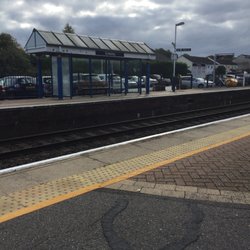
To-day, Westbury is a moderately important junction station, where the Bristol-Southampton and…read moreBristol-Weymouth services cross the West of England main line from Paddington to Plymouth.
It's all a far cry from former times: the station was opened in 1848, on a line from Chippenham, with services being extended to Warminster in 1851, Weymouth and Bath in 1857 and Salisbury in 1856. It continued as a country junction until 1900, when it was rebuilt in its present form as the first part of the new through route from London to Plymouth via Castle Cary. Through services began in 1906, and so began Westbury's golden age as a major junction station.
It didn't last long: in 1933, a bypass line was built around the station to the south, for non-stop London-Plymouth expresses. The introduction of High Speed Trains in 1980s brought more decline, as the London-Paignton trains were routed via Bristol, the engine depot closed, staffing at the station was reduced, and the old platform one was closed.
To-day, Westbury is expanding rapidly as a dormitory town for Bath and Bristol, and commuter traffic is increasing as a result, to some 300,000 passengers a year. There is an intermittent main-line service to London and Taunton, but the main services are the half-hourly Bristol-Portsmouth trains, and the two-hourly Weymouth service. Additional local services to Bristol are laid on at rush hour, and there are three direct trains a day to London via Salisbury. It can all seem quite busy again at certain times of the day.
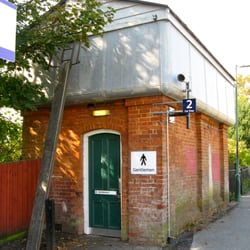
Station facilities remain basic, however, even if the fine buildings from 1900 have survived: but a new buffet and new toilets are being built, and there is a small waiting room, though ticket office hours remain limited. Most trains use the island platform (2 and 3), although platform 1 remains open for some services. The station has recently been made accessible for wheelchair users and other passengers with disabilities.