Cancel

    Open app

    Search

    Caerleon Roman Baths Photos

    Recommended Reviews - Caerleon Roman Baths
    Your trust is our priority, so businesses can't pay to alter or remove their reviews. Learn more about reviews.
    Yelp app icon
    Browse more easily on the app
    Review Feed Illustration

    1 year ago

    Helpful 0
    Thanks 0
    Love this 0
    Oh no 0
    Photo of Hannah P.
    18
    208
    302

    16 years ago

    Helpful 1
    Thanks 0
    Love this 1
    Oh no 0

    Verify this business for free

    Get access to customer & competitor insights.

    Verify this business

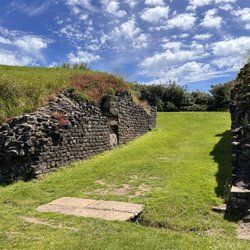
    Caerleon Amphitheatre - Photo taken from official website: http://www.cadw.wales.gov.uk/

    Caerleon Amphitheatre

    (2 reviews)

    Just outside Caerleon's fortress wall stands the great amphitheatre, which could once could seat a…read morewhole Roman Legion - representing up to six thousand spectators! Some say it has a link with King Arthur's Britain. Geoffrey of Monmouth wrote his 'History of the Kings of Britain' around 1140, and this became the main source of all the later Arthurian legends - including the one which claims King Arthur held court at Caerleon for several years. Years after the Roman legion left, Caerleon would have been regarded as one of the wonders of Britain, with the amphitheatre representing a very impressive ruin - and some theorists have even said the remains could be a prototype Round Table. Nowadays, the amphitheatre is occasionally used for open air events and re-enactments. The site is an unstaffed, open site, so entry is free unless there's a special event taking place, and there's also free parking available nearby (in Broadway, off High Street).

    Have you seen the Gladiator film? Then think back to it and imagine a smaller place within Wales,…read morenot far from Cardiff city, but it is not an easy route to get to by public transport, however it is still possible... Also imagine just massive green and muddy land where a circualar shape of ground has been cut deep into the ground to create an Ampitheatre. Here is where they used Tigers, Bears, and Lions to fight men, making the men try to kill the animals or for the animals to try and kill the men. So I'm sure such events during the Roman times would have been pretty historic at the time as much as if not it is more so historic in memory of the times and lives that exsisted within the centuries that the Romans did in Wales. To me, it made me think of an open air theatre like the one in Cornwall, except there are no seats, only mounds ofdeep green ground. It is a pretty spectactualar sight to see and it is also free, I most certainly recommend it to all... It is wheelchair accessable and children friendly. It is not far from the Roman Museum and the Roman Baths in Caerleon.

    St Woolos Cathedral

    St Woolos Cathedral

    (2 reviews)

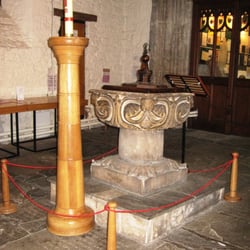
    Set high on Stow Hill and commanding fine views over Newport, the Cathedral of St Woolos (Welsh: St…read moreGwynllyw) is the mother church of the Anglican Diocese of Monmouth. Incorporating elements spanning 1,000 years, it has a rich and fascinating history. History The exact origins of the church are shrouded in legend, but the first church is said to have been built around 500AD by Gwynllyw, a local Lord. He fell in love with Gwladys, daughter of the King Brychan (modern Brecon) but, having been refused her hand in marriage, he abducted her. Evidently she still married him and, over time, Gwynllyw was converted to Christianity both by Gwladys and their pious son Cadog (later St Cadog). Gwynllyw then built a religious settlement or Clas on the site of the present cathedral - chosen, again according to legend, after an angel in a dream told him to build a church where he found a white ox with a black spot on its head. This original 6th century building would have been made of wood and wattle-and-daub, but the site was revered sufficiently for the Saxons to build a later stone church on the site of the present St Mary's Chapel, possibly in the 10th century. The remains of this church constitute the oldest part of the present building. In 1080 a new church with a nave and lean-to aisles was built by the Normans, immediately east of the Saxon building. The earlier church was probably by this time a ruin, as the Norman west door pierced its east wall. Around 1200, the Saxon chapel was restored and the walls raised, with narrow lancet windows inserted above arched tomb niches. The church was badly damaged in 1402 by the forces of Owain Glyndwr, but later in the 1400s substantially enlarged and repaired, mostly by Jasper Tudor, uncle of Henry VII. The north aisle was enlarged and fine Perpendicular Gothic windows were inserted, followed later on by a similar enlargement of the south aisle, and a double-height south porch with a priest's house on the first floor. Finally, the tower was added towards the end of the 15th century, and included a statue of Jasper Tudor, as Governor of Newport 1485-95. The church's history then shows a period of steady decline: much damaged during the Civil War, by the early 19th century St Mary's Chapel had become a charnel house, and the nave had effectively become a chapel, with a singing gallery on the site of the rood screen, cutting off the nave from the chancel. Restoration began in 1818 with the repair of St Mary's Chapel, which then became the main entrance of the church. An extensive further restoration in 1853 replaced the south porch and the two 15th century south aisle windows with three new ones; restored the Norman font and 15th century chancel; and removed the singing gallery and inserted a new chancel arch. The next phase of building resulted from the decision in 1921 to create a new Diocese of Monmouth. After much deliberation, St Woolos was chosen to be the new Cathedral, a process finally completed in 1949. However, it was clear that the original chancel was too small for its function as cathedral, so an new East End was built in 1961-2 by the eminent architect ADR Caroe, decorated with a mural and new rose window designed by the artist John Piper. The church The church is today entered through the 15th century tower, into the 13th century St Mary's chapel. This includes the restored Norman font, with green men on each corner. The effigies in the tomb recesses are unfortunately horribly mutilated and decayed (and, sadly, rather fenced off by modern central heating pipes), although that of Sir John Morgan (d. 1491) and his wife Janet has some better preserved elements. The low window on the right has a mediaeval rose inserted into what is probably an original Saxon window. Stonework on the lower left and right sides also remains from the pre-Conquest church. Eyes are, however, drawn forwards to the Norman door, one of the Cathedral's treasures. The columns are very unusual, and are likely to be Roman, sourced from the settlement at Caerleon. The capitals are also unusual: they are of Composite design, but incorporate Norman humanistic sculpture (depicting praying men and birds). The capitals may therefore have been Roman, with the Norman work carved into them when the church was built. The arch itself has bands of bold zig-zag, billet and chevron decoration. The nave is instantly recognisable as Norman work, with five bays of rounded arches on round piers with scalloped cushion capitals. Both arcades have empty windows which once formed the clerestory, but became internal when the aisles were raised. On the left by the chancel arch, the door to the long-vanished rood-loft can be seen. The north aisle is bright and wide, the Tudor windows filled with clear glass; the south aisle is narrower, and a line of corbels indicates the height of the original aisle. At the east end, a tall modern Gothic arch leads onto St Luke's chapel, a

    Since this Cathedral is in Wales, why not recognise the history of Christianity in Wales, this 5th…read moreCentury Welsh saint and the Welsh people, by giving back this Church it's original and correct name: The Church of St. Gwynllyn.

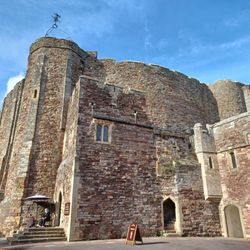
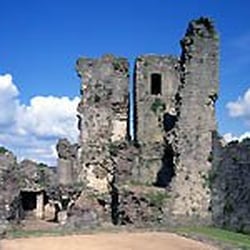
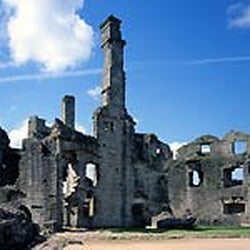
    Coity Castle - http://www.cadw.wales.gov.uk/default.asp?id=6&PlaceID=54

    Coity Castle

    (2 reviews)

    Coity Castle is a magical place full of distant battle cries and that incredible sense that…read moreimportant things have happened there. Built in 1100 and then rebuilt after a siege by Owain Glyndwr, this is a castle often overlooked by visitors to Wales, despite its extremely important part in Welsh history. Although other castles, such as Cardiff Castle, Caerphilly Castle and Castell Coch, are more visited, I would argue that it's the lesser known relics which are more interesting. This Medieval castle is built up on a hill, with clear evidence of moats, and looks almost like a half-rotten tooth sticking up into the sky. It has just as much grandeur and fairy-tale quality as a person could ask for in a castle. This historic site is well worth a visit; sunset will reward you will specular photographs and views.

    This is another of South Wales's impressive Norman Castles, standing in ruins near the town of…read moreBridgend in South Wales, not far from Cardiff. It was built by Sir Payn "the Demon" de Turberville, one of the legendary Twelve Knights of Glamorgan who are supposed to have conquered the area under the leadership of Robert FitzHamon, Lord of Gloucester. Although it was originally built soon after 1100, a lot of the castle actually dates from the fourteenth century and later. Parts of it were rebuilt following the siege by Owain Glyn Dr in 1404-05. Despite being in ruins, there are still plenty of interesting features to see - including the remains of the central octagonal pillar for the vaults of the castle. If you have OS map 170 the reference is SS 923815. Nearby you can also visit Newcastle and Ogmore Castles in a day trip.

    Caerleon Roman Baths - landmarks - Updated May 2026

    Loading...
    Loading...
    Loading...