Cancel

    Open app

    Search

    Bognor Regis Spiritualist Centre

    5.0 (1 review)
    Open 6:00 pm - 8:00 PM

    Bognor Regis Spiritualist Centre Photos

    Recommended Reviews - Bognor Regis Spiritualist Centre

    Your trust is our priority, so businesses can't pay to alter or remove their reviews. Learn more about reviews.
    Yelp app icon
    Browse more easily on the app
    Review Feed Illustration

    5 years ago

    Helpful 0
    Thanks 0
    Love this 0
    Oh no 0

    Verify this business for free

    Get access to customer & competitor insights.

    Verify this business

    St Mary's Parish Church C of E

    St Mary's Parish Church C of E

    5.0(1 review)
    3.8 mi

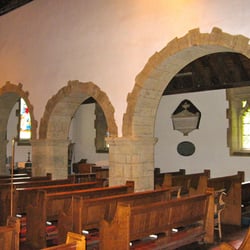
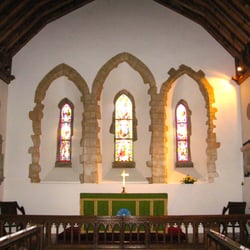
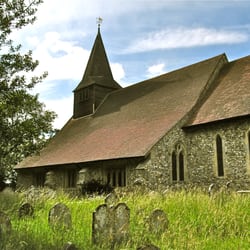
    Walberton is a prosperous village, mostly modern except for…read morea leafy enclave around the church, and its wooded churchyard. History The Domesday Book records a priest and church, and the Nave of the current church may well date from the Saxon period. The nave arcades were cut through in the 12th century to link to the aisles. The chancel dates from the 13th, as does the substantial stone porch. The aisles were rebuilt in the 14th or 15th centuries and again in the 17th and 18th, when dormers were added and galleries inserted. There are a number of original lancets, but the rest of the windows date from more recent restorations. The church is slightly unfortunately notorious for a severe restoration in 1903 by the architect Richard Creed. He rebuilt the aisles, roof and belfry (including the supporting frame), faced the walls in hard flint, scraped the interior and replaced the aisle windows in the 14th century style and the west window in that of the 16th century. He removed a large amount of the archaeological detail, including some of the Saxon walling which incorporated red Roman bricks and tiles in the quoins. The protests led to the establishment of Diocesan Advisory Committees although, arguably, many Victorian restorations were just as drastic. The church The setting is delightful and, like nearby Yapton, the roofs sweep low over the aisles. Inside, the most noticeable feature is the irregularity of the arcades: there are four bays to the south and three to the north, similar in style (very plain, round headed and unmoulded), but of varying widths and heights. The chancel fared better under the restoration, and retains its lancets and 13th century feel. Furnishings of note are limited to a tub font, from the late 11th century (restored in 1903 from a nearby farmyard), and the glass to Lord Woolton (d. 1964) in the south aisle, which lists his appointments rather like a CV. The graveyard has a huge early 19th century vault for the Prime family, and a charmingly macabre one to Charles Cook (d. 1767), which graphically depicts his death by a falling tree.

    Photos
    St Mary's Parish Church C of E
    St Mary's Parish Church C of E
    St Mary's Parish Church C of E

    See all

    Holy Trinity Church

    Holy Trinity Church

    5.0(1 review)
    6.3 mi

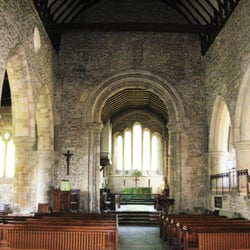
    Bosham is a lovely village, set on the harbour of the same name, near Chichester, in Sussex. It is…read morea popular place for tourists. History The Romans founded a settlement here, close to their magnificent palace at Fishbourne, and it was from here that King Harold set sail for Normandy on his fateful trip to meet Duke William - more of that later. It is also said to be the place where King Canute tried to hold back the tide. The church itself is set close to the harbour. It was mentioned by Bede in the eighth century, and St Wilfrid met a group of Irish monks who had settled here in 641 AD. Their leader, Dicul, is said to be buried in the crypt, and the cell in which he lived can be visited. But what the church is really famous for is its depiction in the Bayeaux Tapestry, which shows King Harold worshipping here prior to his journey to Normandy in 1064. This makes it probably the earliest surviving British building depicted in art. That visit set in train the events that would result in the Norman conquest and Harold's death. The church The present building has some significant Saxon elements, most importantly the impressive Romanesque chancel arch, with roll mouldings and a slight horseshoe shape, which dominates the interior, and dates from around 1040 AD, (though some scholars have dated it to immediately after the Conquest). Also Saxon are the lower stages of the tower, the nave itself, the western part of the chancel (with herringbone masonry) and a triangular-headed window in the east tower wall. The two-light openings in the tower are both Norman. The handsome Early English arcades were inserted in the 12th century, although the aisle windows were renewed in the 14th century (and those in the south aisle were renewed again in Victorian times). The rib-vaulted crypt in the south aisle was also built in the 14th century. The chancel was extended in the 13th century, and to this we owe the impressive five-light Early English east window with marble shafts on the rere-arches, and matching pairs of lancets to the north and south. Fittings and furnishings are rich: the attractive font dates to 1200; the north aisle has a 13th century piscina with a Norman pillar as its drain; and the base of the easternmost north aisle arcade pier has beasts on three of its corners with wonderful grimacing expressions. In the south aisle is an empty 14th century tomb recess, and in the chancel is a late 14th century tomb recess with a rather worn female effigy. The north aisle has a 13th century chest with lock. Finally, in the south east aisle window are four roundels of 15th century Flemish glass, showing angels holding the implements of Christ's Passion - pincers, spear, scourge and hammer. They are said to be from Norwich cathedral.

    Photos
    Holy Trinity Church
    Holy Trinity Church
    Holy Trinity Church

    See all

    Bognor Regis Spiritualist Centre - churches - Updated May 2026

    Loading...
    Loading...
    Loading...