Cancel

    Open app

    Search

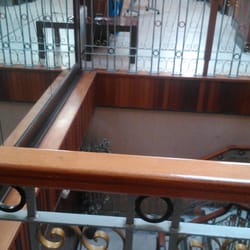
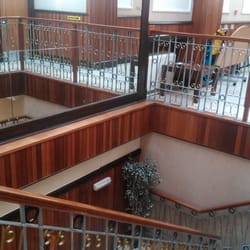
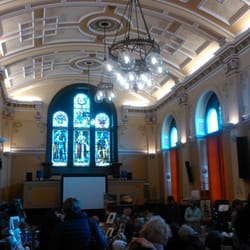
    Bishop's and Earl's Palaces

    4.0 (1 review)
    Open 9:30 am - 5:30 pm

    Bishop's and Earl's Palaces Photos

    Bishop's and Earl's Palaces Reviews in Other Languages

    Verify this business for free

    Get access to customer & competitor insights.

    Verify this business

    Standing Stones of Stenness

    Standing Stones of Stenness

    5.0(2 reviews)
    8.9 mi

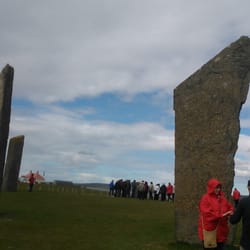
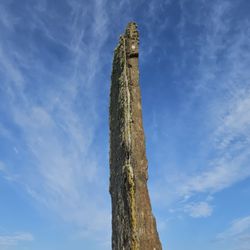
    Not sure what the name of this historical place is. Seems Yelp doesn't know either because there…read moreare 2 Yelp pages for this UNESCO World Heritage site. Stenness Stone Circle or Standing Stones of Stenness? Which name is correct? Maybe both of them. The Ring of Brodgar is another of the Neolithic Stone Circles located in the Orkney Islands. Anyways, we visited both the Stenness Stone Circle (Standing Stones of Stenness) and the Ring of Brodgar. Both historic sites were part of a tour we took of the Orkney Islands in Scotland, and both sites were historically impressive. I was surprised to find out that the Stones of Stenness are actually older than the famous Stonehenge. Using radiocarbon analysis, the Stones of Stenness were dated to around 3100 to 2900 BC. That would make them about 5400 years old!!! Originally there were 12 large stones, but now there are only 4 stones left measuring up to 6 meters high. It is believed that back in the day, the Stones of Stenness was a ceremonial site that celebrated the relationship between past and living communities. This UNESCO World Heritage Site is located in a beautiful setting in the Orkney Islands. It is surrounded by a lush green setting close to the water. So pretty! From the Stenness Stone Circle (Standing Stones of Stenness) site, it is a short walk to the Barnhouse Settlement which is a the ruins of a Stone Age village. Very cool to see this UNESCO World Heritage site as well. Do Not Miss visiting this AWESOME Iconic Historical sight!! To see it in person is a One of a Kind experience!!

    Historians consider the Stones o' Stenness the earliest henge monument in the British Isles,…read moreprobably erected five-and-a-half thousand years ago. Today, four of the original megaliths remain staunchly upright, part of the ellipse of 12 stones of which they were originally a part. The Standing Stones, along with Skara Brae, the Barnhouse Settlement, the Ring of Brodgar and Maeshowe, comprise the Heart of Orkney UNESCO World Heritage Site. The size of the Standing Stones completely dwarfs a human, provoking the inevitable questions of how, not to mention exactly why, these Neolithic henges were built. Standing over the centerpiece of the ellipse, the stone hearth, one also contemplates the henge's place in stone age society all those thousands of years ago. While many of the original megaliths, as well as the encircling ditch and bank typical of stone henges, show little evidence of themselves today, it's not hard for a visitor to feel transported through time.

    Photos
    Standing Stones of Stenness
    Standing Stones of Stenness
    Standing Stones of Stenness

    See all

    The Old Man of Hoy - The Old Man of Hoy, 450ft (137m) high.

    The Old Man of Hoy

    5.0(4 reviews)
    18.0 mi

    Hoy is the second largest of the Orkney Islands, but has a tiny population of around 270, mostly…read moreconcentrated in the east of the island. The west side is much quieter (and Hoy is pretty quiet already) and consists effectively of just two settlements, the hamlet of Rackwick and Quoyness village. The Old Man of Hoy is the island's most famous attraction. It's a spectacular sea-stack, over 137m (450ft) high. As well as its height, the vivid red sandstone makes it an astonishing sight. The sandstone actually sits on a bed of hard (and very ancient) basalt rock. The stack itself may only be about 400 years old in its present form, as pictures and descriptions from earlier times refer only to a headland here, and it is thought that the stack was created by a series of storms in the 17th century. Erosion continues, so it is only a matter of time before the whole stack collapses. It's a challenging climb (for very experienced climbers only), and was only first ascended in 1966. Around 50 people a year attempt the climb these days, with several routes to choose from. Dangers include loose rocks, its sheer verticality and, of course, the incredibly changeable weather. (And once you get to the top, there's no alternative but to climb back down again, unless you've booked a helicopter). Amazingly, people have spent the night on the small grassy patch on the top. Not for the faint hearted! The easiest way to get a view is from the Thurso-Stromness ferry, although the stack is not terribly distinct as the background of the cliffs reduces the impact. The best way is to make a day trip from Stromness on the passenger ferry to Hoy (Quoyness), and then either hire a bike or take a taxi across to Rackwick. From there it is a 45 minute walk on a good, though steep, path to the cliffs at Hoy. (The care ferry goes to the other end of the island and is rather infrequent). The cliffs themselves are amazing enough, being some of the highest in the British Isles, but the stack is just astonishing. As well as the geology, the plant and animal life here is plentiful. It's a particular haven for rock-nesting birds, and insects. In my book, it is one of those places everyone should visit at least once in their life.

    An awesome place to visit as all of Orkney, before going abroad see what the British Isles have to…read moreoffer. One the great sites in UK

    Photos
    The Old Man of Hoy - It's a good view from 450ft up...just don't get too close to the edge...

    It's a good view from 450ft up...just don't get too close to the edge...

    The Old Man of Hoy - Old Man of Hoy from the nearest landside cliff.

    Old Man of Hoy from the nearest landside cliff.

    The Old Man of Hoy - Sea-cliffs on the headland close to the Old Man of Hoy, also about 450ft (135m) high.

    See all

    Sea-cliffs on the headland close to the Old Man of Hoy, also about 450ft (135m) high.

    The Italian Chapel

    The Italian Chapel

    4.9(8 reviews)
    6.7 mi

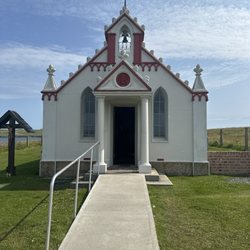
    In 1942, over 500 Italian prisoners of war were brought to Orkney in order to construct the…read moreChurchill Barriers at Scapa Flow, a long standing base for the British Navy. Their camp was located on the tiny island of Lamb Holm where the remains of pathways and Nissen footprints can still be seen. Lovingly and impeccably preserved, however, is the so-called "Italian Chapel," built by prisoners who longed for a suitable house of worship. Under the guidance of artistically-inclined prisoner Domenico Chiocchetti, the men converted two Nissen huts using whatever material they could salvage: concrete, paint, metal and even wood from war ships sunk in the Flow. The chapel took a couple years to complete, but prisoners were able to use it for worship while construction continued. Chiocchetti was, in fact, still working on the altar painting when the Barriers were completed in 1944; while his fellow prisoners were sent elsewhere, Chiocchetti remained on Orkney to finish what he started. In 1960, he returned to the chapel to restore his paintings, bringing with him his wife and the altar cloths she had embroidered for the church she'd heard so much about. When he left after the three week project, Chiocchetti bestowed the chapel to the Orkadians who had shown him and his fellow prisoners so much hospitality and friendship during the war, despite circumstances. Today, the chapel endures as a symbol of fraternity much revered by Orkadians (Mass is even held here the first Sunday of every month). Since you don't need much time to visit and it's easily accessed, the Italian Chapel is worth adding to any Orkney itinerary. Open year-round "from dawn to dusk."

    A great free attraction (although donations are welcome) open all year round! I went at the very…read morebeginning of January this year when a lot of other attractions were closed, and this was still open. A lovely wee chapel with a statue of St George outside (how ironic hey Scots!) that is very well kept and remarkable both inside and out. Definitely a not-to-miss attraction whilst on the Orkneys!

    Photos
    The Italian Chapel - Front

    Front

    The Italian Chapel
    The Italian Chapel

    See all

    Skara Brae

    Skara Brae

    4.9(15 reviews)
    14.2 mi

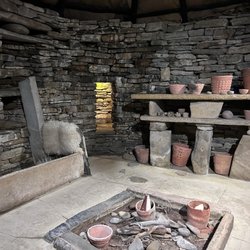
    Skara Brae is a fantastic look into the past. To stand there and look into the living conditions…read moreof pre iron age people in the Neolithic period is just incredible. The story of the discovery of this place due to a storm that uncovered it, the items left behind as if they just got up and walked away, the cleverness of the planning of the construction with no modern tools. This place is truly amazing and most definitely worth the visit. You're actually standing in a stone age village and can walk through looking down into the ancient dwellings.

    Before starting our cruise of the United Kingdom, I must admit that I had never heard of Skara…read moreBrae. I'm sure that I was not the only one either. What is the Skara Brae? It is a UNESCO World Heritage Site. It is a stone built Neolithic Village. What does Neolithic mean? Another name for Neolithic is the New Stone Age. So the Skara Brae was built a long long long long time ago. This village is over 5000 years old!! That is older than Stonehenge and the Great Pyramids in Egypt!! It is the oldest known village in all of Europe where you can still see the houses with their original stone furniture folks. It is truly incredible how well preserved this village is. Start at the visitor center to purchase your tickets. It would better to buy your tickets online for a lower price and to guarantee you get in. Before you see the original village, stop by the replica Neolithic house to see how it may have looked back in the day. After that, follow the path to view the 9 Neolithic houses. Make sure you follow the rules and remain on the path!! Do not be "that guy" who has to touch everything and have a selfie with the ancient artifacts!! We had an amazing time learning about Skara Brae, and imagining how our ancestors may have lived over 5000 years ago. It is situated in a stunning setting in Scotland overlooking the beach and ocean!! Back at the visitor center grab a bit at their cafe if you are hungry, and make sure you check the gift shop for souvenirs on your way out.

    Photos
    Skara Brae
    Skara Brae
    Skara Brae

    See all

    Broch of Gurness - Interesting chambers to go in and explore.

    Broch of Gurness

    5.0(4 reviews)
    10.8 mi

    This is cool place to explore Neolithic ruins and lots of little chambers to explore and look…read morearound. It was less cool than Jarlshof in Shetland, but still pretty neat--especially if you're just hanging out in Orkney. Even in the wind and driving rain near the water, it was still fun to climb around and explore the ruins. There are lots of little chambers you can climb into and play games around. The kids really enjoyed it. Smaller and less interesting than Jarlshof in Shetland, but still a nice stop.

    This is a ruined Iron-Age broch and associated prehistoric village from around the first or second…read morecentury BC, with an absolutely spectacular setting, at the end of a promontory overlooking Eynhallows Sound and the island of Rousay. Brochs are unique to Scotland, and their exact function is still not precisely known. Essentially, a broch is a tower, originally about 10m high, with a double wall with passages in it, and a central area presumed to have been open to the air. The towers taper slightly to the towards the top, giving them a shape akin to power station cooling towers. There was usually a single, low entrance to the tower from the outside, and no windows to the outside, but small openings to the interior. Some of them are isolated, and others form part of iron-age villages, but are nearly always by the sea. The most commonly accepted theory is that they were defensive structures, which could be easily sealed off from attackers: livestock would shelter in the central area, and the inhabitants in the spaces within the walls. As well as protection, their height may have provided a look-out function as well. Locations close to the sea were always vulnerable to pirates and other sea-faring enemies, so the locals would need somewhere to escape to quickly. In the case of Gurness, the broch was part of a village complex, which also had an outer wall, and three ramparts for additional defence. The broch itself was probably about 8m (26ft) high, and 20m (65ft) in diameter, which is rather wider than the classic broch shape. The village may have had about 40 families at its peak, but had declined and appears to have been abandoned around 100AD. The stones were then taken from the broch for other buildings - a trend that appears to have been kept up throughout history, so that the broch is now only 3.5m high. The site was then occupied by successive waves of immigrants, from the Scottish Picts in the 5th century, to the Vikings, who appear to have used the site for a burial. Thereafter, the site seems to have been left alone until the excavations in 1929 revealed the true extent of the site. Facilities at the site are fairly basic: there is a car-park, and a small ticket-office and shop, with an interpretation display. Some of the site is accessible by wheelchair via the grassy slopes, but assistance is recommended, and it is not suitable in wet weather. The site is 180m from the car park and, for those intrepid enough to get there by bus (route 96), it's a 45 minute walk from the village of Evie. There are also tours of this and other archeological sites organised from Kirkwall - enquire at Tourist Information. If you are driving, it is easy to make a day-long circuit of Orkney Mainland which takes in Maeshowe, Skara Brae, the circles at Stenness and Brodgar, and Gurness.

    Photos
    Broch of Gurness - Broch of Gurness, showing main broch structure in the background

    Broch of Gurness, showing main broch structure in the background

    Broch of Gurness - A ruined staircase inside the Broch.

    A ruined staircase inside the Broch.

    Broch of Gurness - The Broch overlooking the water.

    See all

    The Broch overlooking the water.

    Bishop's and Earl's Palaces - landmarks - Updated May 2026

    Loading...
    Loading...
    Loading...