Battelfield Memorial Park Photos


More like Battelfield Memorial Park
Recommended Reviews - Battelfield Memorial Park
Start your review...



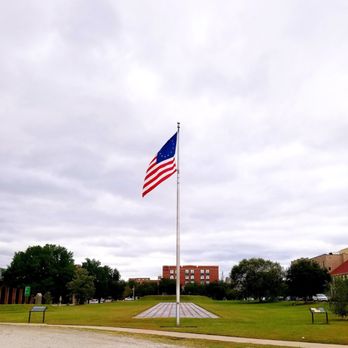
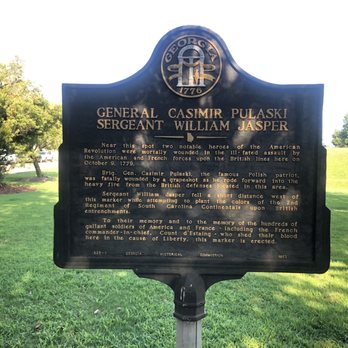
In the past when I thought of the Revolutionary War, I assumed that the battles were held in the north. I tend to think of Savannah as mainly being involved in the Civil War. That is why it was so cool to find this Revolutionary War battlefield on a recent trip to Savannah. I have since learned that there was a whole southern theater to the Revolutionary War. On October 9, 1779 more than 8,000 troops over three armies fought in the Battle of Savannah. During the battle 800 troops died or were wounded making this the seconded bloodiest battle of the war. During the battle, 2.500 crown loyalists who controlled Savannah faced off against 5,500 revolutionaries who were composed of soldiers from France, America, Germany, Haiti, Poland, Scotland, Ireland, and Sweden. During the battle five columns of the Continental Army attacked the British enemy lines. When the battle ended Savannah remained with the British. Battlefield Park, located on the corner of Louisville and MLK Jr. Blvd, was purchased by the City of Savannah in 2003 and in 2005 archaeologists discovered remains of the redoubt, a fort that was created during the battle. Money was raised through private donations and today the battlefield is a memorial. The Coastal Heritage Society's Preservation Team and Archaeology Team researched and restored the battlefield. They installed historic Interpretive panels which details the history of the battle. The fort has been recreated so visitors today can see how it looked in 1779. 800 granite stones were arranged to represent the dead and wounded. If you are interested in learning more about the battle you can do so at the Savannah History Museum located across the street. They hold a program called Loyalists and Liberty which teaches about the southern campaign of the war and it is offered to school field trips. On October 9th every year at dawn, a march is held by the Coastal Heritage Society to honor their ancestors who fought in the Revolutionary War. Eight nations who sent troops in support of the revolution are represented to honor their sacrifice. Today the site of the battle is a public park and it is open daily for self guided tours. read more
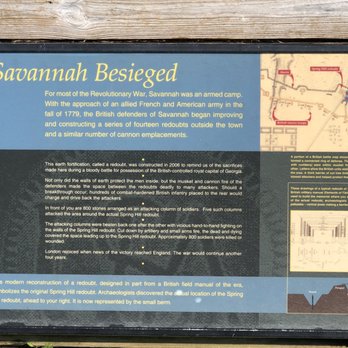


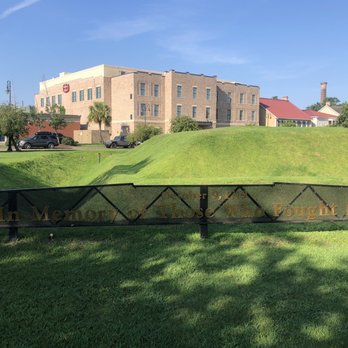


Battlefield Memorial Park (BMP) is to commemorate the estimated 800 troops that were wounded or paid the ultimate sacrifice during the Revolutionary War Battle of Savannah. BMP is located on the corner of Louisville and Martin Luther King Jr. Blvd, between the Visitor's Center/Savannah History Museum and the Georgia Railroad Museum/Savannah Children's Museum. Eight hundred granite stones are arranged in rows of ten with our nation's flag in the middle. There is an information board to the right of it. - Parking - I am assuming that you can park at the Georgia Railroad Museum, as the memorial is at the entrance to the Museum. If not, you can park at the Visitor's Center and walk over. "We don't know them all, but we owe them all" - Anonymous. read more