Cancel

    Open app

    Search

    ASA Biggs House Photos

    Recommended Reviews - ASA Biggs House

    Your trust is our priority, so businesses can't pay to alter or remove their reviews. Learn more about reviews.
    Yelp app icon
    Browse more easily on the app
    Review Feed Illustration

    9 months ago

    Helpful 9
    Thanks 3
    Love this 4
    Oh no 0

    Verify this business for free

    Get access to customer & competitor insights.

    Verify this business

    Hope Plantation

    Hope Plantation

    5.0(1 review)
    12.3 mi

    Hope Plantation is in Windsor, NC. It was the home of former NC Governor David Stone…read more Hope Mansion and the King-Bazemore House can be toured with a docent on certain days and times so check the website before visiting to make sure it will be open. You start your visit and buy your ticket at the Roanoke-Chowan Heritage Center. It has restrooms, a gift shop and two rooms to view that provide background information about the property. You can either walk or drive to the houses as they are a distance away. I was not sure what to expect when I decided to visit Hope Plantation and did not expect that the tour would be as long as it was and so thorough. It is possible that my tour was longer than normal as I was very interested in all of the facts provided. I was very impressed with this property; the history and the restoration. I try my best to find the hidden gems to visit so was excited that I found another. Both houses are on the National Registry for Historic Places. The land of the plantation sits was from a land grant by King Charles II of England. It was to lure settlers from Virginia and was given to Francis and Elizabeth Hobson. Elizabeth inherited the property after her husband died and later married Zedekiah Stone. The story told is that Elizabeth missed her homeland Hope Parish so the property was named Hope. David Stone was given the Hope tract of land as a wedding present. He constructed the Hope Mansion. The house was completed in 1803. It is of a Georgian style with Federal Period influences. The enslaved community provided the labor to run the plantation. The highly skilled labor can be seen with the craftsmanship of the home. After David Stone died, his son sold the property. It changed owners many times. In 1960 though the property was deteriorated and Bertie Country residents worked to save the property. They created a historical association and raised the funds to purchase the property. Then went on to restoring the mansion through research. The outside was completed in 1969 and by 1972 the restoration was completed. The King-Bazemore House was relocated to the plantation in 1974 to be restored. It is an example of a colonial home and would be compared to the Hobson-Stone House that was destroyed when the mansion was built. I highly recommend visiting this property in Bertie County if you love history and historic properties. You will not be disappointed. These properties are amazing and the restorations impeccable.

    From the owner: Restored home of former North Carolina Governor David Stone (1770-1818). Located four miles west of…read moreWindsor, NC, the plantation complex offers unique insights into the late 18th & 19th century rural life in eastern North Carolina and the South.

    Photos
    Hope Plantation
    Hope Plantation
    Hope Plantation

    See all

    Nuclear Mishap Historical Marker - Nuclear Mishap Historical Marker, Eureka

    Nuclear Mishap Historical Marker

    4.0(1 review)
    50.9 mi

    Yes, I drove an hour round trip to take a picture of a sign but this one is special. It denotes the…read moretime that the United States bombed North Carolina, nearly a hundred years after the end of the Civil War. The marker reads, "Nuclear Mishap. B-52 transporting two nuclear bombs crashed, Jan. 1961. Widespread disaster averted; three crewmen died 3 miles south." Okay, all kidding aside. Three Air Force crew died and in the process, prevented what would have been an unspeakable tragedy. It is a serious matter. During the height of the Cold War, the United States had a policy of keeping armed aircraft in the air at all times in the event of a conflict. Nuclear deterrence and all that. Well, this B-52G Stratofortress took some structural damage during an air refueling and while preparing to land at nearby Seymour Johnson Air Force Base, it experienced a major failure of the right wing. The plane broke up and exploded at 8000 feet. "As a result of the breakup of the plane, two MK39 nuclear weapons were released at a height of between 10,000 and 2,000 feet. Seven of eight arming, fusing, and firing switches and devices in one bomb automatically actuated. Only a crew-controlled switch prevented a nuclear detonation. Since its parachute deployed, one bomb had only minor damage when it fell about a mile from the crash site. The second bomb fell free, without its parachute deploying, and broke apart on impact." "Components of the bomb were sought for several weeks. The decision was made to leave remaining portions of the weapon containing uranium, believed to have entered the water table, in the ground. As a precaution, the government purchased part of the site and still maintains an easement in order to prevent digging in the vicinity. Periodic groundwater tests, still conducted by the state, have revealed no contamination." As the sign mentions, the actual crash is three miles away and the grounds are secured. Here in downtown Eureka, there isn't much. A small sandwich shop is near the sign if you're hungry. [Review 15486 overall, 990 of 2021, number 3029 in North Carolina.]

    Photos
    Nuclear Mishap Historical Marker - Nuclear Mishap Historical Marker, Eureka

    See all

    Nuclear Mishap Historical Marker, Eureka

    Barker House - Penelope Barker House, Edenton

    Barker House

    4.6(8 reviews)
    28.5 mi

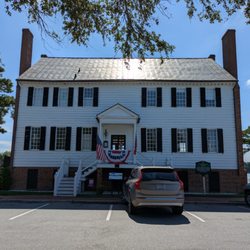
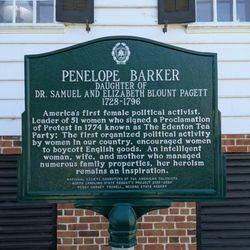
    The Barker House in Edenton, North Carolina, is a storied landmark that blends architectural…read moreelegance with deep historical resonance. Built in 1782 for Thomas and Penelope Barker, the home originally stood two blocks north of its current location and began as a modest Federal-style parlor wing and half hall. Penelope Barker is best known for organizing the Edenton Tea Party in 1774, a bold act of protest in which 51 women signed a petition against British taxation--making it one of the earliest political demonstrations by women in America. Unlike the Boston Tea Party, these women signed their names and sent the petition directly to King George III, drawing international attention and criticism from British newspapers. Since relocated (yes, they moved it two blocks), it now serves as Edenton's Welcome Center and the headquarters of the Edenton Historical Commission. Stop in for information about Edenton sights and history. I wasn't staying long here, but I was helped by friendly folks who clearly love their town. [Review 839 of 2025 - 4269 in North Carolina - 24398 overall]

    We were greeted by an excellent curator that provided us a very warm Welcome into the Barker House…read more The house is a beautiful step back in time with period antiques and a very nice gift shop. I purchased a Tea House cookbook and was amazed by the recipes along with beautiful historical notes of the area. You must stop in while visiting Edenton!

    Photos
    Barker House - Upstairs exhibit

    Upstairs exhibit

    Barker House - Downstairs books for sale

    Downstairs books for sale

    Barker House - Upstairs porch

    See all

    Upstairs porch

    Thelonious Monk - The marker in Thelonious Monk Plaza.

    Thelonious Monk

    3.0(1 review)
    41.7 mi

    So I know I can't be the first person to want to hit the Thelonious Monk Trail in Rocky Mount. But…read moreit looks like I'll be the first to write about it. I was visiting Raleigh, and I wanted to do the pilgrimage so bad that I hit the road early one bright Sunday morn headed east. Here's what I saw: 1) Thelonious Monk Plaza - I came into town this way, just a slight bit north of the main downtown strip. This plaza is one in the old-school sense - you won't find a minimall with Bath & Body Works around here, rather it's the old train station. This is where the historical marker is planted that identifies one of the true American greats. It makes sense to have jazz markers by the old train stations - it brings back the America of old, and also reminds you that the musicians generally built their careers by moving out. 2) Thelonious Monk Mural - I walked about half a mile from the Plaza to see this (incidentally, on a bright Sunday morn I was the only sign of life in downtown Rocky Mount). If you didn't know it was a tribute to Monk, you would just think it's a slightly unusual mural - a triangle of houses with a trompe l'oeil river stream/piano keyboard that literally flows out onto the pavement (entitled "Monk's Corner"). This was apparently one wall an arts center that no longer exists, sadly - it's near the Harambee Street Apartments. I walked back to my car via Main Street, which allowed me to look at the attractive old historic buildings in downtown, none of whom were doing any business on Sunday. 3) Thelonious Monk Park - Now this was a slight hunt, considering not even Old Man Google registers this park as a place. Further, there's a street address given near Washington/Dunn, but the sign that names the park is over on Wye which spurs off of Washington. That confused me a bit - you can basically identify the park, but I felt like I was slightly trespassing when I wandered along the residential neighborhood to get there. This is a "park" in the sense that you can have a picnic under the gazebo or push your kids on some swings - otherwise it's just a small green space. Monk's childhood home no longer exists but would have been somewhere on the grounds. 4) Monk Rd - This road, just a block south of Monk Park, was obviously named after the man, but there's about as much significance to the name here as there is to the man they named Washington Street after (whoever that was) - its just the name. Nice that it runs parallel to the train tracks, at least. And that's pretty much it at this point. There's been talk about erecting a statue for Monk here, which would be a great idea - the great John Coltrane statue in High Point would be the model to follow, down to the sound samples and all. Here's hoping that happens. Until then, though, you've got this at least. And if you check it out, put on "Pannonica" for the soundtrack - that's what I was listening to, and it seemed to capture the feel perfectly.

    Photos
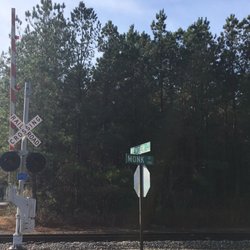
    Thelonious Monk - Monk St, at the crossing. And that's the Thelonious Monk Trail, straight no chaser.

    Monk St, at the crossing. And that's the Thelonious Monk Trail, straight no chaser.

    Thelonious Monk - The mural, "Monk's Corner."

    The mural, "Monk's Corner."

    Thelonious Monk - The park, with the train rolling on in the background.

    See all

    The park, with the train rolling on in the background.

    William Blount Historical Marker - William Blount Historical Marker, Windsor

    William Blount Historical Marker

    4.0(1 review)
    11.5 mi

    Traveling around and reviewing historical markers, a few names here and there seem to be a bit more…read morefamous than others. This is one of those. The marker reads, "William Blount. Member of Continental Congress, signer of the Federal Constitution, governor S.W. Territory, Senator from Tennessee. Birthplace 1/5 mi. southwest." It is marker number A-41 and it was erected in 1951. William Blount came from one of North Carolina's most prominent families and was educated in private academies in both North Carolina and Virginia. He served in the American Revolution as a paymaster and later held multiple terms in the state legislature, contributing to the adoption of the United States Constitution and the cession of western lands. As Governor of the Southwest Territory, he played a key role in negotiating the Treaty of Holston with the Cherokee and helped establish the state of Tennessee, chairing its constitutional convention. Blount College, now the University of Tennessee, was named in his honor. Though elected to the United States Senate, he was expelled in 1797 for involvement in a plot related to British expansion, but was later acquitted and returned to Tennessee politics. He died in Knoxville in 1800, leaving behind his wife Mary Moseley Grainger and seven children. Blount County Tennessee is named for him, as are both Blount Street in Raleigh North Carolina and Madison Wisconsin. Interestingly, Blount County in Alabama is named not for William, but for his half-brother Willie Blount. [Review 835 of 2025 - 4265 in North Carolina - 24394 overall]

    Photos
    William Blount Historical Marker - William Blount Historical Marker, Windsor

    See all

    William Blount Historical Marker, Windsor

    ASA Biggs House - landmarks - Updated May 2026

    Loading...
    Loading...
    Loading...