Cancel

Open app

Search

Alciston Church

5.0 (1 review)

Alciston Church Photos

Recommended Reviews - Alciston Church

Your trust is our priority, so businesses can't pay to alter or remove their reviews. Learn more about reviews.
Yelp app icon
Browse more easily on the app
Review Feed Illustration
Photo of David J.
96
2344
11912

17 years ago

Helpful 0
Thanks 0
Love this 0
Oh no 0

Verify this business for free

Get access to customer & competitor insights.

Verify this business

St Nicholas' Church

St Nicholas' Church

5.0(1 review)
6.5 mi

Iford is a small village in the Ouse Valley near Lewes, consisting of a single lane which loops off…read morethe Lewes to Newhaven road. Half way around is the surprisingly large and complex church of St Nicholas, dominated by an imposing central pyramidal tower. Built just after the Norman Conquest, the nave and central tower date from around 1090, with the current chancel built slightly later, perhaps around 1100. In the late 12th century, a north aisle was added but subsequently removed, and the remains of the three-arched arcade can be seen inside and out. Around the same time, the pyramidal tower cap was added and, in the 13th century, a little north chapel off the chancel, which now serves as a vestry. The interior is dark and atmospheric. It is dominated by the tall, Norman chancel arch, decorated with a roll and chevron motif, although the capitals are part of a Victorian restoration. The arches under the tower are all plain. The tower above contains three bells dated 1426, dedicated to Saints Margaret, Katherine and Botolph. A low, wide arch in the chancel leads to the former north chapel, and has a corbel in the form of a head at the east end: the chancel itself has an unusual arrangement of three, round-headed arches under a single oculus window at the East end. At the west end is the font, from around 1200, lit by a single lancet above the original (and now blocked) west door of the first church.

Photos
St Nicholas' Church
St Nicholas' Church
St Nicholas' Church

See all

Church of St Mary

Church of St Mary

5.0(1 review)
0.9 mi

Selmeston is a tiny one-street village just off the A27, with a lovely little church. The village…read moreand church were mentioned in the Domesday Book, although most of what now remains dates from a Victorian restoration in 1867. The church is built of flint in the typical Sussex style, with a red-tiled roof and a tall bell-turret with tiled walls and a shingled spire. Inside, the nave is dominated by the unusual wooden arcade, with octagonal wooden columns with curved braces rather than arches. These are 1867 replacements for the originals. The windows are also copies of the originals, the one in the chancel with glass by Kempe. On the floor is an attractive memorial ledger stone to Ann Cox (d. 1741), and in the chancel a 16th monument, used as an Easter Sepulchre. The interior has the following inscription: 1532 Here lyeth Dam Beatris Bray svm tyme the wyffe of Syr Edward Bray and dawgter of Raffe Sherley of Wyston and Wyfe of Edward Elderton Another memorial in the vestry floor has very strange wording indeed, almost a riddle: It reads: Here lyeth ye body of Henry Rochester Dyed May 28 1646 Apostrophe AD Omnes. This life that's packt with ielovsles and fears I love not. That's beyond the lists of fears. That life for me. For here I cannot breathe my prayers ovt. There I shall have breath to say Ovr Father that's in heaven wth me where chores of sancts and innocents there be Christianos. No sooner christened bvt possession I took of the heavenlie habitation. Strange indeed.

Photos
Church of St Mary
Church of St Mary
Church of St Mary

See all

Church of St Michael the Archangel - Aumbry in the nave

Church of St Michael the Archangel

5.0(1 review)
2.4 mi

Litlington is a delightful village in the Cuckmere Valley, between Seaford and Eastbourne. Although…read morestill a farming community, it has long made an additional living out of tourism; its famous Tea Gardens are now over 100 years old, and it is a popular stop for those hiking the South Downs Way. Its church is typical of the modest villages around these parts: a simple building with an unaisled nave and chancel, modest porch and a small, spired belfry. The main part of the nave and the chancel date from around 1150, with the western part of the nave (under the belfry), and the porch dating from the 14th century. Inside the details are simple but attractive: the windows are a mixture of Norman round-headed lights, Early English lancets and trefoil ogee-headed lancets, with two larger Victorian Decorated windows in the nave: the rough-hewn beams of the kingpost roof may be original. A strange niche opposite the Norman south door - delightfully filled with flowers on my visit - may have been an aumbry. The chancel has a 13th century sedilia and a 16th century Easter Sepulchre. At the west end, the early 16th century font still retains its original lead lining. Outside, the porch and northern buttresses below the belfry have 13th century mass dials. In the belfry, one of the bells dates from 1450, and was cast in the Whitechapel Bell foundry Overall, this is the simplest of village churches: modest but delightful. I enjoyed my visit here, and will come again.

Photos
Church of St Michael the Archangel - Font - 16th century. The little door behind leads to the belfry.

Font - 16th century. The little door behind leads to the belfry.

Church of St Michael the Archangel - Chancel arch and chancel

Chancel arch and chancel

Church of St Michael the Archangel - Trefoil headed light (left); large Early English lancet (right); and 13th century sedilia

See all

Trefoil headed light (left); large Early English lancet (right); and 13th century sedilia

Church of St Michael and All Angels

Church of St Michael and All Angels

5.0(2 reviews)
0.9 mi

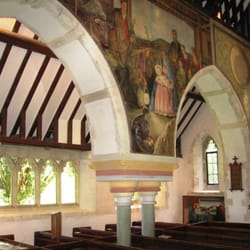
Berwick is a surprising little village: in many ways it is no prettier, charming or attractive than…read moredozens of other villages on the edge of the Sussex Downs. But its church draws big crowds every year, with a constant stream of visitors wending their way down the single little lane to St Michael's. What they find is a conventional building, dating from the 12th or 13th century, set in an attractive churchyard. The exterior is standard Sussex: flint walls, tiled roof and a shingled broach spire, all nearly hidden by an ancient yew. Inside, a south aisle arch suggests a 13th or early 14th century century date, there's a 14th century Decorated Gothic Easter Sepulchre in the chancel, and a primitive Saxon font at the west end. But, if I'm honest, you won't notice any of those, because what grabs the attention are the modern wall paintings and the astonishing north aisle arcade. The latter dates from a restoration in 1856, and its strange style - a Gothic arch on twin columns - was hated by Pevsner: 'illiterate and clumsy' he states in the Buildings of England. The church guide calls it 'innovative'. It's certainly different. Perhaps more successful is the idea of filling the large Victorian windows with clear glass: this lets light flood in, and the Sussex countryside provides a stunning vista. And then there are the paintings: these date from 1942-3, in the midst of war, a bold idea of the then Bishop of Chichester, to commission art in the time of war. The idea was to revive the mediaeval tradition of wall paintings found so often in other Sussex churches. Duncan Grant, Vanessa Bell and Quentin Bell (part of the 'Bloomsbury Group') were the artists, and the subjects were traditional biblical scenes, given modern and local twists: Christ is crucified while a soldier in World War II uniform looks on; the Nativity is acted out in a Sussex barn. The colours are bright and fascinating, but whether you like them or not is a matter of taste. I'm not entirely convinced - the plethora of colour on the architectural details is a bit too much for me, but I can see how others will admire them. There is only one way to decide, of course: go and have a look for yourself.

This Church is absolutely gorgeous. It was decorated by members of the the Bloomsbury group, mainly…read moreDuncan Grant and Vanessa Bell. Its a really nice place to visit especially if you are also visiting Charlston (where the Bloomsbury group lived/worked).

Photos
Church of St Michael and All Angels

See all

Church of St Mary the Virgin, Kemptown - St Mary Brighton - nave from baptistery

Church of St Mary the Virgin, Kemptown

5.0(1 review)
11.6 mi

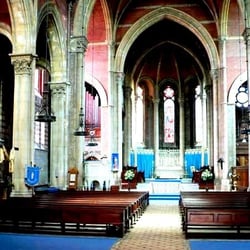
Never can such an unprepossessing exterior have hidden such a gem. From the outside, St Mary's…read morelooks like you average, run-of-the-mill neo-gothic Victorian church. It doesn't even look that large, and has the added humiliation of a public lavatory attached on one side. But once inside, you turn and find yourself in a cathedral-like space: a huge nave, an even larger crossing and a spectacular chancel and sanctuary. This is architecture as drama, writ large. St Mary's has had an interesting history: opened in 1827 to cater for the burgeoning suburbs of east Brighton, the original church was a rather handsome neo-classical building, modelled on the temple of Nemesis in Athens. Alas, like many Regency buildings, it was badly built, and partially collapsed during building work in 1876. The architect commissioned to design its replacement was William Emerson, known mostly for his work in India. St Mary's is his only church in the UK, and he chose the decorated gothic style for his new creation, albeit one with other elements: the aisle arches are round-headed and groups of Early-English lancets proliferate - all in red brick, with Bath stone detailing. The arcades rise to Corinthian capitals, both in the nave and in the apse of the sanctuary. Cleverly, Emerson made full use of the changes in levels, first down from the entrance and baptistery into the nave, and then back up again into the sanctuary, to emphasise the height. (The nave is 40ft across and 60ft high.) The only element not completed was the tower, which was abandoned for lack of funds, although early drawings show what was intended. The church has a wide array of Victorian stained glass, including an example by Kempe, although other workshops predominate. (The web-site has excellent pictures of all the glass). The furnishings are also of high quality, including a carved pulpit of Caen stone, and a marble font, which stands on a plinth of granite from the Schreckhorn mountain in the Bernese Oberland in Switzerland. This commemorates the second Vicar, Julius Elliott: an accomplished rock climber, he was the second to ascend the North Face of the Matterhorn, but died in 1869 after an apparently successful ascent of the Schreckhorn, at the age of 28. The other notable feature is its organ, which is known for its tonal quality, enhanced by the excellent acoustics of the church. The only downside to all this grandeur is that to-day's rather smaller congregation struggles to resource the scale of maintenance required of such a huge building. It needs generous visitors.

Photos
Church of St Mary the Virgin, Kemptown - St Mary Brighton - original design with the tower (never built)

St Mary Brighton - original design with the tower (never built)

Church of St Mary the Virgin, Kemptown - St Mary Brighton High Altar Reredos (1893)

St Mary Brighton High Altar Reredos (1893)

Church of St Mary the Virgin, Kemptown - St Mary Brighton Mosaic 01

See all

St Mary Brighton Mosaic 01

The Church of the Good Shepherd

The Church of the Good Shepherd

5.0(1 review)
2.1 mi

Pevsner states in his Sussex volume of the Buildings of England that Lullington church '..will not…read moreeasily be forgotten'. I am sure you will agree. The church is one of those which has lost its village: what remains of this little hamlet is now at the bottom of the hill, half a mile away. Just a single house stands next door. The easiest approach to the church is in fact from Alfriston, via the footpath which crosses the 'white bridge' over the Cuckmere River. You continue straight ahead, cross the South Downs Way, walk up a short flight of steps to the right of Plonker's Barn, and rise gently up the hill, until the path enters a thickly wooded copse. Just beyond the copse is the little clearing where the church sits. There is a narrow, slippery brick path ahead to the adjacent lane, but it's hard to find from the road. Once there, it becomes clear that it is not just its remoteness that makes it special: this is Sussex's smallest church, and may well be the smallest in England. Once rather larger, the church is said to have burned down in Cromwellian times, and the villagers rebuilt only the Chancel (and not even all of that) as their church. It seats just 20 people; services are held in the summer only, as there is neither heating nor lighting. The exterior is of flint, with a red tiled roof and a weather-boarded and shingled bell turret. The outline of the extent of the original church can be traced on the ground. The details in the chancel suggest a late 13th century or 14th century date, with simple and trefoil lancet windows, and a small piscina. But it is the atmosphere you come here for, not the architecture. And that is very special indeed.

Photos
The Church of the Good Shepherd

See all

Church of St Peter

Church of St Peter

5.0(1 review)
2.6 mi

Firle - or West Firle as it is also known - is a perfectly preserved manorial village just south of…read moreGlyndebourne. The descendants of the mediaeval Lords of the Manor still live in the substantial country house of Firle Place, begun in the 16th century and now open to the public. The church of St Peter is tucked away at the back of the village, and seems to be overlooked by the many visitors flocking to the house and the local pub. This is a pity, because it packs a lot of history into it walls. The oldest part of the building, the north door, dates from around 1200, but otherwise most of the fabric - tower, nave and chancel - date from later in the 13th century. The aisles with their fine Decorated Gothic arcades and clerestory of cinquefoil windows were inserted in the 14th century, the porch in the 15th and finally the Vestry or Gage Chapel in the 16th. The immediate impression on entering is one of spaciousness: the aisles are generous, and lit by Decorated Gothic windows, the east window of the south aisle containing original glass depicting the Trinity and two thurifers: one with the censer swung up, the other down! The Gage Chapel is separated from the Chancel by a very fine two-bay arcade in the Perpendicular style, although it is hard to appreciate with the organ located in the first bay. Also in the Chancel is a 13th century piscina and two Early Gothic lancet windows: the east wall and window is a modern replacement. However, it is the monuments for which the church is best known. These mostly relate to the Gage family and their ancestors. At the east end of the north aisle are three brasses. The centre one is of Bartholomew Bolney (d. 1476) and his wife Eleanor, whose daughter married William Gage in 1472. Either side are the brothers Thomas Gage (d. 1590), with his wife and children, and George Gage (d. 1569). In front of the chancel step are two more brasses, one to Mary Howard (d. 1638) in her funeral shroud, and one to Alice Levett, wife of the vicar of Firle, (d. 1676). If this wasn't enough, the Gage Chapel (or vestry) contains both alabaster monuments and more brasses. The monuments were by Dutch sculptor Gerard Johnson, and the drawings for them - complete with the client's comments - are preserved at the Manor. The most impressive is against the East wall, of Sir John Gage (d. 1556), who was Constable of the Tower and Chancellor of the Duchy of Lancaster under Henry VIII and Lord Chamberlain of Queen Mary. He and his wife are portrayed in marvellous, realistic life-sized effigies, which have survived in perfect condition. They repay a close look to admire the astonishing detail in which they are carved. The other two tombs, on the north walls, are similar, but topped by brasses rather than by effigies: one to Sir Edward Gage (d. 1569), son of Sir John; and John Gage (d. 1595) and his two wives, son of Sir Edward, who had the tombs erected. It's hard for any other furnishings to compete with these monuments, but the John Piper window in the Gage chapel (1985) may interest aficionados of modern stained glass, and the bell-frame under the tower, and two mass dials scratched onto the north wall outside, are worth a look.

Photos
Church of St Peter
Church of St Peter
Church of St Peter

See all

Church of St John the Divine

Church of St John the Divine

5.0(1 review)
25.6 mi

Patching village sits just above a gap in the South Downs, north west of Worthing, and above the…read moreglorious sweep of road known as 'Longfurlong', now part of the A280. The village has some picture-postcard thatched cottages, and a mediaeval church, dedicated to St John. History The village and church are first mentioned in the Saxon period in 948AD, and again in the Domesday survey, but the present building dates from around 1200. There is an unbroken list of Vicars from 1282 to the present day. The sequence of building in the church presents something of a mystery, as the fine arches beneath the tower (and the odd orientation of the nave) suggest that this may have been intended as the original crossing. The church was renovated in 1835, 1856 and especially in 1889, when the spire, porch and vestry were added, as well as its rededication to St John the Divine. The Church From the outside, the church is typical Sussex: flint walls, stone dressings and a tall, shingled spire, and Early English Gothic lancet windows throughout. Inside, the nave is wide and barn-like, with a magnificent, original roof. But what catches the eye is that the chancel arch of off-centre, with the nave apparently pushed to the left. Just before the chancel arch to the left is an archway to what is now the north transept, but is actually beneath the tower, and there are also arches to the east and west, all with shafts in classic 13th century style. The chancel is entered through an impressive Victorian screen, and has two lancets in the East End with a small Oriel window above, and a fine piscina with stiff-leaf capitals. The carved reredos is a modern addition. Furnishings include a very fine octagonal 15th century font, with quatrefoil panels enclosing rosettes, and a 19th century pulpit incorporating 16th century arabesque panels. On the floor beneath the tower is a fine 18th century memorial, to Mary (d. 1737) and Robert Bushby (1739). Their epitaphs read: Here Lyes beneath A Lass deprived of Life A tender Mother And a Loveing wife A faithfull friend A Father dear A loveing husband That lyeth here The modern parish includes the nearby church of Clapham and the larger church of Findon, up the Longfurlong road. The church is a Grade I listed building.

Photos
Church of St John the Divine

See all

Alciston Church - religiousorgs - Updated May 2026

Loading...
Loading...
Loading...