Cancel

    Open app

    Search

    Whalebone Arch Photos

    Recommended Reviews - Whalebone Arch

    Your trust is our priority, so businesses can't pay to alter or remove their reviews. Learn more about reviews.
    Yelp app icon
    Browse more easily on the app
    Review Feed Illustration
    Photo of Tanis L.
    283
    1056
    6355

    3 years ago

    Helpful 1
    Thanks 0
    Love this 3
    Oh no 0

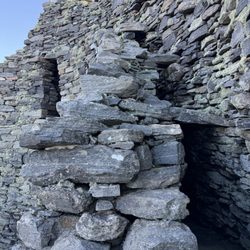
    Dun Carloway Broch - Looking back at the multiple levels from the top of the ruined stairs.

    Dun Carloway Broch

    5.0(2 reviews)
    6.5 mi

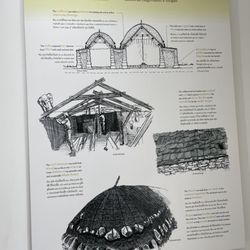
    When I visited the Dun Carloway Broch (Scottish Gaelic: Dùn Chàrlabhaigh) area on Thursday 11 July…read more2019, the parking lot and main visitor centre were open, however the broch itself was undergoing restoration and hence temporarily closed to visitors. I opted to observe the broch from outside and check out the visitor centre. One aspect I enjoyed, here at the broch and in northern Scotland in general, is the signage being both in English and the native Scottish Gaelic. Inside the visitor centre were a few displays covering different parts of the interior of the broch and the different time periods of importance for their usage. Brochs were a form of residence in Scotland in BC times up to about 800 AD. They were used up until about 800 AD, however their routine construction ended in roughly the first century BC. I thought this was a cool, that ancient (pre-AD times) architecture was at least semi-intact in Scotland. A true testament to human curation and restoration efforts. A variety of items were available for purchase. I went with a guidebook in both the native Scottish Gaelic and foreign English. The interior of the visitor center was well designed for visitor circulation. Worker(s) were kind.

    Dun Carloway Broch is an iron-age prehistoric site, about 5 miles north of Callanish on the Isle of…read moreLewis. Brochs are unique to Scotland, and their exact function is still not precisely known. Essentially, a broch is a tower, originally about 10m high, with a double wall with passages in it, and a central area presumed to have been open to the air. The towers taper slightly to the towards the top, giving them a shape akin to power station cooling towers. There was usually a single, low entrance to the tower from the outside, and no windows to the outside, but small openings to the interior. Some of them are isolated, but others form part of iron-age villages, but are nearly always by the sea. The most commonly accepted theory is that they were defensive structures, which could be easily sealed off from attackers: livestock would shelter in the central area, and the inhabitants in the spaces within the walls. As well as protection, their height may have provided a look-out function as well. Locations close to the sea were always vulnerable to pirates and other sea-faring enemies, so the locals would need somewhere to escape to quickly. They generally date from around the first century AD. The one at Dun Carolway is one of the best preserved of all, with one side standing some 5m high. The remains give an excellent insight into the overall structure. As well as the archaeology, the tower has a spectacular position overlooking the sea on Carloway Loch, giving amazing views and as well as a feeling of remoteness.

    Photos
    Dun Carloway Broch - Looking in under the stairs.

    Looking in under the stairs.

    Dun Carloway Broch - The broch.

    The broch.

    Dun Carloway Broch - Looking out the the sea from the main gate.

    See all

    Looking out the the sea from the main gate.

    The Black House - The kitchen and hearth.

    The Black House

    4.0(1 review)
    1.5 mi

    This is a small museum, bringing to life one of the traditional 'Black Houses' of the Isle of…read moreLewis. Based on a design which goes back centuries, these were essentially long, stone houses with heavily thatched roofs and very small windows, with living accommodation for the family at one end, and for their animals at the other. Heat from the animals helped maintain the temperature, as did a central, open-hearth fire sustained by burning dried peat. There were no chimneys in the houses, so smoke from peat fire found its way through the thatch to the outside, making the interior sooty black. But the name apparently wasn't coined until the 20th century, when new, white houses with all mod cons were built, and the old houses were renamed to distinguish them. The house in the museum is furnished as it would have been earlier in the 20th century, complete with the fire but no electricity. There are also other farm buildings around, a 1920's croft house, and a more modern house converted into a visitor centre. On my visit, we were told that the last Black House was still inhabited in the traditional way right up to the end of the 1960's. Apparently, many of the elderly people re-housed into modern accommodation found it very hard, since one of the unique features of the traditional houses is how well insulated they are against the almost constant, ferocious wind of the Hebrides: inside, it was almost completely silent. They found their new homes noisy and tinny in comparison. Although the site is reasonably accessible for wheelchairs, there are uneven floors and paths. There are toilets on site (including a disabled one), as well as a shop. The site is also a popular one with local school trips, seeing how their great-grandparents may have lived.

    Photos
    The Black House
    The Black House
    The Black House

    See all

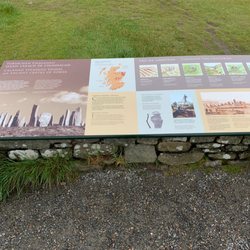
    Stones of Callanish - Informational placard about the standing stones.

    Stones of Callanish

    4.7(10 reviews)
    10.1 mi

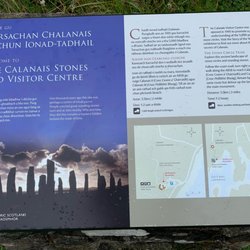
    When visiting the approximately 5,000 year old Calanais Stones (Stones of Callanish) on Thursday 11…read moreJuly 2019, I took a gander about both the visitor centre, including the gift shop, and the standing stones. The visitor centre was very informative and provided historical and spiritual context for the stones and their importance for the people who have lived in the area for the past few thousand years. I found a number of very cool finds at the gift shop that I bought including small rocks, a book with information about the stones, and a leather bracelet. A stone circle trail led out to the circle and around the different stones. Informational placards were located at different points along the trail. Coos (some also call them cows or cattle) in a field neighboring the stones watched on as I walked past and took pictures of them. I managed to catch the historical site in a lull before lunch and found a few other people exploring as well. As a geologist, it was fun to see the textures in the rocks that composed the stones. On my way out (around 12:30 p.m.), traffic was picking up with some people parking about half a mile down the street.

    As far as neolithic Stone Circles go, they do not get more enigmatic and prodigious than The…read moreCallanish Stone Circle. The Callanish Stone Circle is older than Stonehenge, and one of the oldest stone circles in Europe. This stone circle is set in a remote and wild section of Scotland that is as beautiful as it is rugged, and the Stones of Callanish add another element of wonderment to the backdrop. Geoff D. didn't think the stones at Callanish were that big or impressive next to Stonehenge, but the stones at Callanish are most certainly bigger than "3 and 4 foot tall rocks that one can walk around in about 30 seconds". I am 5 foot 1, and the stones were several feet taller than I. Besides that, a comparison between Stonehenge and Callanish strikes me as such a novice mistake: both circles are entirely different. A big difference is that Callanish appears to fall in line with a lunar calendar, as opposed to a solar one. Considering the weather is much wilder in the Outer Hebrides compared to southern England, and that Callinash was excavated from a peat bog in 1857, I think it is amazing that this stone circle is in such good shape. Callanish wasn't reconstructed as Stonehenge was, it stands now how it was hundreds of years ago. Also, aside from Callanish, there are several other stone circles in the area that are in plain eye's view from Callanish. The mythology surrounding the Callanish circles is also intriguing, as this stone circle has a few unique theories attached to it. Some people explain the presence of the stones as the giants of old who then lived on the island. The giants refused to be Christianised, so St. Kieran turned them to stone. Another theory is that the stones were carved to look like an army of giants to thwart any Viking raid in the island. Who wants to raid an island protected by an army of giants? The Isle of Lewis is out there, even by Scottish standards, but certainly worth the trek. Not only for the stone circles either, the area is full of amazing sites.

    Photos
    Stones of Callanish - Hedgy the Hedgehog (a plush) on a rock in front of a tall central standing stone.

    Hedgy the Hedgehog (a plush) on a rock in front of a tall central standing stone.

    Stones of Callanish - Visitor centre informational placard.

    Visitor centre informational placard.

    Stones of Callanish - Hedgy the Hedgehog (a plush) with one of the standing stones for scale.

    See all

    Hedgy the Hedgehog (a plush) with one of the standing stones for scale.

    Whalebone Arch - landmarks - Updated May 2026

    Loading...
    Loading...
    Loading...