Cancel

    Open app

    Search

    Watts Cemetery Chapel

    5.0 (3 reviews)

    Watts Cemetery Chapel Photos

    Recommended Reviews - Watts Cemetery Chapel

    Your trust is our priority, so businesses can't pay to alter or remove their reviews. Learn more about reviews.
    Yelp app icon
    Browse more easily on the app
    Review Feed Illustration
    Photo of David J.
    96
    2344
    11912

    13 years ago

    Helpful 0
    Thanks 0
    Love this 0
    Oh no 0

    11 years ago

    Helpful 0
    Thanks 0
    Love this 0
    Oh no 0

    11 years ago

    Helpful 0
    Thanks 0
    Love this 0
    Oh no 0

    Verify this business for free

    Get access to customer & competitor insights.

    Verify this business

    St Nicholas Parish Church

    St Nicholas Parish Church

    5.0(2 reviews)
    0.3 mi

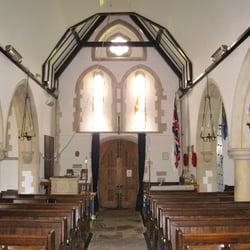
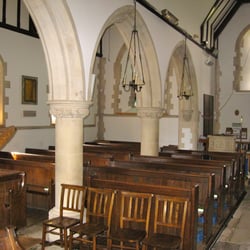
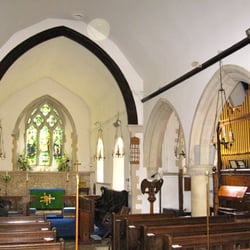
    The parish church of St Nicholas in Compton has the double honour of being Surrey's best Norman…read morechurch, and of possessing England's only two-storeyed sanctuary. It is well worth a visit. The lower part of the tower and the corners of the nave date from the earlier Saxon church. The Norman work is in two phases: the chancel arch and chancel date from 1080-1100, and the aisles with their solid, rounded arcades, together with the upper sanctuary, date from 1160-80. The only major later addition was the upper part of the tower with its shingle broached spire, in the late 13th or 14th centuries. The porch is Victorian. Inside, the whitewash reveals a wealth of Norman decoration. The chancel arch has fine dogtooth carving, and the capitals of the arcade piers have scalloped and crude foliage designs. The east nave wall has the remains of an unusual 15th century painted decoration, of stepped cubes in perspective, instead of the usual Judgement. The chancel is a gem: the lower sanctuary is framed by an exquisite arch with roll mouldings, saw-tooth and dog-tooth ornament. The balustrade of the lower sanctuary is Jacobean, c. 1620 (as are the fine pulpit and screen), but this is outshone by the Romanesque balustrade of the upper sanctuary: this is original Norman work (c. 1180), making it the oldest architectural timberwork in situ in England. Squints to the north and south chancel walls may relate to anchorite cells: that on the south side may have been a chantry chapel. An ancient wooden staircase joins the two sanctuaries. The fittings and fixtures are equally rich: the north aisle and lower sanctuary have 14th and 15th century tomb recesses, and piscinas and aumbries abound. The chancel arch has rare Crusader graffiti, a 12th century image of a knight with a pointed helmet, with crosses and intersecting circles. The east window has 13th century stained glass of the Virgin and Child, and in the nave floor are brasses to the Thomas Genning and his family (d. 1508), though sadly with some of the images missing. The church has no fewer than four services on a Sunday. After your visit, the nearby Watts Cemetery Chapel provides a striking contrast of Arts and Crafts workmanship.

    It is many many years since I went inside St Nichols Church and it warms my heart looking at the…read morephotographs to see that it has not been ripped apart in the name of 'modernisation' It is one wish on my 'bucket list' to visit the Church again - there is no reason why I should not and would choose a fine warm Sunday to journey up from Bognor Regis - it is not a million miles away - and mingle in with the congregation. I spent a few years of my childhood living in Binscombe but then it was just a little village - a far cry from that now, and what was the road is now a pavement! Thank you so much for preserving some of our heritage I know it isn't an easy task, while nothing lasts forever! it would be so sad to loose everything at this point in time...

    Photos
    St Nicholas Parish Church
    St Nicholas Parish Church
    St Nicholas Parish Church

    See all

    The oldest synagogue in England

    The oldest synagogue in England

    5.0(2 reviews)
    31.3 miAldgate

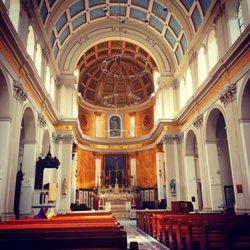
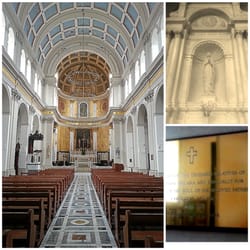
    There's not much to add to Templar's comprehensive review: still regarded by many as one of the…read moremost important centres in the Anglo-Jewish community, the Bevis Marks Synagogue is beautifully maintained. It is strongly reminiscent of the Wren and Hawksmoor churches of the City in its classical architecture and furnishings, which include impressive brass candelabra and 17th century wooden benches. The Synagogue's tradition is Orthodox, so men and women are separated: men on the ground floor, women in the galleries. Their opening hours (for visits) are slightly longer than advertised on their website, so it's worth contacting them ahead of a trip to London if you want to pay a call. Tourists (as opposed to those attending services) are asked to pay £3 for entry, and men are asked to wear a skull cap - one will be provided if you don't have one. Your bags may also be searched. They sell a small range of postcards and books at the entrance.

    Situated in a secluded courtyard, the Bevis Marks Synagogue was opened in 1701 to serve the Spanish…read more& Portuguese Jewish Congregation. Today it is one of the best-preserved houses of worship of its period still in regular use. The Inquisition, revived by Ferdinand and Isabella, turned its attention to these crypto-Jews, and from the last years of the fifteenth century, they: were systematically persecuted, arrested, tortured, tried, and burnt at the stake. From about this time there was a constant exodus of 'Marranos' who succeeded in escaping from Spain and Portugal or its dependencies to avoid persecution and a small number of them reached Protestant England. Outwardly, they were obliged to behave as Christians, for at that time Jews were not allowed officially, to enter the country, but at any rate they could live there, provided that they behaved with circumspection, and could meet in secret in each others' houses for prayer. The first Jewish house of worship of the resettlement of the Jews in England was as opened in 1656 in the upper floor of a house in Creechurch Lane, which is but a stone's throw from the present Synagogue in Bevis Marks The site of this house is today marked by a plaque, on the rear corner of Cunard House in Creechurch Lane. Jews were permitted to return to Britain in 1657 under Oliver Cromwell. They felt that the time was opportune to present a petition in the form of a humble address to Oliver Cromwell asking for the official re?admittance of the Jews to England Their decision was no doubt a wise one, as Cromwell, reared in a Puritanical atmosphere with its emphasis on the Old Testament was likely to hear favourably any petition presented by the 'people of the Old Testament'. Some of the most eminent figures of Anglo-Jewry sat at prayer in the Synagogue such as Sir Moses Montefiore. Disraeli was born into the Congregation and there are links to the Rothschilds. Today it is regarded as the most distinguished British Synagogue. The magnificent wooden Ark or cupboard) resembling a reredos, at the east end, is built in classical architecture in the manner of Sir Christopher Wren's time. It contains (as is the custom in Jewish synagogues') the sacred scrolls of' the Pentateuch, or five books of Moses, written in Hebrew on parchment, which are read in consecutive instalment over the period of a year as the central feature of the Sabbath Service. Several splendid seventeenth century vestments and silver ornaments belonging to the scrolls survive. The entablature of the Ark has as its central feature the Ten Commandments written in Hebrew (abbreviated), above which are inscribed in Hebrew the words 'Know before Whom thou standest'. The silver hanging Sanctuary Lamp, burning perpetually before the Ark, was presented by Edward Foligno in 1876 and evidently replaces an earlier example, now lost. Except for the addition of the doors to the Banca or Wardens' pews and to the Haham's or Chief Rabbi's seat in 1787, and of the choirstalls in about 1830, the ancient synagogue has remained virtually unchanged. Electric light was installed in 1929 Even though recently restored, the interior has barely changed since it was built. It is in the style of many Nonconformist chapels of the period. The influence of Sir Christopher wren is also evident. The Synagogue has one of the finest collections of Cromwellian and Queen Anne furniture in the country and the magnificent brass candelabra with glowing candlelight. On 19th December 1951 the Congregation held a Service to celebrate the 250th anniversary, of the opening of the Synagogue which was attended by the Duke of Edinburgh. On 22nd March 1956 British Jewry held a Service of dedication and thanksgiving at the Synagogue on the tercentenary of the resettlement of the Jews in the British Isles. Twelve pillars, symbolising the tribes of Israel, support the ladies' gallery, the reading desk and Echal are flanked by 10 candlesticks representing the Ten Commandments; and the interior is dominated by seven magnificent candelabra, corresponding to the days of the week. One of the great oak beams supporting the roof is said to have been presented by Princess (later Queen) Anne. In 1992 and 1993 the synagogue suffered great damage from terrorist bomb attacks on the City of London. Nearly £200,000, raised by donation, has since been spent in repairing and renovating the structure
    Photos
    The oldest synagogue in England

    See all

    Church of St John the Divine

    Church of St John the Divine

    5.0(1 review)
    26.9 mi

    Patching village sits just above a gap in the South Downs, north west of Worthing, and above the…read moreglorious sweep of road known as 'Longfurlong', now part of the A280. The village has some picture-postcard thatched cottages, and a mediaeval church, dedicated to St John. History The village and church are first mentioned in the Saxon period in 948AD, and again in the Domesday survey, but the present building dates from around 1200. There is an unbroken list of Vicars from 1282 to the present day. The sequence of building in the church presents something of a mystery, as the fine arches beneath the tower (and the odd orientation of the nave) suggest that this may have been intended as the original crossing. The church was renovated in 1835, 1856 and especially in 1889, when the spire, porch and vestry were added, as well as its rededication to St John the Divine. The Church From the outside, the church is typical Sussex: flint walls, stone dressings and a tall, shingled spire, and Early English Gothic lancet windows throughout. Inside, the nave is wide and barn-like, with a magnificent, original roof. But what catches the eye is that the chancel arch of off-centre, with the nave apparently pushed to the left. Just before the chancel arch to the left is an archway to what is now the north transept, but is actually beneath the tower, and there are also arches to the east and west, all with shafts in classic 13th century style. The chancel is entered through an impressive Victorian screen, and has two lancets in the East End with a small Oriel window above, and a fine piscina with stiff-leaf capitals. The carved reredos is a modern addition. Furnishings include a very fine octagonal 15th century font, with quatrefoil panels enclosing rosettes, and a 19th century pulpit incorporating 16th century arabesque panels. On the floor beneath the tower is a fine 18th century memorial, to Mary (d. 1737) and Robert Bushby (1739). Their epitaphs read: Here Lyes beneath A Lass deprived of Life A tender Mother And a Loveing wife A faithfull friend A Father dear A loveing husband That lyeth here The modern parish includes the nearby church of Clapham and the larger church of Findon, up the Longfurlong road. The church is a Grade I listed building.

    Photos
    Church of St John the Divine
    Church of St John the Divine
    Church of St John the Divine

    See all

    Parish Church of St Peter and St Mary

    Parish Church of St Peter and St Mary

    5.0(1 review)
    27.6 mi

    Fishbourne is best known for the remains of the impressive Roman palace which once stood in the…read morevillage. But it is has a pretty little church wit mediaeval origins, if rather heavily rebuilt in the 19th century. History The church was built between 1243 and 1254, but may initially have consisted only of the present chancel. The nave and bell-cote were added in the 14th century. Little changed until 1821 when a north transept was erected, with a stuccoed porch. In 1847 a south aisle was added, and the transept and nave were enlarged westwards to form the church we see today. The church The setting is a little surprising: although uncomfortably close to the A27, it is well screened by trees and can be approached from the village by a short, public footpath through woods and fields, which provides an altogether more sylvan setting. The exterior walls are a mixture of ragstone and flint, all very neat and testifying to the Victorian rebuild. Inside, apart from a small section of the arcade wall at the west end, the nave and aisles are now basically of 19th century date. The aisles of three bays on either side are each as wide as the nave, and give it a bright and spacious feel. The fabric of the chancel is 13th century, with one original lancet to the south east. (All the rest were renewed.) This space is altogether more intimate, and contains some ancient looking pews possibly Jacobean? used as choir stalls. In one of the lancets is a fragment of old glass possibly 16th or early 17th century. Other items of interest include two memorials at the west end, one in Latin to Anthony Wells (d. 1594) and one to an unknown member of the Lane family, dated 1612 and carrying the crest of the family. Outside on the north east corner of the chancel are pilgrim crosses, possibly made by Continental visitors going to the shrine of St Richard of Chichester, from 1262 onwards. The church has a lively and active congregation, currently raising funds to build a new parish hall.

    Photos
    Parish Church of St Peter and St Mary
    Parish Church of St Peter and St Mary
    Parish Church of St Peter and St Mary

    See all

    Hillsong Church London

    Hillsong Church London

    4.2(23 reviews)
    29.9 miBloomsbury

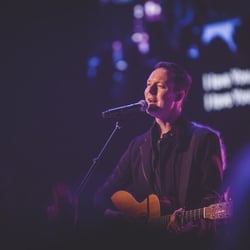
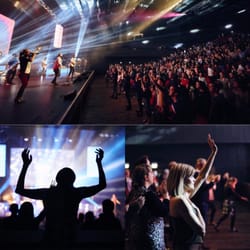
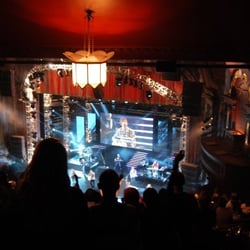
    ABUSIVE, 80% BORING, AND NOT CARING ABOUT CHILDREN'S SAFETY:…read more THEY ARE FILTHY CROOKS. And the sermons delivered by their pastors (not their guests I have seen so far this year) at the Central London branch are SO boring!!! I have not heard such boring messages since I became a born again Christian and I think we have not since the world began. What is going on? They are SO pathetic!!! God sees. God agrees. Of course. On Sunday 23/11/2025 at Hillsong Church Central London at Dominion Theatre there was a serious incident. *A female church volunteer deliberately* endangered my precious sons Jeremiah and Ethan who are 10 and 8 years old by providing us with wrong information at the start of the service. As I raised concerns about this potentially dangerous misinformation, do you know what their response was? Three security staff and a Hillsong church female staff member attempted to terrorize and threaten me, and they vigorously defended the hypocrite female volunteer who deliberately gave me the wrong information endangering two young children, how evil! The female church staff member's behavior stemmed from jealousy (it was 100% jealousy getting her to attempt to terrorize and threaten me like that, the confidence she tried to exhibit after the church service was extremely fake, she wanted to give the impression that I am the one in the wrong and she has finally done the right thing mistreating me the way she did at the start of the church service, cock and bull story, her jealousy is monstrous) and honestly I don't care because I have other important *GOOD* things to do in this world. I passed kindergarten and I am very focused. After the church service, three of the security staff at Dominion Theatre continued their harassment. I was forcibly escorted out with Jeremiah and Ethan by two of the security staff (without having caused a scene during the church service, no) while my precious son Ty who is 16 had gone to the restroom. The two security staff refused to let me re-enter the hall to get my precious son Ty after forcibly escorting Jeremiah, Ethan and I out. Only one man who attended the church service intervened, asking the abusive two security staff to allow me back inside to get my third child, but they still denied me that. I very much thanked that man who intervened. I then spotted my son Ty, who, noticing my absence in the hall, was calling my phone to find out where I was; I had to shout his name for him to come to me. They wouldn't let me go back inside to get my own child? It highlights how fitting the term "FILTHY CROOKS" is for them. A third security staff mocked us, laughing at me, Jeremiah and Ethan. I contacted news outlets like SKY News to expose the way I was mistreated. Yesterday 30/11/2025, as we went to church my precious children and I for God, I was told by one of the abusive security staff from the previous Sunday that Hillsong Church Central London has refused that I continue to attend their church. Someone called Steve, a church representative I believe, spoke to me and confirmed this. They mentioned an email was sent to me about it. I told them I had not received that email which is true. THEIR JEALOUSY IS DISGUSTING AND MONSTROUS! And ugly. What they don't know is that the night before God, who is always on my side, revealed a secret to me and instructed me not to disclose it until after I attended church yesterday and witnessed their actions. God clearly stated: "NOT THIS TIME", in a very strong and powerful manner. I wonder what God meant. God spoke that against those at Hillsong who support my mistreatment, showing me, assuring me, that he is on my side. He is definitely infinity percent not with them when it comes to the way they treated me the previous Sunday and yesterday. THANK YOU SO MUCH, LORD! YES!!! Please FIRE and BAN the three abusive security staff, the abusive jealous female church staff and that female volunteer who deliberately gave me wrong information. Shut down their evil. For good. Now. THANK YOU. Patricia Wagner

    It's always great to visit this church here in Bloomsbury, the community are friendly and you feel…read morelike you're home around your family!

    Photos
    Hillsong Church London
    Hillsong Church London
    Hillsong Church London

    See all

    St Margaret's Church Barking - Nave

    St Margaret's Church Barking

    5.0(1 review)
    37.6 miBarking, Dagenham

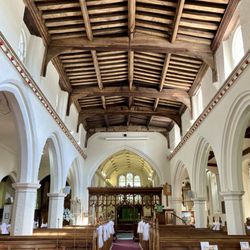
    At the edge of the bustling town centre is a delightful (and substantial) mediaeval church, which…read moreis well worth a visit. St Margaret of Antioch was built as a chapel within Barking Abbey, and in 1300 it became the town's parish church. It sits east of the centre in a wide expanse of green - once the Abbey grounds, of which only the Curfew Tower remains. The church has been expanded over the years, so it now contains a happy mix of all periods from the 13th to the 16th centuries. Inside, the oldest part is the chancel and part of the nave, which date from c. 1215, although most of the fabric is 15th Century: the outer north aisle and chapel were added in the 16th Century using materials from the dissolved abbey. In 1772, the church was heavily remodelled under the direction of a local landowner, Bamber Gascoyne, who had much of the original fabric encased in decorative plasterwork. Of this, the lovely chancel ceiling remains, complementing the fine mediaeval roofs in the nave and north aisles. Traces of mediaeval painting remain in the chancel arch. However, the true joy of the church is its furnishings, testament to the wealth of Barking from the 17th Century onwards, when it was a sizeable fishing port. In the chancel, the memorial to Sir Charles Montagu (d. 1625) shows him in his tent on campaign, dozing while armed musketeers stand guard. Nearby is the fine engraved tombstone of Martinus, the first recorded Vicar of Barking, dating from 1315. Of special note is that to Captain John Bennett (d. 1715) and his mother and father, his figure surrounded by the fore and aft of a fully-rigged sailing ship, navigational instruments and globes. He also has a fine tomb in the churchyard in the same style. The nave has poppyhead pews incorporating 18th century woodwork, and the classical-style font (c.1635) is topped by a jolly cover, decorated by Jessie Jack, daughter of the Arts & Crafts craftsman George Jack. There is some good stained glass, and the Fisherman's Chapel includes statues of local notables associated with the parish, including Captain Cook (who married Elizabeth Batts here in 1762), the Quaker and prison reformer Elizabeth Fry, and St Ethelburga, the first Abbess of Barking. The church is the centre of a busy parish life, and includes an excellent tea room in the adjoining church centre, where I enjoyed a lovely lunch and a very friendly welcome.

    Photos
    St Margaret's Church Barking - The Curfew Tower, the only remaining part of Barking Abbey to survive.

    The Curfew Tower, the only remaining part of Barking Abbey to survive.

    St Margaret's Church Barking - Nave, looking west

    Nave, looking west

    St Margaret's Church Barking - Stained-glass window depicting the last supper

    See all

    Stained-glass window depicting the last supper

    Watts Cemetery Chapel - religiousorgs - Updated May 2026

    Loading...
    Loading...
    Loading...