Cathays Park in Cardiff is one of Europe's finest Civic Centres, built in the early years of the…read more20th century to reflect Cardiff's rapid development as a major city and trading port, largely due to the export of coal. What had been a small town of a few thousand souls in 1800 was, by 1900, the largest coal exporting port in the world, and home to over 150,000.
A key figure in the early life of Cardiff was the local landowner, the 1st Marquess of Bute. He was responsible for the rebuilding of Cardiff Castle and Castell Coch, and in 1898 sold what had been the grounds of a Georgian Mansion to the City to enable construction of the Civic Centre. It now contains the National Museum of Wales, the main buildings of the University, administrative buildings of the Welsh Assembly, Law Courts and, as its crowning glory, Cardiff City Hall.
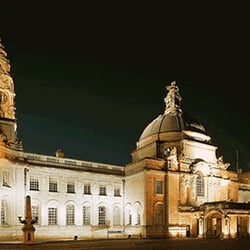
Completed in 1904 and built in white Portland stone, this magnificent baroque building was designed by the firm Lanchester, Stewart and Rickards after an architectural competition. The basic design includes an imposing central dome and entrance portico, with an offset 194ft (60m) tall bell tower. The external statuary represents the City's three rivers, the Taff, Rhymney and Ely.
The bell tower is something of a landmark, and contains five bells, each inscribed with a motto in English or Welsh:
Hour bell: 'Y gwir yn erbyn y byd' (His truth against the world)
1st Quarter - 'I mark time, dost thou?'
2nd Quarter - 'Duw a phob daioni' (God is all goodness)
3rd Quarter - 'Time conquers all and we must time obey'
4th Quarter - 'A gair Duw yn uchaf' (God's voice on high)
Inside the main entrance hall has two grand staircases leading to the grand first floor reception, appropriately called the 'Marble Hall'. The most impressive internal rooms (there are also offices, of course) are the Council Chamber and the Great Assembly Hall. The latter possesses three huge bronze chandeliers and has been used for all sorts of functions, from dinner dances (which my Mum and Dad used to attend for 1/6 in the 1950s!) to banquets for Royalty and visiting Heads of State. The Council Chamber, of oak and Breccia Marble, is also worth a look, and was used for a meeting of the European Council in 1998.
The Edwardian period was a time when Wales was rediscovering its history and confidence, and so the interior reception halls - especially that on the first floor - are decked out with the best Edwardian marble statues of Welsh heroes and heroines by noted sculptors of the day. To modern eyes, apart form the dubious historical accuracy, they are a bit overblown, but impressive nonetheless.
Better is the building's impressive art collection, mostly of late Victorian English painting, including some minor pre-raphaelite works by Blair Leighton and my favourite, 'Winter', by the Scottish artist, Joseph Farquharson, (much beloved of Christmas Cards). There are also portraits of political figures, such as Lloyd George, George Thomas and James Callaghan, and a rather odd triple portrait of Diana, Princess of Wales by John Merton (for hardened Diana fans only).
As well as conferences, banquets and similar events, the Marble Hall is licensed for weddings and they can also cater for receptions for up to 500 guests.