Cancel

    Open app

    Search

    Temple Church

    3.8 (6 reviews)

    Temple Church Photos

    Recommended Reviews - Temple Church

    Your trust is our priority, so businesses can't pay to alter or remove their reviews. Learn more about reviews.
    Yelp app icon
    Browse more easily on the app
    Review Feed Illustration

    7 years ago

    Helpful 3
    Thanks 0
    Love this 5
    Oh no 0
    Photo of Melanie M.
    2
    332
    328

    17 years ago

    Helpful 3
    Thanks 0
    Love this 1
    Oh no 0

    16 years ago

    Helpful 1
    Thanks 0
    Love this 1
    Oh no 0
    Photo of Xaviant H.
    134
    40
    178

    9 years ago

    Helpful 1
    Thanks 0
    Love this 0
    Oh no 0

    17 years ago

    Helpful 1
    Thanks 0
    Love this 0
    Oh no 0
    Photo of Lisa B.
    5
    378
    358

    16 years ago

    Helpful 0
    Thanks 0
    Love this 0
    Oh no 0

    Verify this business for free

    Get access to customer & competitor insights.

    Verify this business

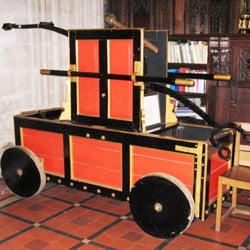
    St Mary Redcliffe Church - 18th century fire engine.

    St Mary Redcliffe Church

    4.2(17 reviews)
    0.2 mi

    As fine an example of English Gothic as you are likely to find anywhere in Britain, it's hard to…read morebelieve that this imposing edifice is a parish church and not a cathedral. It totally dominates the area and its spire can be seen miles away. There is a lot of history here, which I didn't have time to explore thoroughly as I was mainly interested in the architecture. I was looking for a particular roof boss of a labyrinth (which is in the north aisle if you're wondering), but there's lots of other interesting things to see. I liked the water balance sculpture in the north transept, where a flow of water can tip a balance scale either way at random intervals, thus demonstrating chaos theory according to the blurb. Lots of other interesting carvings and wonderful roof bosses,nterestingly mostly in the north aisle. Also look out for the rusting iron tramline rail in the grounds, which was thrown over the adjacent houses in a bomb blast during WW2 and has been left in the ground here where it landed - a very sobering reminder of the Blitz.

    In 1574, no less a person than Queen Elizabeth I is reputed to have declared the church of St Mary,…read moreRedcliffe to be the "fairest, goodliest and most famous parish church in England." And who can argue with that? The church owes its existence to the merchants who made Bristol a major mediaeval trading centre. Here, wines from France, sherry from Spain and port from Portugal was imported. Later, it was a major port for the New world, with tobacco and, less happily, the slave trade adding to its wealth. Although begun in the 12th century, the merchants paid for the church to be rebuilt in the English gothic perpendicular style in the 15th century, delivering a series of vast stone vaults, filled with light from huge panel windows. Even the transepts have vaulted aisles. The result is a church of larger and more impressive proportions than many a cathedral. Seen from outside, the tower (at 292ft (90m), it is the second highest parish tower in England), soars among the modern offices that surround it. The double porch, dating from the mid-14th century, is a marvel of gothic decorated architecture. The outer porch, with its seven-pointed arch, has a distinctly moorish feel, doubtless reflecting the travels of its benefactors abroad. Besides the architecture, the interior also has much of interest, particularly the various tombs, brasses and memorials. These include a number connected with the New World: Sir William Penn, father of the founder of Pennsylvania is buried here; and a whalebone, presented by John Cabot, after returning from his voyage to Newfoundland in 1497, hangs on a wall. Part of its glory is found by looking upwards: the roof contains over 1,200 decorated bosses where the ribs cross and intersect. The church has a cafe in the crypt open 10-16h, serving snacks and lunches. Music is also important to the church, whose impressive choir produces its own CDs. The website has German, French and Dutch language versions. *************************** Photos added 29-01-2008

    Photos
    St Mary Redcliffe Church
    St Mary Redcliffe Church
    St Mary Redcliffe Church

    See all

    St George's Bristol - Taken from their website

    St George's Bristol

    4.4(8 reviews)
    0.8 mi
    ££

    St Georges is a beautiful venue just off Park Street on the way up to Brandon Hill. Its…read moremagnificent palladian facade will prepare you well for a night of classical music. Their usual line up is classical, but they also have a really eclectic mix of Jazz and World Artists perfoming. The latter, especially, are often the type of acts who do tours of rarer artistic and cultural venues around the country. This means the acts are extremely unique, but in my experience so far, they're always utterly phenomenal and very worth knowing about and seeing. This is a venue Bristol should really be proud of - it's lesser well known than the more major music venues in the town, which is perhaps why they still have a massive degree of quality with regards to the acts they invite to perform. I strongly advise getting involved with St Georges, keeping track of the programme, and experiencing a night of music in this phenomenal venue.

    A concert hall just off Park Street that puts on a lot of classical performacnes, as well as some…read morejazz and other genres. Run by the council, it offers cheap access to a bit of culture. It's quite an experience climbing the stairs and entering under the thick sandstone pillars, the building is very imposing. Opened in 1999 the interiors stayed smart since then, and they're currently celebrating their tenth birthday. If you enjoy classical music, or just want to sample it, the lunchtime concert series is a good opportunity and at only £7 (£4 for students, children and job seekers) an absolute steal. They have relaxing gardens as well, so you can bring a picnic and make a day of it. As a classical music venue it is excellent, with good accoustics and a grand open space. I've been told that St. Georges is one of the countries, as well as one of Bristol's, finest music venues.

    Photos
    St George's Bristol
    St George's Bristol
    St George's Bristol

    See all

    Saint Stephen's Church

    Saint Stephen's Church

    4.5(4 reviews)
    0.5 mi

    I am a fan of anything with some history behind it, and in Bristol I sometimes find this a bit hard…read moreto fin. I mean obviously you have Bristol Cathedral, Clifton Suspension Bridge, HMS Great Britain etc etc but I want to find something a little less touristy. Well, if you are like me then check St. Stephen's Church out. It's breathtaking inside and really well looked after. There are not hoards of tourists which means you can spend as long as you want exploring. There is also a really great cafe within the Church's gardens which is so nice and peaceful. The coffee they serve is also pretty damn good! Well worth a look if you are both a tourist and a resident of Bristol.

    This is a large and well preserved 15th century town church, filled with monuments, with an…read moreimpressive tower, quiet churchyard and a small modern cafe. History Although there has been a church on the site since the 11th century, the present structure dates from a comprehensive rebuilding in the late 15th century. The tower and East window were the gift of John Shipward, Mayor of Bristol (d. 1473). The clerestory was repaired after a storm in 1703, and the aisle and east window repaired in 1873. It now has an active ministry to the City Centre, with innovative, modern forms of worship. The church The most impressive external feature is the tower. This is 152ft high, of an elaborate Perpendicular Somerset design, but with a Gloucester style crown with complex open tracery, decorated with pinnacles and gargoyles. The main church has aisles to the nave, of seven bays, but no crossing, with large Perpendicular windows in both aisles and clerestory. The church has impressive monuments: on the north wall is a tomb chest with effigies and statuettes in ogee niches, to Edmund Blanket (d. 1371), a clothier and wool merchant. Also on the north wall is one to Martin Pring (d. 1627), who explored the coast of what is now Massachusetts, Maine and New Hampshire. This is an elaborate affair, decorated with allegorical figures, urns, a mermaid and merman, an hour-glass, scythes and anchors. There is a large collection of monuments and memorials by the door to the cafe at the east end of the south aisle. Two are of particular note: the huge and colourful tomb of Sir George Snygge (d. 1617), complete with life-sized semi-reclining effigy beneath a large strap-work cartouche with columns either side. On the south wall is the rather humbler but attractive memorial to Robert Kitchin (d. 1594) and his wife; in the form of an engraved brass plaque, it shows them facing each other in prayer, with a delightful poem below: Robert Kitchin, Alderman, and his wife, Lieth neere this place, closed in earth and clay, Their charities alike in death and life, Who to the poor gave all their goodes away, Leaving in trust such men to act the same, Who might with truth perfor(m) their good intent, So that the poore indeed and (m)eke in name, To lasting ages in this Citie meant, And other places of this Kingdom faire, As Kendall towne and Stuckland Field both have, With Bathe the native place of her first ayre, The bountie of their guyftes they to them gave.

    Photos
    Saint Stephen's Church
    Saint Stephen's Church
    Saint Stephen's Church

    See all

    Bristol Cathedral - Tomb of Abbot Newberry, d. 1483, Eastern Lady Chapel.

    Bristol Cathedral

    4.4(23 reviews)
    0.6 mi

    Bristol Cathedral, formally the Cathedral Church of the Holy and Undivided Trinity, is the Church…read moreof England cathedral in the city of Bristol, and was built 1220-1877. it is located at the bottom of the steep hill In Clifton an sits majestically n the green there, and opposite the City Hall of Bristol.

    We came to Bristol Cathedral as the meet-up place and 1st stop on our Bluebeard to Banksy walking…read moreTour of Bristol. The Cathedral is located in this gorgeous open square, and overlooks the Bristol City Council buildings. For me, the curlicue fanciful Victorian Architecture was most dominant, but our guide pointed out the Chapter House is dated from the medieval period and various restoration and expansion efforts were continuously pretty much undertaken over various centuries, so that now the Bristol Cathedral is a beautiful and harmonious blend of Gothic - Medieval, Tudor, Restoration and Victorian architecture. Luckily its still standing as it wasn't damaged during the WWII blitz of the city. An interesting fact our guide told us was that no member of the Bristol City Council ever comes to worship here. Instead they go to a church, which is located directly opposite this Cathedral, because back at the turn of the 19th century, the then-Councillors requested the Bristol Cathedral Bishop for them to be seated closer to the front. The Bishop refused and so they Councillors decided to build their own Church, where they could be given more prominence. If in Bristol, I definitely recommend coming to check this Cathedral out. Yelp 157/ 2019

    Photos
    Bristol Cathedral - A wall of the Chapter House, dated to 1165. This is one of the best surviving examples of Norman Romanesque in Britain.

    A wall of the Chapter House, dated to 1165. This is one of the best surviving examples of Norman Romanesque in Britain.

    Bristol Cathedral - The vault outside the inner Chapter House door, dated to 1165. This is one of the best surviving examples of Norman Romanesque

    The vault outside the inner Chapter House door, dated to 1165. This is one of the best surviving examples of Norman Romanesque

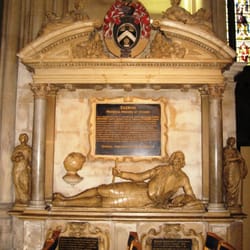
    Bristol Cathedral - Tomb of Sir Charles Vaughan, d. 1630.

    See all

    Tomb of Sir Charles Vaughan, d. 1630.

    Church of St Thomas the Martyr

    Church of St Thomas the Martyr

    5.0(1 review)
    0.2 mi

    Now in the care of the Churches Conservation Trust, St Thomas the Martyr has a particularly…read moreattractive 18th century interior and fittings regarded by some as worthy of a London Wren church. History Founded at the end of the 12th century, the church served the population of a new district of Bristol, south of the main bridge. Originally dedicated to St Thomas a Becket, the dedication was changed after the Reformation on orders of Henry VIII (who forbade the veneration of the saint who defied his king). The church was rebuilt at the same time as St Mary Redcliffe in the 14th and 15th centuries, and was reputedly one of the grandest of Bristol's churches, filled with altars and chantry chapels. However, by the 1780s, the fabric was in such dangerous condition it was decided to build a new church. The architect chosen was James Allen, and the building was built 1789-1796. Allen had intended to alter the west tower to match, but a lack of funds meant that the handsome Perpendicular Gothic tower from the 15th century survives. The church Allen's design has a plain classical exterior: only the east end is rendered in stone, as the sides were originally hemmed in by buildings. This has a pretty Venetian motif, with a small circular window of 1879, under a pedimented arch decorated with garlands, and a handsome classical door. At the west end, the handsome 15th century tower dominates the rather soulless modern square. Inside, the nave has five bays resting on square pillars, with a tunnel vault and clerestory. The aisles have tall arched windows. Allen retained many of the furnishings from the previous church. The reredos of 1716 has fine Corinthian columns and pilasters, decorated with carvings of wheat, vines and flowers of the highest quality. The original panels containing the Lord's Commandment were replaced in 1907 by paintings by Fritz von Kampf of Clifton, depicting biblical scenes. The Communion rails are 18th century, and the carved oak pulpit dates from 1740. The organ case is by John Harris and dates from 1730, and again has excellent carvings of foliage and cherubs' heads. At the west end, again surviving from the earlier church, is the original organ gallery, with Roman Doric columns. beneath this are two sculptures of saints taken from the former Long Row almshouses. On the north wall are the Royal Coat of Arms of Charles I, (1637) and on one of the nave columns an elaborate early 17th century sword rest. The late 18th century mahogany font was converted into a lectern in 1878, replaced by a rather cumbersome stone design.

    Photos
    Church of St Thomas the Martyr
    Church of St Thomas the Martyr
    Church of St Thomas the Martyr

    See all

    Temple Church - churches - Updated May 2026

    Loading...
    Loading...
    Loading...