Cancel

Open app

Search

Tempietto del Bramante Photos

Tempietto del Bramante Reviews in Other Languages

Verify this business for free

Get access to customer & competitor insights.

Verify this business

Pantheon - Basilica di Santa Maria ad Martyres - stunning

Pantheon - Basilica di Santa Maria ad Martyres

(477 reviews)

Centro Storico

Another great experience while in Rome. I walked up and got in line to pay for my ticket 5 Euros…read more(comes to about 6$ USD) For the people who purchased tickets on line was LONGER than the line for same day purchase tickets. This place is amazing to say the least! Architecture is breathtaking, so much history, and the final resting place for several famous figures such as Renaissance artist Raphael, and the first two kings of a unified Italy, Vittorio Emanuele II and his son Umberto I, along with Umberto's wife, Queen Margherita of Savoy, making it a significant mausoleum for Italian national heroes and celebrated artists Pro Tip the Trevi Fountain is a 5 min walk from this site

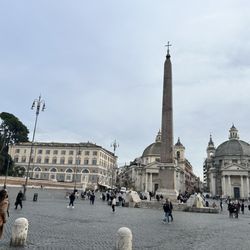
The Pantheon is an ancient Roman temple turned Catholic church, first built in the 2nd century…read moreunder Emperor Hadrian, then consecrated in 609 as the Basilica of St. Mary and the Martyrs, the title it holds to present day. It's an incredible building that's been in continuous use for almost 2,000 years. No Roman ruin, the Pantheon, but a marvel of ancient ingenuity pulled forth into the 21st century. Beautifully preserved and, with its layers of history, particularly emblematic of Rome. The exterior is striking, with the one-two of the grand columned portico and the enormous rotunda. There's an significant-looking inscription across the portico, with M·AGRIPPA·L·F·COS·TERTIVM·FECIT written in giant letters. They apparently translate to "Marcus Agrippa, son of Lucius, made this building when consul for the third time," a hilarious thing to have stamped on a historic landmark in size 1,000,000 font. The Pantheon is in the Piazza della Rotunda, which is also home to the Pantheon obelisk, one of Rome's thirteen ancient Egyptian obelisks. Roaming the piazza and seeing the Pantheon from the outside is free, but it's worth the small expense and hassle to see it from the inside. We visited on our last day in Rome, having already been to the Vatican and the Colosseum on guided tours. The Pantheon was easy enough to navigate on our own, and we were able to walk in without much trouble on a Saturday afternoon in November. The piazza was busy, more crowded than almost anywhere else we went on our trip, but the line to get tickets was manageable. (I will note that there are different lines for cash and credit card and the signage is not that apparent. We lost a few minutes in the wrong line.) We were inside within about twenty minutes. Almost two millennia after it was built, the Pantheon still holds the record for the world's largest unreinforced concrete dome. It is a staggering piece of architecture, massive and majestic, an implausible freak of a monument. The coffered ceiling is spectacular, the recesses creating a geometric pattern that looks, from some angles, almost fake and two-dimensional. At the center of the dome is an uncovered oculus. It had been raining when we visited, and there was rainwater on the marble floor, roped off to protect clumsy tourists. The Pantheon felt like it was mostly dome, but the other elements were noteworthy too, plenty of sculpture and multi-colored marble. There are some important tombs, the most famous belonging to Raphael, who requested to be buried at the Pantheon. A pretty primo resting place. Unless you hate history and art and should have booked yourself a different trip, you have to see the Pantheon when in Rome. It's an amazing place, unlike anywhere else in the world.

Campo dè Fiori - Outdoor Cafe

Campo dè Fiori

(106 reviews)

Centro Storico

Wow I love the Campo de Fiori. The name means the field of flowers, because it used to be a field…read moreof flowers and vegetable gardens here before it became this square. Unfortunately from the 16th to 19th century this place became a public execution site. Yikes. The most famous execution was Giordano Bruno in 1600, in which there is now a statue in his honor for freedom of thought. Happy thoughts, happy thoughts. Pass forward to present day. This area is lively with the open air markets where you can find vendors selling produce, flowers, spices, cheese, and artisanal goods. My boyfriend and I came here to explore the live market and also to look for souvenirs to bring home. The vendors here are really aggressive and I would have enjoyed it more if they gave me space to look instead of hound me to buy buy buy. Like chill dude can I look at what I'm buying. Sigh. We were here til closing time and even get to see how the vendors efficiently and quickly packed up their stalls and belongings to wrap up for the day. And of course... a great area to enjoy some gelato.

We're at Campo de' Fiori, Rome's oldest market and possibly the most enthusiastic display of…read moretourist traps per square meter. Once a site for public executions (Bruno's brooding statue still watches over), it now specializes in overpriced pasta and garlic braids. It's more performance art than produce. Vendors heckle, truffle oil flows freely, and yes, someone will try to sell you limoncello in a boot. I walked through as part of a food tour, which felt like the right way to enjoy the chaos, briefly, and with snacks elsewhere. Not the best market in Rome, but definitely the most theatrical.

Colosseo - Arch of Constantine

Colosseo

(1.1k reviews)

Aventino

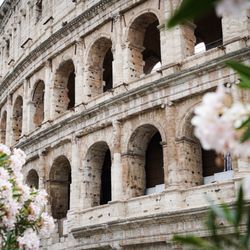
The Colosseum is the most incredible thing I've ever seen on this planet. Nothing prepares you for…read morestanding in front of it in real life. The scale, the power, the history, everything about it is absolutely breathtaking. You can feel the history the moment you step inside. Knowing what happened there centuries ago gives you literal shivers. It's emotional, intense, and awe-inspiring all at once. Every stone tells a story, and it makes you feel so small in the best way possible. This is not just a landmark, it's an experience that stays with you forever. If you come to Rome and don't see the Colosseum, you missed everything. Rating: 10/10 -- unforgettable, unreal, legendary

Holy shit, the Colosseum. It's one of the craziest things I've ever seen, a massive historical…read moremarvel, a monument to human ingenuity and cruelty, the highs and lows of our entire existence. You have to see it before you die. No photograph, no movie, can fully conjure the real thing. Its scale, its majesty, the psychic bridge it provides to a violent and fascinating past. Standing in the Colosseum is about as close as I've gotten to time travel. We booked a three-hour tour with Crown Tours, covering the Forum, Palatine Hill, and the Colosseum. This was definitely the way to go. I loved both the simplified logistics and the live, on-site history lesson. That said, if you're not the guided tour type, the Colosseum does kind of speak for itself. We went around noon on a Friday during low season, when it was busy but nowhere near peak crowding. I imagine a summertime visit with kids would be pretty uncomfortable. But the Colosseum is worth a fair amount of physical suffering. Maybe not being mauled and eaten by lions, but definitely a little body odor and heat. The Colosseum is both the largest standing amphitheater in the world and the largest ancient amphitheater ever built. These may be the least surprising facts I've ever read on Wikipedia. The place is named for its colossal size, and honestly that alone would make it worth visiting. The size, though, is maybe its third or fourth most notable feature. The architecture is iconic. I was about to start describing it, but everyone knows what the Colosseum looks like: it looks like the Colosseum. It looks both more and less like the Colosseum up close and from within. I don't remember the striations in the travertine walls from any history books. The interior is breathtaking. Our guide sat us down and we gawked at the tiered seating and arena of this enormous world wonder, a place that once accommodated some 50,000 spectators for any given event, where an estimated 400,000 people and a million animals met violent ends. It's kind of wild that any of this was a) allowed and b) how people got their kicks, but the enthusiasm for brutality is comprehensible enough in 2025. I know exactly who would be in the stands with popcorn, watching people whose lives hold no value for them fighting to the death. Our tour ended on the ground floor of the Colosseum, and we wandered the upper level on our own, looking down at the arena and the exposed underground, which required its own ticket and didn't seem to have many visitors. We visited the gift shop and bought a postcard for our kids, though I don't quite know how to explain this place to our five- and three-year-old sons. I hope to bring them in person one day, when they're older and more knowledgeable about the ways of the world. There might be heat, there might be crowds, but they'll have to see the Colosseum.

Spanish Steps - Spanish Steps

Spanish Steps

(82 reviews)

Centro Storico

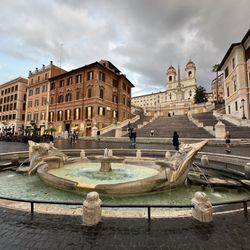
The Spanish Steps are absolutely breathtaking!!…read more The Spanish Steps connect the Piazza di Spagna below with the stunning Trinità dei Monti church above. The Trinità dei Monti is worth a visit when you're here, it's full of history, artwork and phenomenal statues. The area around the Spanish Steps are chock full of fabulous restaurants and high end shops. The views from the top after climbing the 135 steps are glorious. You can see the Spanish embassy in the square below from the terraces above. We ate at a local Trattoria that did not disappoint. It has became a cultural hub for artists, writers and royalty. A luxury shopping landmark, and a quintessential symbol of Roman glamour, culture, and social life. I've been before and will come back. Such a sight to see and I LOVE Italy!!

The Spanish Steps were built between 1723 and 1725 to connect the Bourbon Spanish Embassy in Piazza…read moredi Spagna with the French church of Trinità dei Monti above. Thev steps were designed by architect Francesco de Sanctis, the staircase quickly became both a practical pathway and a grand public gathering place. The name "Spanish Steps" comes from the nearby Spanish Embassy to the Holy See, which gave the piazza its name centuries earlier. At the top sits the Trinità dei Monti church, while at the base is the famous Barcaccia Fountain, created by Pietro Bernini and his son, the legendary Gian Lorenzo Bernini. Over the centuries, the steps became a favorite meeting place for artists, writers, and travelers during Rome's Grand Tour era. Poets like John Keats spent time nearby, and today his former home beside the staircase is preserved as the Keats-Shelley House museum. Today, the Spanish Steps remain one of Rome's most iconic landmarks...a blend of Baroque elegance, history, fashion, and people-watching where Rome somehow manages to feel both glamorous and time less.

Tempietto del Bramante - landmarks - Updated May 2026

Loading...
Loading...
Loading...