Cancel

    Open app

    Search

    Tangelo House Photos

    Recommended Reviews - Tangelo House

    Your trust is our priority, so businesses can't pay to alter or remove their reviews. Learn more about reviews.
    Yelp app icon
    Browse more easily on the app
    Review Feed Illustration
    Photo of Ariel W.
    4395
    5918
    103856

    3 years ago

    Helpful 26
    Thanks 3
    Love this 31
    Oh no 1

    2 years ago

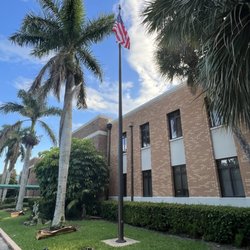
    Beautifully restored building in a beautiful part of Vero Beach. Great job for the people that did the restoration!

    Helpful 0
    Thanks 0
    Love this 0
    Oh no 0

    Verify this business for free

    Get access to customer & competitor insights.

    Verify this business

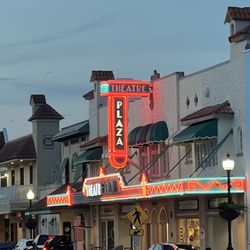
    Theatre Plaza

    Theatre Plaza

    5.0(1 review)
    0.3 mi

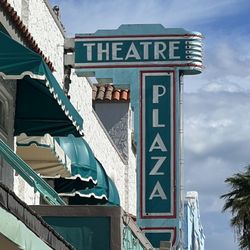
    This historic theater building opened on October 20, 1924 in Vero Beach. It was previously known as…read morethe Vero Theatre or Florida Theatre. The 800-seat theatre was designed by architect F.H. Trimble and was the city's first motion picture theatre. The building was designed in Mediterranean Revival style that was popular in Florida during the land boom years in the 1920's. It has the stucco exterior walls and terra cotta decorative tiles that were popular style elements of the time. On opening day, the first feature film shown was The Hunchback of Notre Dame. Even a potential hurricane with torrential rain could not stop people from coming out even though the rain resulted in the flooding of the theatre's $10,400 pipe organ temporarily putting it out of commission. This theatre is directly responsible for the creation of Indian River County. In 1925, St. Lucie County Sheriff J.R. Merritt began Sunday raids of the theater to enforce the county's blue laws which restricted certain businesses and activities on Sunday. Farmers enjoyed taking their families to town on Sunday to watch a film and pointed out that blue laws ere not enforced in St. Lucie. The theater manager William Atkin, ticket seller William Frick and theater operator Henry Metz were all arrested. Eventually even the first mayor and part theatre owner Rep. A.W. Young was also arrested. in response Vero representatives went to Tallahassee to form their own county, The Legislature approved the bill in May, naming Vero the county seat of the new Indian River County. Governor John Martin signed it into law in June 1925 creating Indian River County. The last film to be shown in the theatre was Desperately Seeking Susan. The theatre closed shortly after due to competition from larger, more modern movie theaters. This was the only movie theater in Vero Beach before World War II, and is one of the last commercial buildings from the 1920's in downtown Vero. In 1990, the building was purchased and turned into apartments upstairs and retail stores on the ground level. Over the years, there have been intermittent efforts to refurbish the inside of the theater. On April 28, 1992 the historic theater was added to the National register of Historic Places. Today new life is being brought to the old building with the opening of businesses like Downtown Dippers, an ice cream shop.

    Photos
    Theatre Plaza
    Theatre Plaza
    Theatre Plaza

    See all

    Bethel Creek House of Refuge

    Bethel Creek House of Refuge

    5.0(1 review)
    2.7 mi

    Five stars for the history! The Houses of Refuge were federally operated life saving stations that…read morewere built on the beach so that the keeper could rescue ship wreck victims during a time period when the main form of travel and hauling goods was by ship. The houses were spread approximately 20 miles apart along Florida's coast and were often very isolated. They were all built exactly alike with a main house, a cistern, and boat house. The house that was nearest to where I live, the Orange Grove House of Refuge was the last place barefoot mailman Ed Hamilton spent the night before he disappeared forever into the Hillsboro inlet. What exactly happened to him is a mystery that has never been solved. The houses of refuge are long gone except for the House of Refuge Museum at Gilbert's Bar in Stuart which you can still visit today. I have visited that house as well as discovered several of these historical house of refuge markers along the east coast of Florida as far south as Miami. In 1915 the Life Saving Service became the US Coast Guard. The Bethel Creek House of Refuge is also no longer here. It was the first house of refuge constructed on the east coast of Florida and was active from 1876-1936. It once stood in what is now the Jaycee Beach Park and there is a historical marker in the park dedicated to it erected in 2013 by Florida Society Colonial Dames XVII Century Ann Waggaman, President. Surrounding the marker are blocks from the foundation of the Bethel Creek House of Refuge. The first keeper of this house was John Houston. In 1917 the Bethel Creek House of Refuge was destroyed by a fire and replaced by a building that was removed in 1936. During WWII the station was reopened with a 40 foot watch tower to look for German U-Boats off the coast. In 1950 the Federal Government gave these 8 acres of land the the city of Vero beach who developed it in to the Jaycee Park in 1956.

    Laura Riding Jackson

    Laura Riding Jackson

    5.0(1 review)
    3.7 mi

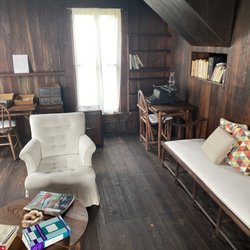
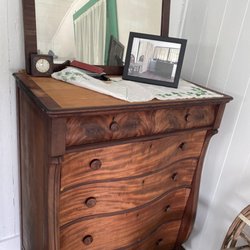
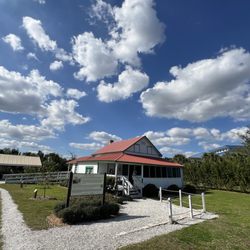
    On the campus of Indian River State College you can visit the historic 1910 home of Florida poet…read moreand author Laura Riding Jackson. She was a famous author, critic, poet, and novelist. Laura was born to immigrants on January 16, 1901 in New York City. Her first husband was history graduate student Louis Gottschalk. The couple moved to Kentucky where Laura began to publish her poems in The Fugitive, a literary magazine founded by writers from Vanderbilt University. During this time she began corresponding with an English writer Robert Graves who was also published by the magazine. In 1926 she went to England to work with Graves on his book a Survey of Modern Poetry. That same year her first book of poetry, The Close Chaplet was published. Over the next ten years she published 20 volumes of fiction, essays, and poetry. Laura and Roberts moved to Mallorca and their house became a gathering place of some of the most celebrated writers of the time. The Spanish Civil War caused Laura to return to the United States where she met her next husband Schuyler B. Jackson, a poetry critic for Time magazine. Today Laura Riding Jackson's papers are at her alma mater Cornell and Harvard Universities. In 1968 Laura completed Rational Meaning: A new Foundation for the Definition of Words which she worked on with her husband Schuyler and finished after his death. Laura continued to live in this house until her death on September 2, 1991. The simple but beautiful home is an example of the cracker type of vernacular architecture that was popular in Florida during this time period. The term cracker came from the sound whips would make as pioneers drove cattle. The home was originally built a few miles north of Vero Beach in Wabasso, Florida in a hammock near the railroad tracks. The home features a wide and deep screened in porch with some of the original furniture and lots of oversized windows for cross ventilation to cool the home before air conditioning was a standard feature. Another cooling feature is that the house faces east to catch ocean breezes. The oldest part of the house is the center portion made of Florida pine. In the 1950's Jacksons later added the North bedroom and bathroom and installed indoor plumbing. The second floor of this house was used as a guest room. Laura's bedroom is in the front of the house off of the sitting room where you can see the remains of her personal library. Many of her belongings are still in the room. Like all cracker homes, this house has a tin roof that was pitched so the rain could run off. Today the house is propped off the ground on cinder blocks but when it was built it sat on wood logs. This helped the air to circulate under the house cooling it. Chickens could get protection in this area and when the floor was swept the dirt would fall through the area where the floorboards came together, allowing it to escape from the house. Until 1989, Laura lived in the home without electricity. She relied on kerosene for heat and light and propane for cooking. In the back of the house is a pole barn that was part of the Jackson's organic citrus business. Here they would pack fruit and send it by train up north to their clients. Today it a welcoming area to enjoy a picnic lunch or the area can be reserved by groups. Surrounding the barn is a garden. The home is registered as a Friends of the Library USA National Literary Landmark and is listed on the Florida Literary Map. After Laura Riding Jackson passed away in 1991, a group of individuals created the non-profit Laura (Riding) Jackson Home Preservation Foundation to save the home because of its important connection to literature, history, architecture, and the environment. On August 9, 1994 this home was moved to the Environmental Learning Center. After they decided they wanted to use the land for something else, Indian River State College stepped up and donated the land the house now sits on. On July 14, 2019 the home was moved to it's current location on the Mueller Campus. The Foundation raises the funds to preserve the home. One way they do this is by opening for public tours and requesting a $5 donation. This year the house is open for tours from November through April each year on the second Sunday of each month from 1pm-5pm and every Tuesday from 1pm-5pm. You can also arrange for private tours from the foundation. As a fan of famous literary writers, history, and architecture I really enjoyed my visit to this historical landmark. It is the little touches like the cans in the kitchen cabinet or seeing Laura's actual slippers laid out in front of her bed that make you feel like you stepped back in time.

    Photos
    Laura Riding Jackson
    Laura Riding Jackson
    Laura Riding Jackson

    See all

    Tangelo House - landmarks - Updated May 2026

    Loading...
    Loading...
    Loading...