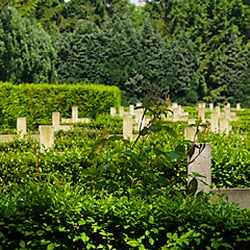
This tiny cemetery in the Schaerbeek suburb of Brussels originally served as the Tir National, or…read morenational rifle range, for training police and soldiers. Then in the First World War, the occupying German authorities put it to use as an execution ground for judicially convicted civilians. But the enclosure entered history on October 12, 1915, when the British nurse Edith Cavell was lined up against the wall here and shot for treason.
The execution might or might not have been technically justifiable, but for the German government, it was a diplomatic disaster. More than any other action besides the sinking of the Lusitania, this execution - over the strenuous objections of the US Ambassador - swept the American public and government into the British and French camp. It did not help the German argument that Miss Cavell might have been one of the nicest, most honest people who ever lived. Or that her last words were: "Patriotism is not enough, I must have no hatred or bitterness towards anyone."
Later on, Miss Cavell's body was returned to England for burial. After World War II - and more executions - the enclosure was designated a cemetery for fallen resistance heroes.
Today, scarlet rose bushes come alive every spring among the white crosses and green hedges. Families still leave flowers on birthdays. This is a quiet, modest resting place in the middle of a busy city. It is difficult to find, but well worth the effort.