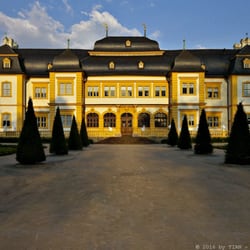
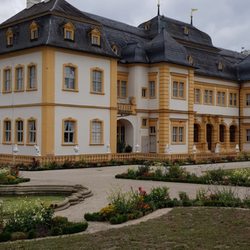
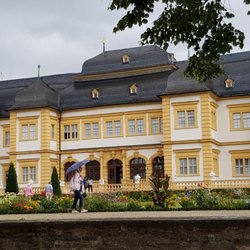
What a magnificent and enchanting property! Even on an early spring day without too many green…read moreleaves on trees and bushes, we truly enjoyed strolling around this massive property with ponds and fountains, walkways with manicured hedges, numerous statues and figurines, or just being in the quiet highly orchestrated garden in Rococo style imagining how the royals and aristocrats may have lived in luxury in the times past.
As a frame for the "summer and pleasure house," today's Schloss Veitshöchheim, a flower garden was created from 1702, which was roughly marked out in a square. This resulted in the creation of a front garden with a main entrance and driveway. On the north side there was a kitchen garden with a carp pond and on the south side an elongated tree garden, which served as a wood for pheasants and game.
Under Prince-Bishop Johann Philipp von Greiffenclau (ruled 1699-1719), the fundamental work to convert the pheasantry into a representative garden was carried out in 1702/1703. The balustrades, lining walls, enclosing walls, main paths and lakes that still exist today were created.
Under Prince-Bishop Carl Philipp von Greiffenclau (1749-1754), Johann Wolfgang van der Auwera (1708-1756) created the first figure cycles.
The differentiated design of the garden that exists today was created from 1763 by Prince-Bishop Adam Friedrich von Seinsheim (1755-1779). He commissioned the "most important German garden sculptor of his time" Ferdinand Tietz (1708-1777) with the creation of further figure cycles. In just a few years between 1765 and 1768, he carried out the commission. The last phase of the figurative decoration took place from 1772 to 1780 by Johann Peter Alexander Wagner (1730-1809).
After Seinsheim's death, the importance of the garden was not fully recognized for a long time until the garden was restored to the Rococo state of 1779 in the 50s and 60s of the 20th century . This garden is likely to be the most differentiated garden in the German-speaking area in terms of content and also practically comprehensible contexts of meaning. The cosmological program of this garden sees the Prince-Bishop's castle as a symbol of heaven. The large, freely grown trees at the castle, at the large and small lake and in the roundabout are ingredients of the 19th century .