Cancel

Open app

Search

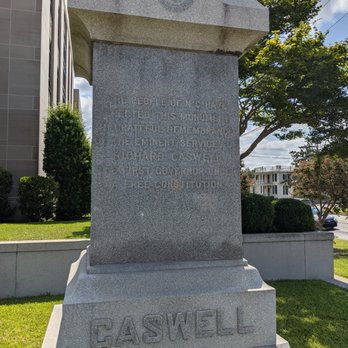
Richard Caswell Monument

5.0 (1 review)

Richard Caswell Monument Photos

Recommended Reviews - Richard Caswell Monument

Your trust is our priority, so businesses can't pay to alter or remove their reviews. Learn more about reviews.
Yelp app icon
Browse more easily on the app
Review Feed Illustration

5 years ago

Helpful 14
Thanks 0
Love this 12
Oh no 0

Verify this business for free

Get access to customer & competitor insights.

Verify this business

Richard Caswell Gatlin Historical Marker - Richard Caswell Gatlin Historical Marker, Kinston

Richard Caswell Gatlin Historical Marker

3.0(1 review)
1.1 mi

This green and gold historical marker is located in the parking lot of the visitor's center. It is…read morenot an official state marker and indicates that it is "privately funded and erected in honor of R.C.Gatlin." The marker reads, "Richard Caswell Gatlin, January 18 1890 - September 8, 1896. Kinston Native, West Point Graduate, US Army Officer, Confederate General. Born at Red House Plantation two miles west of Kinston. Grandson of North Carolina's first State governor, Richard Caswell. Served in the Black Hawk War 1832, Indian Territory 1832-1839, 2nd Seminole War 1839-1842 and Mexican War 1845-1848 where he was wounded and decorated for meritorious service at the Battle of Monterrey. Commanded US Army posts in Florida, Arkansas, Nebraska, Utah and New Mexico before resigning to service his home state during the Civil War. Commanded Confederate Department of North Carolina 1861-1862 and was NC State Adjutant General 1863-1865. Kinston/Lenoir County's first West Point graduate and only Confederate General. Buried in Fort Smith National Cemetery, Arkansas." Online, there is more information. "Richard Caswell Gatlin, soldier, Confederate officer, and farmer, was born at Kinston, Lenoir County. His father was John S. Gatlin, the son of John Gatlin who was one of the early settlers of Kinston; his mother was Susannah Caswell, the youngest child of Governor Richard Caswell." "While on a visit to Fort Smith, Ark., he was captured by Arkansas State forces on 23 Apr. 1861 when the state was on the verge of secession. After his parole, he resigned his commission in the U.S. Army and offered his services to North Carolina. He was first made adjutant general of the state, with the rank of major general of militia; later he received the rank of colonel of infantry in the regular Confederate Army and was given command of the Southern Department, in charge of coastal defense, with headquarters at Wilmington." "After the war Gatlin moved to Arkansas where he engaged in farming in Sebastian County until 1881, when he moved again to Fort Smith. He died at Mount Nebo, Yell County, Ark., at the age of eighty-seven, and was buried in the National Cemetery at Fort Smith." [Review 15465 overall, 969 of 2021, number 3009 in North Carolina.]

Photos
Richard Caswell Gatlin Historical Marker - Richard Caswell Gatlin Historical Marker, Kinston

Richard Caswell Gatlin Historical Marker, Kinston

Richard Caswell Gatlin Historical Marker - Richard Caswell Gatlin (1809-1896)

See all

Richard Caswell Gatlin (1809-1896)

CSS Neuse Civil War Interpretive Center

CSS Neuse Civil War Interpretive Center

4.8(11 reviews)
0.1 mi

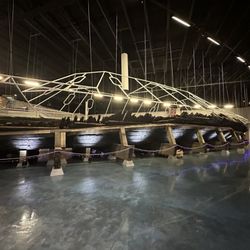
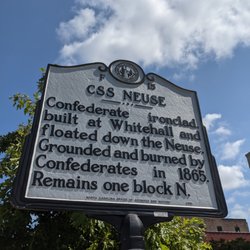
As I've seen a few Confederate things here and there lately including Beauvior (Jefferson Davis's…read moreretreat) in Biloxi https://www.yelp.com/biz/beauvoir-the-jefferson-davis-home-and-presidential-library-biloxi?hrid=BWsZt2A-u_ExRjKPtx8scQ and the Confederate Memorial Hall in New Orleans https://www.yelp.com/biz/confederate-memorial-hall-museum-new-orleans?hrid=8Yw80LszilMVhINuwhjdkw this was an interesting addition to the story of the Confederacy. You might not have known that the CSA had a brown water navy but they did. The Neuse (and two other ironclad ships) defended the rivers of the South from Union ships. The display here starts off with a ten to fifteen minute movie that tells the tale of the Neuse. And to be honest, if they hadn't hit a sandbar on the way to the battle of New Bern, they might have been able to have some affect on the Civil War. After the movie, you'll get to see what remains of this ship. And the first time i saw it, I was impressed with the size. I had no idea that it was this large! While all that remains is the below-the-waterline pieces, it is surrounded by memorabilia that tells the tale of the Southern side of the Civil War as well as what life was like on board the ship. Quite interesting and well worth the $5 entry fee. [Review 15477 overall, 981 of 2021, number 3020 in North Carolina.]

If you're interested in the history of the Lenoir county area - and especially the Civil War, this…read moreis a must see. Very interesting museum focusing on the history of Kinston area in the Civil War, with the CSS Neuse as the center piece. The relic of the old CSS Neuse is very interesting, but the museum is about more than the ship. Overall the museum has done a great job of making the history interesting and coming alive.

Photos
CSS Neuse Civil War Interpretive Center

See all

Foster's Raid Historical Marker - Foster's Raid Historical Marker, Kinston

Foster's Raid Historical Marker

3.0(1 review)
1.1 mi

This marker stands at one of the busiest intersections in Kinston and points out a piece of the…read moreCivil War that happened here. There is a motel parking lot if you want to stop. The marker reads, "Foster's Raid. On a raid from New Bern to Goldsboro, the Union troops led by General J. G. Foster passed through Kinston, Dec. 14, 1862." Online, there is more information. "On July 6, 1862, Gen. Ambrose Burnside and two divisions departed New Bern for Virginia, leaving his longtime friend Gen. John G. Foster in charge of the Department of North Carolina. Anchored to the New Bern area due to his small numbers, Foster oversaw the strengthening and construction of defenses and fortifications. Work crews, comprised largely of refugee slaves, constructed a line of defensive works from the Trent River to the Neuse intersected by Forts Totten, Rowan, and Dutton." "The responsibility of confronting the invaders was left to the few North Carolina regiments remaining in the state, but their limited numbers seriously hampered their ability to dislodge the enemy. A surprise attack on the Federal force at Washington on September 6 had initial success with the Confederates capturing three field guns and supplies and destroying a ship. But the arrival of Federal reinforcements turned the tide of the battle. A separate attack on Federally occupied Plymouth in December had similar results." The Federals attempted a raid of the Goldsboro railroad and believed that they had done significant damage however the damage done to the railroad was not extensive enough to disable it for long. Confederate engineers and work crews had the railroad running regularly by the dawn of the new year. The raid's only lasting success was the thorough stripping of resources all along its path through the countryside. [Review 15532 overall, 1036 of 2021, number 3071 in North Carolina.]

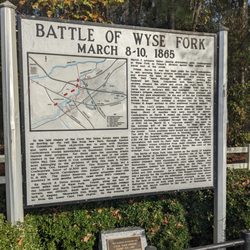
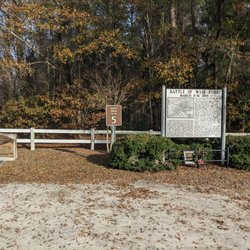
Battle of Wyse Fork Historical Marker - Battle of Wyse Fork Historical Marker, Kinston

Battle of Wyse Fork Historical Marker

3.0(1 review)
3.7 mi

Being a somewhat coastal city, Kinston experienced both the Revolutionary War and the Civil War…read more This marker points out an extended engagement as Union forces sought to develop a supply line through the area that was guarded by Confederates. In the end, some 1257 Union soldiers were lost and more than 1500 Confederate. It is considered a Union Army victory. There is a lot of information to digest on the marker. The first paragraph reads, "In the late stages of the Civil War Union forces were intent on moving up the rail line from New Bern through Kinston to Goldsboro. Their objective was to unite with Sherman and open a supply route through eastern North Carolina. Confederate troops entrenched on Southwest Creek sought to impede their progress. For three days the opposing armies clashed in the fields and woods south and east of the creek. Union Maj. Gen. Jacob D. Cox commanded over 13,000 soldiers, most belonging to the divisions of Brig. Gen. Innis N. Palmer and Brig. Gen. Samuel P. Carter. Gen. Braxton Bragg led a Confederate force of 12,500 men, organized in divisions led by fellow North Carolinians Gen. Robert F. Hoke and Gen. D. H. Hill. The Junior Reserves, mostly seventeen-year-olds mustered in only months before, came under Hill's command." "The Battle of Wyse Fork (also known as the Battle of Kinston and the Battle of Southwest Creek) involved one of the largest concentrations of troops ever on North Carolina soil." The marker has a small parking area. There are other markers around Kinston that point out some defensive and offensive positions and battles. [Review 278 of 2024 - 3535 in North Carolina - 21313 overall.]

Photos
Battle of Wyse Fork Historical Marker - Battle of Wyse Fork Historical Marker, Kinston

Battle of Wyse Fork Historical Marker, Kinston

Battle of Wyse Fork Historical Marker - Battle of Wyse Fork Historical Marker, Kinston

See all

Battle of Wyse Fork Historical Marker, Kinston

Richard Caswell Monument - landmarks - Updated May 2026

Loading...
Loading...
Loading...