Cancel

    Open app

    Search

    Reclining Figure

    3.0 (1 review)

    Reclining Figure Photos

    Recommended Reviews - Reclining Figure
    Your trust is our priority, so businesses can't pay to alter or remove their reviews. Learn more about reviews.
    Yelp app icon
    Browse more easily on the app
    Review Feed Illustration

    6 years ago

    Helpful 14
    Thanks 0
    Love this 11
    Oh no 0

    Verify this business for free

    Get access to customer & competitor insights.

    Verify this business

    Papua New Guinea Sculpture Garden at Stanford

    Papua New Guinea Sculpture Garden at Stanford

    4.9(14 reviews)
    0.9 mi

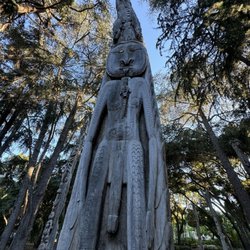
    This isn't just an art exhibit, it's a whole experience! The setting here is like a jungle, full of…read moreplantlife and fallen leaves, with different stone sculptures, wooden carvings, and totem pole artworks almost camouflaged among the tree trunks and branches, displayed underneath the shade, and benches situated randomly within the forest of art. In 1994, Anthropology grad student and researcher, Jim Mason, organized a project to have a group of artists, aged 27-74, coming from 6 different villages in the Sepik River region of Papua New Guinea, to create the beautiful sculptures at Stanford University. The landscaping and plants of the garden were organized by other entities. The artwork is based on Kwoma and Iatmul mythology and stories of creation, the center of the garden created in the likeness of "spirit homes". Two of the pieces, The Thinker and The Gates of Hell, were inspired by the Rodin sculptures on campus bearing the same names, but tell their own stories. The history and design of this sculpture garden are fascinating, and the natural environment and overall maintenance of this exhibit make it an appealing place to visit. It's even a desirable area of campus to hold school events (they had just finished such an event when I visited this past Sunday). Also, free parking is available at Stanford on the weekends.

    Its a very cool outdoor installation located on the Stanford campus. T They sculptures are spread…read moreout and all have interesting descriptions of the culture and the art. This is a perfect COVID activity as its not crowded, everything is spread out and its outdoors. Mask up and keep your distance and its all good. There are at least 12 other art installations nearby as well as the Student Union and main bookstore.

    Photos
    Papua New Guinea Sculpture Garden at Stanford - The Thinket

    The Thinket

    Papua New Guinea Sculpture Garden at Stanford - The Thinker

    The Thinker

    Papua New Guinea Sculpture Garden at Stanford - Sculptures/forest

    See all

    Sculptures/forest

    Stone River - Andy Goldsworthy

    Stone River - Andy Goldsworthy

    4.6(5 reviews)
    0.7 mi

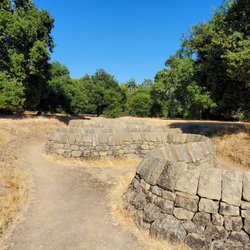
    Checked out this art piece on the Stanford University campus on Sunday, and it was reminiscent of…read morethe artist's Wood Line log sculpture in SF, which I had visited several months prior, the curves of the sandstone river wavy like the slither of a snake. It was built by 8 stone-wallers from Great Britain and consists of 6,500 stones, with the artist aiming to emphasize a connection to nature through the sculpture's materials, location, and design. The parking lot in front of the Anderson Museum (on Museum Way) is free on weekends and provides direct and easy access to this awesome Andy Goldsworthy exhibit.

    Also known as 'The Snake", Stone River is an permamant art installation on the Stanford Campus. It…read moreis the work of Andy Goldsworthy. Goldsworthy, a native of Brittan, uses natural products and strives to make a connection to the area the art is emplaced. From the artist : 0 "Movement, change, light, growth and decay are the life-blood of nature, the energies that I try to tap through my work." and "My sculpture can last for days or a few seconds - what is important to me is the experience of making. I leave all my work outside and often return to watch it decay." True to his vision, Stone River was constructed using limestone from campus buildings damaged during the 1989 Loma Prieta earthquake. The installation is massive stretching almost 320 feet and used almost 130 tons of stone. From my perspective it looks like a giant snake especially from the air. As noted Stone River is located on the Stanford Campus and is right next to the Cantor and Andersen art museums. Its a cool stop especially if you have kids as they can run amok over, around etc on it.

    Photos
    Stone River - Andy Goldsworthy
    Stone River - Andy Goldsworthy - View from parking lot

    View from parking lot

    Stone River - Andy Goldsworthy - Sculpture

    See all

    Sculpture

    Butternut

    Butternut

    5.0(2 reviews)
    1.1 mi

    This is an easy-to-miss horse sculpture, made of bronze and metal with the simple appearance of…read moredriftwood pieced together into a lovely work of art. A similar art piece can be found at the Cantor Arts Center as part of a series by the artist, Deborah Butterfield, however Butternut, named after its color, is easier to access and view right in front of the Stanford Hospital, with tables and seating in the vicinity as well. Free self parking (up to 2 hours) is available in the Pasteur Visitor Garage, hidden underground. I wouldn't go out of my way for it, but the sculpture is worth some attention if you're in the area.

    Butternut is a public art installation location on the ground of the Stanford University medical…read moreCenter. It is the work of artist Deborah Butterfield. This is the 3th or her Horse series that can be found on the Peninsula with the other being in the Cantor, and of all places in the middle of nowhere in Mountain View. Deborah Butterfield began sculpting horses back in the 1970's. She started with sticks and clay, but soon progressed to scrape metal. She later moved on to cast bronze. She selects individual pieces of wood and then creates the bronze cast. The wood/bronze is then used to create the horses. A native of San Diego, California, her art can be seen in museums around the country. From the artist: ""The lines of the branches do not simply outline the forms of horses, they create the contours through an accumulation of simple or energetic lines that seem to build up from within. This is three-dimensional gesture drawing, and the result is both skeletal and muscular." The sculpture at first glance appears to be driftwood with all of its detail, but when you touch it and feel the cold hard metal its shocking everything even though I know what to expect. There is a stark simplicity to the sculpture as a whole from a distance, but the intricate details of the casting and the complexity the small shapes form are shockingly complex. The sculpture is about 40 feet from the sidewalk and up a slight hill. There is nothing around and I have to admit I spent a good 30 minutes enjoying both the relative quiet and the sculpture from different angles. I am always fainted by the works. Cast in bronze, they really look like driftwood. Despite being somewhat skeletonized, they appear to be alive. Up close the intricate detail reveals itself. Each angle brings a new view and you can find yourself gazing at it for a long time. Butternut as noted is close to the new Stanford Hospital. In and of itself it is not a destination, however, given its proximity to the Cantor, and numerous other art installations, it is best part of a multi stop trip.

    Photos
    Butternut
    Butternut
    Butternut

    See all

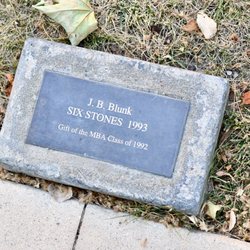
    Six Stones

    Six Stones

    2.0(1 review)
    0.6 mi

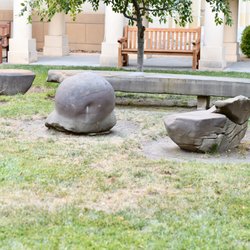
    Six stones is a public art installation located on the Stanford University Campus. it is the work…read moreof noted sculptor and artist J.B. Blunk Blunk, a native of Kansas is primarily known for his woodwork and ceramics. In the 50's he spent 4 years in Japan and that had a profound impact on his art. His most famous piece, "The Planet" can be seen at the entrance to the Oakland Museum. From the artists wife: ""Once he chose that spot he became that place," says Christine Nielson, his wife until he passed away in 2002. "It wasn't nature so much as it was just the world that his material existed in," she says, adding she would not call him a naturalist. Blunk felt a relationship with the wood that grew around this place, on the Northern California coast, and had an undeniable connection with the redwood burls washing up on its beaches that he salvaged" As noted he was known for his woodwork. In this aspect he is generally without peers and I am a huge fan. My mother had a small wood item made by him and its exquisite. This display IMHO is not. I'm not sure what to think about it. It really looks like the zen garden rock display I created for my backyard. The rocks are a bit interesting in shape but after about 2 minutes I was ready to move on. As noted it is located near the main quad and Hoover Tower. It can be reached from a short walk from nearby parking and there are at least 6 noteworthy installations nearby on top of all of the other offerings in the area. As with most art this piece is better part of a multi stop walking tour.

    Photos
    Six Stones
    Six Stones
    Six Stones

    See all

    Luna Moth Walk I

    Luna Moth Walk I

    4.0(1 review)
    0.6 mi

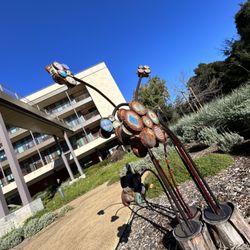
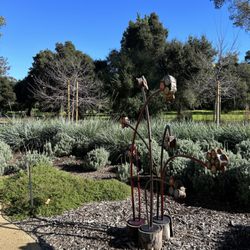
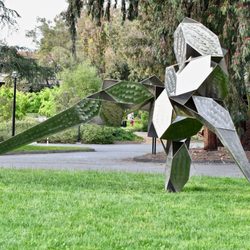
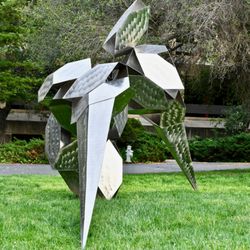
    Luna Moth Walk I is a public art instalation located on the Stanford University campus. It is the…read morework of artist Charles Ginnever. Ginever, was born In San Mateo, California in 1931. In the early 50's he traveled to Paris and learned sculpting. Whats fascinating at least to me is that he and another sculptor, Mark di Suvero.(who's works I have done a review for) ventured from San Francisco to New York in 1957. During that long road trip they both found that the whole abstract expressionism movement was not being expressed in sculpture and both decided to make that a focus. From a discourse on his style: "The Minimalist discourse around materials was pertinent to Ginnever's enterprise, but what he could not accept was the way in which Minimalism, in his view, acquiesced to the determining influence of architectural space. Movement around a Minimalist installation might provide additional information about the work, but not about its essential form, which remains readable from any perspective. Instead of seizing the opportunity to interrogate the influence of the spatial systems that housed it, it had submitted itself to the system without a fight. This was a big problem for Ginnever, who regarded the right angle as an instrument of spatial control, functioning under the (arrogant) assumption that space could or should be controlled. To accept the right angle--and indeed any perspectival "system"--was to accept the idea that rigid spaces and forms were somehow "good" or "right," or even possible. sculpture.org/documents/...ginnever/ginnever.shtml " Alot of his work is in private hands however, here in California we are lucky to have several works displayed to the public. As with his other sculptures, I am immediately reminded of oversized WWII tank barriers. However, the complex interplay of angles and its ability to literally become something else from different angle draws you in and hold your attention. As noted it is located in the Lasuen Mall near the main campus bookstore and library. It can be reached from a short walk from nearby parking and there are at least 6 noteworthy installations nearby on top of all of the other offerings in the area. As with most art this piece is better part of a multi stop walking tour.

    Photos
    Luna Moth Walk I
    Luna Moth Walk I
    Luna Moth Walk I

    See all

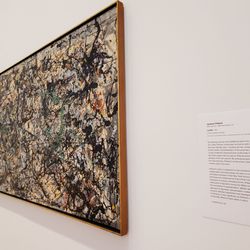
    Anderson Collection At Stanford University - Jackson Pollock's Lucifer

    Anderson Collection At Stanford University

    4.7(37 reviews)
    0.8 mi

    Admission to this museum that features American modern and contemporary art is free!…read more It's pretty sizable with two floors and several interesting pieces. If you're there on a weekend look out for the free pubic in-person tours on Saturdays and Sundays at 12:30pm and 2:30pm. We took one and it was better than wandering around the exhibits ourselves. Worth a stop if you're visiting the Stanford campus.

    Disclaimer: I give any free museum five stars. Well, it will cost you your zip code. I just gave…read morethem 58008, hoping they'd realize later what it spells upside down. This is one of the world's most outstanding private assemblies of postwar American art, gifted by Bay Area collectors Harry W. "Hunk" and Mary Margaret "Moo" Anderson and their daughter Mary Patricia Anderson Pence, who looks more like Moo but acts like Hunk. The museum, which opened in 2014, houses 121 paintings and sculptures and is known for its focus on movements like Abstract Expressionism, Color Field Painting, and Pop Art. The collection is celebrated for featuring canonical works by some of the 20th century's most significant American artists. Key figures and their works include: Jackson Pollock: The monumental drip painting "Lucifer," considered by many to be the outstanding drip painting still in private hands before it was gifted to Stanford. Mark Rothko: The signature color-field work, "Pink and White over Red." Clyfford Still: A large, imposing piece called "1957-J No. 1 (PH-142)." Richard Diebenkorn: Works like "Ocean Park #60," which displays his progression into abstract forms using geometric shapes and a subdued color palette. Other Masters: The collection also includes works by Willem de Kooning, Franz Kline, Philip Guston, Robert Motherwell, and Helen Frankenthaler. The museum building itself is spacious, which means it feels mostly like space. The coolest thing was the meticulous library that felt too nice to even touch. Be sure to see the Cantor Arts Museum next door. Random Notes: One exhibit had a music video by Nick Cave on repeat, which was annoying and a little out of place, echoing throughout the museum. Oddly, it was not the Nick Cave you are thinking off (i.e. Bad Seeds). It was a different Nick Cave. Which is weird. It's like saying "Oh, yeah, no, that painting of the flower over there is actually Georgia O'Queef." 1. One of the collection's anchor pieces, a major painting by Clyfford Still, was acquired a jockey who had won the famous 1950s television quiz show, "The $64,000 Question," and then retired to open an art gallery in San Francisco. 2. Mark Tansey's painting "Yosemite Falls (Homage to Watkins)" (1993), depicts the famous waterfall, but instead of falling water, the cascade is made up of cameras and tripods. I looked into an art textbook to try to interpret it and apparently it means I am gay.

    Photos
    Anderson Collection At Stanford University - Lucifer

    Lucifer

    Anderson Collection At Stanford University
    Anderson Collection At Stanford University

    See all

    Reclining Figure - publicart - Updated May 2026

    Loading...
    Loading...
    Loading...