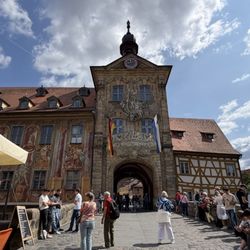
This is by far my favorite city in Germany...at this point I have to admit I'm a little biased…read moresince I had a privilege of living here for two years while serving in the US Army.
Nonetheless, Bamberg offers its enchanting medieval old town atmosphere enticing those who visit with its unique charms that other cities/towns may or may not exude IMHO. No wonder the old town area was designated as a UNESCO World Heritage Site in 1993.
It is nicknamed the "Seven Hill City" or "Franconian Rome." It is sometimes called "Rome of the North" with its seven hills (with castle or church on them): Abtsberg, Altenburg, Jacobsberg, Kaulberg/Obere Pfarre, Michaelsberg, Stephansberg, and Domberg, the hill upon which the Imperial Cathedral is built in the center of all. Rivers Main-Danube Canal and Regnitz also run through it. All that makes a very picturesque town for sure.
A "Castrum Babenberg" existed on the Domberg (Cathedral Hill) and was mentioned in 902 for the first time. King Heinrich II. founded a diocese in 1007. The first cathedral was consecrated in 1020 by Pope Benedict VIII. Heinrich II. also founded a Benedictine abbey on the Michaelsberg.
King Heinrich and his wife Kunigunde chose Bamberg as their favorite residence, and they supported the diocese of Bamberg with their wealth. The royal couple was well-educated and religious. In 1014 Henry was crowned Holy Roman Emperor by pope Benedict VIII. Emperor Henry II died in 1024, and his wife empress Kunigunde in 1040. They were both canonized and are buried in the cathedral in their beloved Bamberg.
The second bishop Suidger of Bamberg was elected as Pope Clemens II. in 1046. His last resting place in the Bamberg Cathedral is the only preserved tomb of a pope north of the Alps.
From the 13th century on bishops were also princes of the German Empire, overseeing the construction of major buildings in the city. It paralleled the economical development of Bamberg.
Bamberg has a long history in brewing beer, thus it is also known as the City of Beer. It was known for its hops trading, and the city flourished with over 90 breweries in the past, however, only nine of them still remain in operation to the present day. The most famous of Bamberg's breweries is the historic the dark "rauchbier" (smoked beer) brewery, Schlenkerla. This 6th-generation family brewery has been quenching thirst since 1405 and still taps beer the old-world way - from wooden barrels. 27 years before the German Purity Law (Deutsches Reinheitsgebot) was issued in 1516, prince-bishop Heinrich III. worried about the quality of beer and ordered that nothing more than hop, malt and water should be in Bamberg's beer. At that time beer already had a long tradition in Bamberg. It is documented that bishop Otto I. granted the Benedictine monks at the St. Michaels abbey the privilege of brewing beer in 1122.
It is a must visit in Germany if you are in Franconia, the vicinity of Nürnburg or even in München. You will not regret it.