*This listing is for the historical landmark / museum, Palacio del Rey Moro. There are other Yelp…read morelistings, with German reviews, for the bar with the same name.
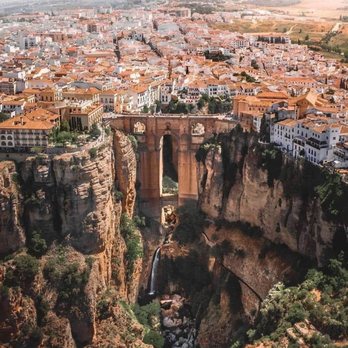
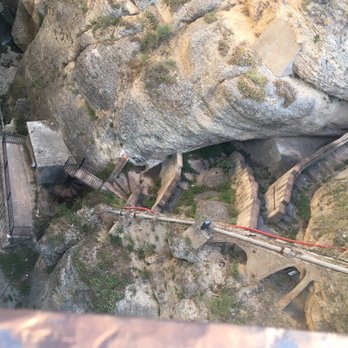
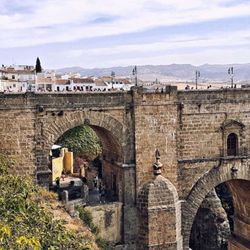
Entry fee was 5€ pp, cash. The palace is currently under renovation (visited during the off-season). There is no actual palace to visit, just the gardens and the water mine, which is a very long staircase, inside a stone structure, down the side of the ravine, to a water source on the floor of the Tajo.
This historic site is a layering of history. The 14thC water mine is authentic to the days of Moorish rule. However, the palace was built in the 18thC, long after the Moors were banished from Spain. The palace was later remodeled by the Duchess of Parcent in 1920. The gardens were created in 1912, by Jean Claude Forestier (the same French architect who designed the Maria Luisa Park in Seville). So you get a combination of stories about historical figures who were never contemporaries of one another. The main attraction at this museum is definitely La Mina (the water mine).
THE MINE
In the 14thC, Moorish king, Abomelik, ordered the cutting of steps into the stone walls of el Tajo so he could have Christian slaves chained to the steps, to pass water up all day, from río Guadelevin. The mine was built concealed, to be kept secret, presumably, from potential invaders, but it was a well-known fear among Spanish Christians that "in Ronda you die carrying water skins." Note that historic records state there were 365 steps in the mine, but today there are 231, and no evidence of the missing steps.
When I saw this place on the Rick Steves Andalucía episode, I couldn't wait to visit. When I got to the winding, grueling 231 stone steps, of non-uniform size, with dripping water all over, making them slippery, I was not as excited. It is a workout, but a good one. I am very glad we did it in the off-season, and not when there are a million sweaty tourists crowding the passage, making it insufferable! Note that the steps of the mine are not the entire descent. There are various terraces in the garden at the top, each with a flight of stairs, leading you slowly down to the mine itself. You have already descended about 1/3 of the cliff before you even get to the mine. *This place is not at all accessible for disabled persons.
The mine, in Moorish times, was the only source of water for the city, and the steps were later the means by which Spanish Christian troops forced entry into Ronda to recapture it 1485.
THE PALACE
Folklore names this place "Palace of the Moorish King" under the belief that a prior palace stood on this site, as the home of King Almonated (who has no Wiki article nor Googleable info). All info I could find about this king was just part of the folklore of this castle.
THE GARDENS
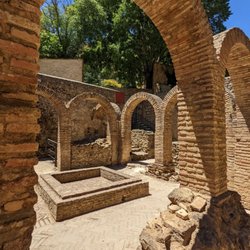
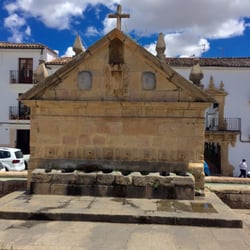
The gardens are a series of courtyard-type niches at street level, followed by stepped terraces graduating down to the entry of the mine. There is not a lot of grassy / soil area, mostly paved patio or pea gravel, along with various small ponds and fountains. There are places to sit on tiled benches. The gardens are in need of a lot of cosmetic repairs (cracked pavers, mildewed paint, chipped tiles, etc). But you can still appreciate their beauty, and the views from them are amazing.
In summary, I would definitely say it was worth my fiver, and all that physical exertion to make contact with 700-year-old history. Definitely a top stop on my Ronda list.
* * * TIP * * *
One tourism guide stated that one of the chambers along the mine's staircase is called Sala de Secretos (Room of Secrets) because while 2 people, each standing close to the wall at opposite ends of the room, can hear each other, their words are oddly completely inaudible to anyone standing in the middle of the same room. Tourists like to put it to the test. (This phenomenon is similar to the "Whispering Gallery" in St. Paul's Cathedral, London.)