Pont de Québec Photos



More like Pont de Québec
Recommended Reviews - Pont de Québec
Start your review...



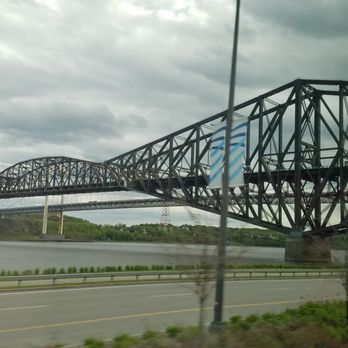
There's a little piece of history worth crossing -- and just flat marveling at -- in Quebec City, when crossing the St. Lawrence River. The riveted steel truss Pont de Québec (in English, simply Québec Bridge) is a triple-threat, allowing crossing by car (Route 175), train (Via Rail and Canadian National), and pedestrian (Nike, loafer, flip-flop, et. al. See: Feet, Your). The bridge will be turning 100 on December 3, 2019. An earlier bridge here collapsed in 1917, and this area has been a place of crossing since the 1880s! Historically speaking, the bridge was essential for getting goods (mainly by train) from the south shore. No bridge, no Québec City. As for the here and now, you'll have to find out for yourself how awesome the train trip is, as it's the one way I didn't experience the bridge. As for the pedestrian crossing, it's at street-level, with a significant barricade between the walker and the zipping traffic (best described as at "car-level") For auto crossing, it's a unique three-lane road (with lights signaling which way has two lanes). PdQ holds the distinction of being the world's longest cantilever bridge. Cantilever, for this unaware, is a bridge building methodology using beams rather than cable. However you see the PdQ, the rusted trusses give parts of the bridge a beautiful, rusted patina. It's a smooth ride, and a great view of Quebec whatever way you cross: In one direction, Québec City itself ... in the other, Pierre-Laporte Bridge. The best way to see the bridge is when you're close by. A good choice, say, if you're seeing the Québec Aquarium, Laurier Québec or Place Ste-Foy shopping centres, Plage-Jacques-Cartier or Domaine-des-Retraité parks ... ...or, you could just cross that bridge when you get to it! read more


7 years ago