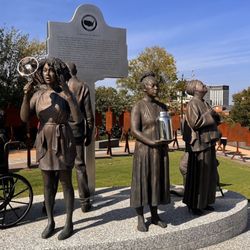
This one was particularly interesting. It stands in front of what is now the public safety building…read morejust across the street from the Tuskegee University entrance. I had to stop here to get a pass to drive and park on the campus and see the chapel. As I walked past the marker, I had to stop and read both sides. Wow, what a great man!
The front reads, "Born in 1930 in Montgomery, Gray was among the foremost civil rights attorneys of the 20th century. Forced by segregation to leave Alabama to attend law school, he vowed to return and "destroy everything segregated I could find." Over a six-decade career, his cases desegregated transportation, education. housing, law enforcement, public accommodations, and government. In the U.S. Supreme Court, Browder v. Gayle won the Montgomery Bus Boycott and Gomillion v. Lightfoot ended gerrymandering of Tuskegee and set the stage for "one man, one vote." Lee v. Macon desegregated all Alabama public elementary and secondary schools. Dixon v. Alabama extended the rights of college students. His clients included Rosa Parks, Martin Luther King Jr., John Lewis, Vivian Malone, Harold Franklin, Freedom Riders, Selma-to-Montgomery marchers, and Tuskegee Syphilis Study victims. In 1970, he and Thomas Reed were the first African Americans since Reconstruction elected to the Alabama Legislature. In 2002, he was the first African American president of the Alabama Bar Association."
On the reverse, "Gray represented the 623 victims of the infamous Tuskegee Syphilis Study, in which the U.S. Public Health Service experimented from 1932-1972 on the effects of untreated syphilis, using African American men from rural Macon County as unwitting research subjects. Available medical treatment was withheld from the men in the study. In 1975, Gray negotiated a settlement for the victims and their survivors. In 1997, President Bill Clinton apologized on behalf of the nation to survivors in a White House ceremony during which he called Gray "a great friend of freedom" and thanked him "for fighting this long battle all these long years." That same year Gray initiated - in honor of the victims and in memory of Bernice Hill Gray - the Tuskegee Human and Civil Rights Multicultural Center, a museum dedicated to the history of the Tuskegee Syphilis Study and to the roles of the Native, European and African American peoples who have lived in what is now Macon County, Alabama."
The marker mentions his representation of Rosa Parks, but not the fact that he had eaten lunch with her earlier on the very day she refused to give up her seat. Nor does it mention that before Parks, he defended 15‑year‑old Claudette Colvin, whose earlier arrest for refusing to move on a Montgomery bus helped lay the groundwork for Browder v. Gayle. Martin Luther King Jr. once described Gray as "the brilliant young Negro who later became the chief counsel for the protest movement," and Gray himself recalled that King would sometimes tell him, half‑jokingly, that if conscience required civil disobedience, Gray should be ready to defend them afterward.
Later, in 1985, he served as president of the National Bar Association, and in 2001 he became the first African American president of the Alabama State Bar. In 2022 he received the Presidential Medal of Freedom, the nation's highest civilian honor, recognizing a lifetime of legal and moral leadership.
The marker was erected in 2016 by the Alabama Tourism Department and the Tuskegee History Center. It does not have a number, but it stands in exactly the right place: at the threshold of Tuskegee University, in the city whose political boundaries he helped restore, and in the county where he fought some of his most consequential battles. It's a fitting tribute to a man whose legal work reshaped not just Alabama but the nation.
[Review 294 of 2026 - 276 in Alabama - 25483 overall]