Palác Adria Photos



Recommended Reviews - Palác Adria
Start your review...



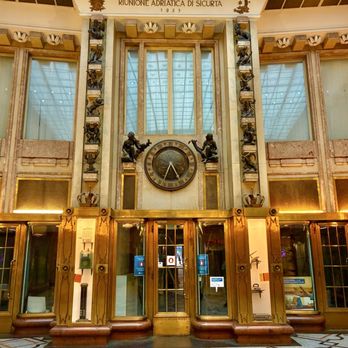
This original art deco interior is full of incredible detail, we spent about 20 minutes just in this one room looking at all angles and surfaces. Lots of brass accents, original mosaic flooring and sculptural details. Definitely worth a stop on your walk through town. read more

On a clear, crisp morning in October, I made a short stop here to admire the architecture of this building. From both viewing it from the plaza outside and wandering its interior, it surely is a unique structure to behold! Sitting along a square that includes other Art Deco and Art Nouveau buildings, Palác Adria stands out in its elaborate style lines outlining every window, and the crenellations* on its roof! This faux palace was built for Italian insurance company Riunione Adriatica di Sicurta in 1923-24, in the Rondo-Cubist style (Czech Art Deco), an angular blocky aesthetic that featured alternating angular and rounded window pediments. The building was designed by Czech architect Josef Zasche in collaboration with architect Pavel Janak's input on the color scheme of the exterior facade. Inside, the passageways and interior design are fabulous! Marble, glass and brass in deliberate curves paired geometric shapes are a treat for your eyes--the beautiful mosaic floor with a Venetian ship motif and the ceiling chandelier in the inner lobby particularly stood out. The main atrium showcases an astronomical clock (not as complex as the famous Orloj) with sculptures depicting the zodiac. Other businesses that are housed within this building include: Adria Café which is well-known for its terrace overlooking the plaza outside, the Adria Theatre (birthplace of Laterna Magika** and meeting place of the Civic Forum during the Velvet Revolution***, an antique book dealer, and a small gallery displaying works by local artists. The theatre club which used to operate here was known to be frequented in the 1960s by former Czech President Václav Havel. While it was early in the morning around 9am and the Galerie kritiků (Critic's Gallery 40 CZK full admission / 20 CZK reduced) nor theatre were open, I did a quick spin inside and was still impressed by the parts I did get to see! *overall jagged pattern of the battlement at the top of a castle wall, with alternating gaps (crenels) and solid upright sections (merlons). **a theatre ensemble part of the National Theatre of Prague, considered the world's first multimedia theatre performance group. ***the non-violent transition of power in what was then Czechoslovakia, occurring November 17-28 1989, including demonstrations against the single party Communist government and resulting in the conversion to a parliamentary republic. read more
More info about Palác Adria
Jungmannova 31
110 00 Prague
Czech Republic
Nové Město, Praha 1
Directions
Hours
Outdoor Amenities




Palác Adria - shoppingpassages - Updated August 2026
Browse Brands
Browse Articles
People who viewed Palác Adria also viewed

Pasáž Lucerna
7 reviews
Nové Město, Praha 1
$$$

VNITROBLOCK
22 reviews
Holešovice, Praha 7
$$

Konsepti
1 review
Holešovice, Praha 7

Klášter sv. Anežky České
9 reviews
Staré Město, Praha 1
$

Kavárna co hledá jméno
38 reviews
Smíchov, Praha 5
$

Hlavní nádraží Praha
92 reviews
Praha 2, Vinohrady
$$

Schwarzenberský palác
3 reviews
Hradčany, Malá Strana, Praha 1
$$

Veletržní palác
28 reviews
Holešovice, Praha 7
$
Mozart Praha
1 review
Praha 10, Vinohrady

Havelský trh
11 reviews
Staré Město, Praha 1
$$