The Pantheon is an ancient Roman temple turned Catholic church, first built in the 2nd century…read moreunder Emperor Hadrian, then consecrated in 609 as the Basilica of St. Mary and the Martyrs, the title it holds to present day. It's an incredible building that's been in continuous use for almost 2,000 years. No Roman ruin, the Pantheon, but a marvel of ancient ingenuity pulled forth into the 21st century. Beautifully preserved and, with its layers of history, particularly emblematic of Rome.
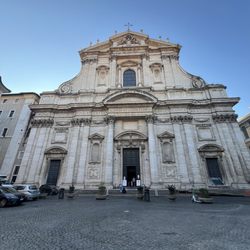
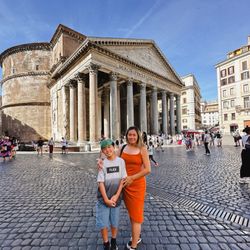
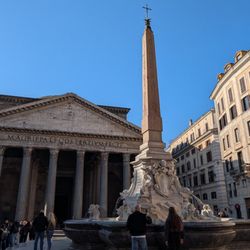
The exterior is striking, with the one-two of the grand columned portico and the enormous rotunda. There's an significant-looking inscription across the portico, with M·AGRIPPA·L·F·COS·TERTIVM·FECIT written in giant letters. They apparently translate to "Marcus Agrippa, son of Lucius, made this building when consul for the third time," a hilarious thing to have stamped on a historic landmark in size 1,000,000 font.
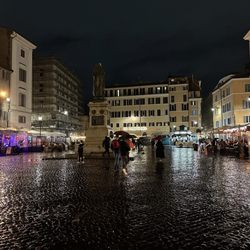
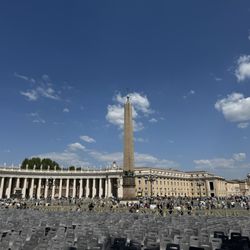
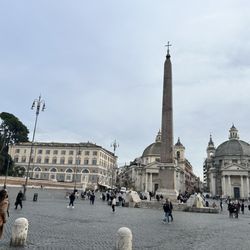
The Pantheon is in the Piazza della Rotunda, which is also home to the Pantheon obelisk, one of Rome's thirteen ancient Egyptian obelisks. Roaming the piazza and seeing the Pantheon from the outside is free, but it's worth the small expense and hassle to see it from the inside.
We visited on our last day in Rome, having already been to the Vatican and the Colosseum on guided tours. The Pantheon was easy enough to navigate on our own, and we were able to walk in without much trouble on a Saturday afternoon in November. The piazza was busy, more crowded than almost anywhere else we went on our trip, but the line to get tickets was manageable. (I will note that there are different lines for cash and credit card and the signage is not that apparent. We lost a few minutes in the wrong line.) We were inside within about twenty minutes.
Almost two millennia after it was built, the Pantheon still holds the record for the world's largest unreinforced concrete dome. It is a staggering piece of architecture, massive and majestic, an implausible freak of a monument. The coffered ceiling is spectacular, the recesses creating a geometric pattern that looks, from some angles, almost fake and two-dimensional. At the center of the dome is an uncovered oculus. It had been raining when we visited, and there was rainwater on the marble floor, roped off to protect clumsy tourists.
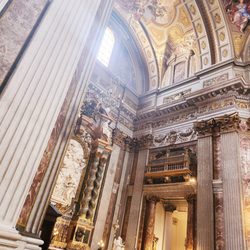
The Pantheon felt like it was mostly dome, but the other elements were noteworthy too, plenty of sculpture and multi-colored marble. There are some important tombs, the most famous belonging to Raphael, who requested to be buried at the Pantheon. A pretty primo resting place.
Unless you hate history and art and should have booked yourself a different trip, you have to see the Pantheon when in Rome. It's an amazing place, unlike anywhere else in the world.