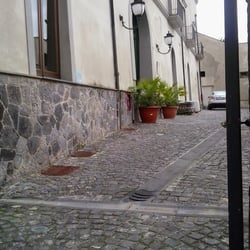
Currently named after the patron saint of Naples, this gate is thought to have existed as early as…read more450 BCE, simply known as the Tufa* Gate that led out of the then Greek city of Neapolis towards the catacombs north of the city.
It is the oldest standing gate of what was seven, one of the main entrance/exits where traffic flowed in and out of the city walls, and a marker to understand where former city boundaries lay. Interestingly the location shifted about 50 meters from its original spot when in 1537 under Spanish rule viceroy Don Pedro de Toledo expanded city limits and relocated gates, in the process removing the two towers previously flanking it as well.
Later in 1656, as an ex-voto beseeching protection from the plague, Neapolitans commissioned Baroque artist Mattia Preti to paint frescos above the seven city gates, of which today only this one remains. It depicts Saints Rosalia and Francis Xavier showing gratitude to San Gennaro, the city's religious benefactor, a bishop martyred in 305 AD, later buried in Duomo di Napoli (Naples Cathedral). This is the same saint for which an annual festival Feast of San Gennaro is held.
In 1659 a bust of San Gaetano, another key figure celebrated as saint of the working class and poor, was added in the upper portion of the gate facing south, and after the 1884 cholera epidemic a painting of Virgin Mary was added as an ex-voto in 1887.
Nowadays there's not much to do except admire it, walk thru, and take in the history that surrounds this place.
*Tuff was the volcanic yellow rock from which the gate was built, although today's iteration is not so clearly distinctive.