Situated on the edge of the village at the top of the hill, St Mary's is Wimbledon's original…read moreparish church and has a history dating back to Domesday.
History
Mentioned in the Domesday book, the original (and probably wooden) church was rebuilt in the 13th century. An 18th century print shows it as a pleasingly rustic building, with a wooden bell turret and spire, probably only 44ft long and 36ft wide.
Although Wimbledon was just a small village, in the 16th century it became the home of Sir William Cecil, later Lord Burghley, advisor to Elizabeth I. His son Thomas built a manor house adjacent, and in 1626-36 Sir Edward Cecil built the Cecil Chapel as a mortuary chapel. The church was enlarged in 1786, effectively being rebuilt west of the chancel arch, in a plain but handsome Georgian style.
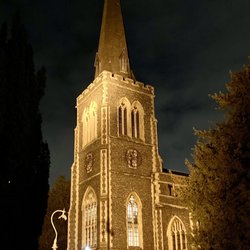
The 19th Century saw the arrival of the railway, and Wimbledon began to expand rapidly as a suburb. Further enlargement was required, and in 1843 Sir George Gilbert Scott was commissioned to undertake the work. He extended the nave, erected a tower and spire, inserted new galleries and completed a new roof, all in the neo-Gothic style. He also encased the earlier Georgian brickwork in knapped flint with stone dressings.
The Church
The exterior is dominated by the west tower, with its tall spire. Surrounded by trees, the picturesque setting evokes the country rather than the city.
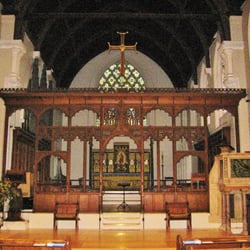
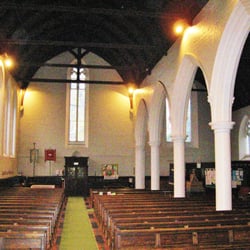
Inside, the aisled nave of 5 bays leads to a two bay chancel. Now whitewashed throughout, it is hard to distinguish the various stages of the building: the oldest part is the south and east wall of the chancel, which dates from the 15th century; the Cecil Chapel survives intact beyond the Warrior Chapel, built in 1920 as a memorial to those who died in the First World War.
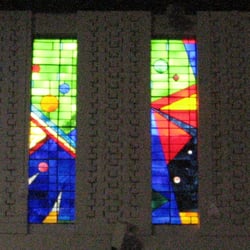
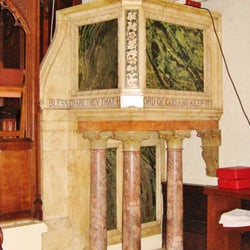
Most of the fittings date from the 19th and 20th centuries, but the Cecil Chapel has an intact 15th century stained glass window depicting St George. A number of memorials are of interest, one of which survives from 1537; another commemorates Sir Richard Wynn MP (d. 1649), treasurer to Henrietta Maria, wife of Charles I. A modern brass in the chancel commemorates Sir William Wilberforce, the slave trade abolitionist. More interesting memorials crowd the surrounding graveyard.
The church has a busy parish life, with children's and youth groups and services every day except Monday and Saturday.